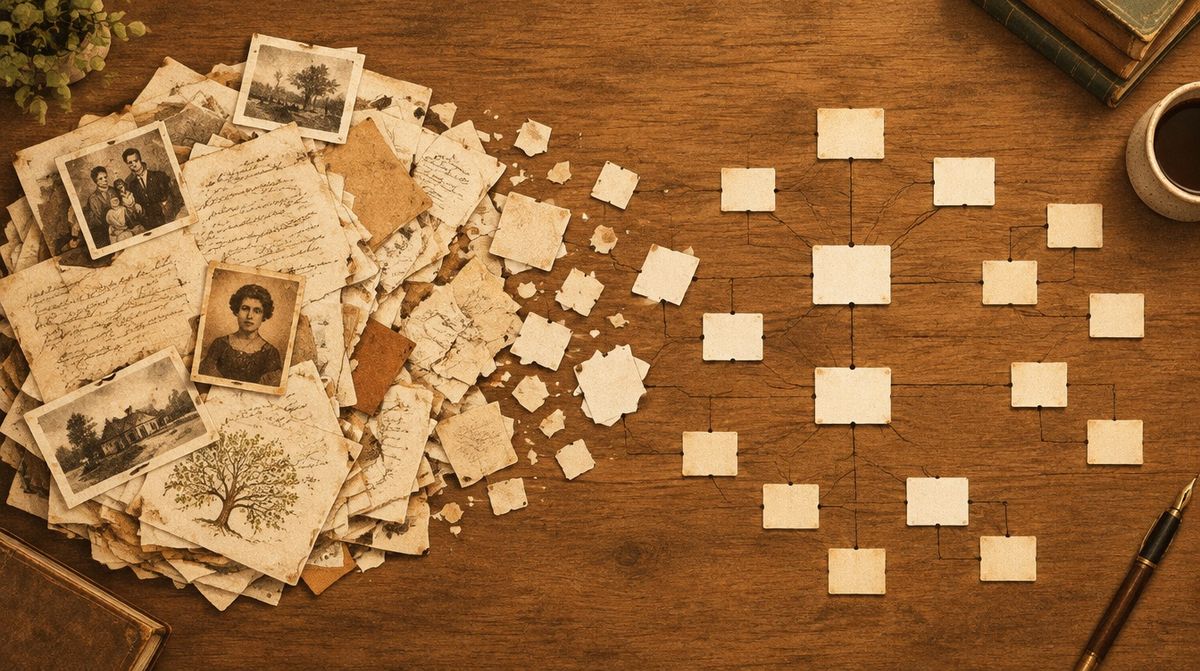
Start with what you already know and the relatives who are still alive, and put it on paper before you open a website. Then open a free FamilySearch account, enter your family back to your great-grandparents, and pull the 1950 and 1940 censuses, which are free. Nothing in your first month needs a subscription.
The rest is the order to do it in, what is actually free on the big sites, and what to do when the usual advice, ask your parents, doesn't apply.
Why does everyone say to start with yourself and work backward?
Because it's the only direction that can be checked. The FamilySearch blog post on beginning genealogy calls it working from the known to the unknown; Family Tree Magazine's ten steps call starting with yourself the golden rule of genealogy. You can prove who your parents are. You can prove who their parents were from a record that names them. Each step back is a record you can find because the step before told you where to look.
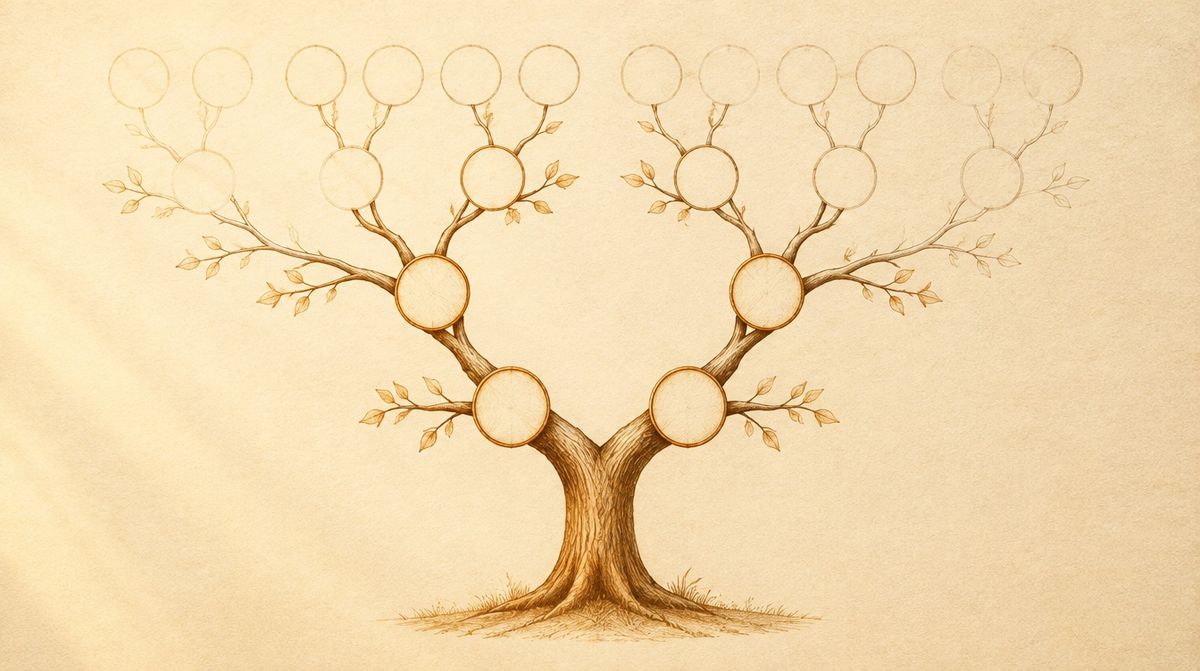
Both guides put a goal before the first search. Family Tree Magazine's example is four generations back, and the FamilySearch post describes a loop: decide what you want to find, gather what the family already has, search, organize, pick the next question. Four generations is a fair first goal: you, your parents, your grandparents and your great-grandparents, fifteen people if nobody is missing. A pedigree chart is the diagram with you at the base and one box per ancestor, like the tree at the top of this post; its blank boxes are your research plan.
What should I write down before I open a website?
Everything you know, and who told you. A thread on r/Genealogy from July 2025 opened with someone almost 30 whose parents were both gone, whose family wasn't close on either side, who had some names and photos, and who got overwhelmed every time they tried to start. They wanted free sites. The two replies I'd keep weren't about websites. One said to skip the online tools for now and record the remaining relatives' stories; another asked whether the poster's mother, who had done this research years earlier, had left any of it behind. Both are free, and both get harder every year you wait.
Three things to collect first:
- The sheet. Name, birth year and place, marriage, death year and place for each of the fifteen people, with a question mark on anything you're unsure of and a column for who told you. Family stories are clues to be checked, as the FamilySearch post puts it, not facts.
- The home papers. Certificates, funeral cards, obituaries, letters, military papers, the family Bible, photos with writing on the back, and any folder a relative filled before you. Photograph or scan each one and leave the originals where they are.
- The oldest relative's memory. One recorded hour with the oldest person who will talk to you: where they grew up, every address they can remember, their parents' and grandparents' full names and where those people came from, what work everyone did, and who is in the photos. One reply in that thread insisted on home addresses, and the reason is below: an address finds a census page when a name search doesn't. The questions to ask are in how to interview relatives.
Write it as it was told to you, mistakes included, and mark it as told; that is one of the four rules in how I organize research.
Which free sites should I use first, and what is actually free on them?
FamilySearch first. Its help center says it plainly: FamilySearch has only one type of account, a free one, and the Church of Jesus Christ of Latter-day Saints provides it free of charge to everyone. The caveats: you need the free account to see records, images and the tree, and FamilySearch doesn't guarantee free access to the third-party sites some of its records link to. The top reply in that r/Genealogy thread said the same: FamilySearch is free, start with one branch and work from there. The getting-started page also offers a free 20-minute online session with a research specialist.
Two warnings. FamilySearch's Family Tree is one shared, public tree; its help center says every user works on the same data, and two people in that thread said not to trust it. I agree: use FamilySearch for the records, treat its tree as other people's work to be checked, and keep your own tree somewhere you control. Second, an index is not a record. The FamilySearch post says to review the original image whenever there is one; there is often more on it than was indexed, and an index is one person's reading of old handwriting.
The National Archives second. The 1950 census was released on April 1, 2022, free, with a name search. The index was built by artificial intelligence and optical character recognition from the handwritten pages, and the Census Bureau's own story says it isn't entirely accurate. The 1940 census has been open since April 2, 2012, free through the National Archives Catalog, where you find people by enumeration district, the area one census taker covered; that is why the addresses from your interview matter. FamilySearch has the 1940 census indexed by name, free with the free account.
The paid sites third, and later. Findmypast's own guide says its tree builder is free and that you may need a free trial or a subscription to reach all the records you need. Several people in the thread said the same of Ancestry: free tree, paid records, and a trial you have to remember to cancel. One reply recommended a paid Ancestry subscription; another said to keep away from paid sites entirely. Wait until the free sites run dry; by then you'll know which record you're paying to see. I don't print subscription prices because they change; is FamilySearch really free covers free versus paid on its own. One pointer from the thread, unchecked by me: a commenter warned that records viewed on a subscription site may stop being viewable once it lapses, so download every record you attach.
What does the first week look like?
No invented family here; the plan is the example.
1. Write what you know, back to your great-grandparents
Fifteen boxes on one sheet: full name as it was spelled at the time, birth year and place, marriage year, death year and place, and who told you. Question marks wherever you're guessing. Expect empty great-grandparent boxes; those blanks are what the rest of the week is for.
2. Interview the oldest relative you can reach
One hour, recorded with their permission. Addresses, full names, birthplaces, occupations, the people in the photos, the stories. Don't correct them; write it as told. Photograph the photos while you're there, backs included.
3. Gather the home papers
One photo or scan per document, named so you can find it again. If a parent or grandparent did this research before you, that folder comes first; Family Tree Magazine's second step is to review what has already been done.
4. Open a free FamilySearch account and enter four generations
Enter the sheet, "about" dates included. Then search the records for your grandparents before anyone older, as one reply in the thread advised. Open the image of each record, not just the index line. Save a copy to your own folder, and keep living people's details out of anything public.
5. Pull the 1950 and 1940 censuses
Search the 1950 census by name on the National Archives' free site; if the name search misses, use an address from the interview and browse the district. The 1950 page gives each person's name, age, sex, race, marital status, relationship to the head of the household, birthplace, naturalization status, occupation and industry. Then find the same family in 1940, by name on FamilySearch or by district at the National Archives. Each age and birthplace on a census page is the lead to the next record. Which records to look for first takes it from there.
By the end of the week: a sheet, an hour of recording, a folder of scans, four generations in a tree you can export, and two census pages per household, for nothing.
What if both my parents are gone and nobody in the family is close?
That was the poster's situation; it changes the order, not the method. Start from your own papers. Your birth certificate names your parents and, depending on the state and the year, their ages and birthplaces. Their death certificates name their parents as the person reporting the death remembered them, a lead to check rather than a fact. Their obituaries name survivors and siblings.
Then look for the work already done. The poster's mother had done this research, and someone in the thread asked: did any of it survive? Boxes, drives, old email accounts, a tree on a site she used. A previous researcher's folder, even a wrong one, tells you where she looked.
Then widen the circle. Not close is not the same as not alive. Aunts, uncles, cousins, your parents' old friends and neighbors; ask each for one thing, the names on the backs of photos. A cousin may already have entered your grandparents in FamilySearch's shared tree; that's a lead and a relative to write to, not a fact to copy.
When should I stop doing it alone?
Most people never need me for the first four generations. The records I'd use for that stretch are the ones you can open for free. What a professional adds at that depth is time, method and proof, not access.
Three reasons to hand it over anyway:
- You've started more than once and quit overwhelmed each time, as the poster had.
- A line leaves the easy records: into another language, across a border, or into books that aren't online.
- You want the first four generations proven, each person tied to a record, before you build on them.
That is what the 1900 package on the pricing page is for: both sides of your family back to about 1900, from $900, with $225 to start and the balance on delivery. It ends in a sourced report and the full research trail. What it doesn't do is replace step two. The relative who remembers the addresses is the one record no archive holds, and that hour is yours to record whether or not you hire anyone.
If you'd rather have the rest done, start with the 1900 package. Every person comes tied to the record that proves them, in a report you can check yourself. Start the 1900 package.
Questions people also ask
What should I do in my first week?
Write down what you know back to your great-grandparents, interview the oldest relative you can reach, and gather and scan the papers already in the family. Then open a free FamilySearch account, enter those four generations, and pull the 1950 and 1940 censuses from the free collections. Do the paper and the people before the websites. The whole week costs nothing.
What if both my parents are gone?
Start with your own birth certificate, which names them, and with their death certificates and obituaries, which name their parents and siblings. Look for any research a parent left behind, in boxes, drives or old accounts. Then widen the circle to aunts, uncles, cousins and your parents' old friends. A family that isn't close is not a family that doesn't remember.
Is FamilySearch really free?
Yes. Its help center says there is only one type of account, a free one, and that the Church of Jesus Christ of Latter-day Saints provides the site free of charge to everyone. You need the free account to see records, images and the tree, and FamilySearch doesn't guarantee free access to the third-party sites some of its records point to.
Which records should I look for first?
The 1950 and 1940 federal censuses, because both are free and each puts a whole household on one page with ages, birthplaces and relationships. Then the birth, marriage and death records for your grandparents. The federal census has been taken every ten years since 1790, so each one is a step back of a decade.
When should I stop doing it alone?
When you've started more than once and quit from overwhelm each time, when a line crosses a border or a language, or when you want the first four generations proven before you build anything on them. The 1900 package covers both sides of your family back to about 1900, from $900 with $225 to start. The interview with the oldest relative is the one part nobody can do for you.
Sources
- How do I get started?, a thread on r/Genealogy (July 2025)
- Getting Started, FamilySearch
- Beginning Genealogy, How to Get Started the Right Way, FamilySearch blog (October 2016)
- Is FamilySearch free?, FamilySearch Help Center
- What is the purpose of FamilySearch and Family Tree?, FamilySearch Help Center
- 10 steps to start your genealogy research, Family Tree Magazine
- National Archives Releases 1950 Census Records, U.S. Census Bureau (April 2022)
- 1940 Census FAQs, National Archives
- About the Decennial Census of Population and Housing, U.S. Census Bureau
- United States, Census, 1940, FamilySearch collection
- How do I make a family tree for free?, Findmypast