From most firms, a report with citations, copies of the records, and a family tree chart in a binder. From me, every package: a sourced report, the research trail including dead ends, and a digital copy of every record. From the 1800s package up, a case vault and a private family website, each fact on the record that proves it.
What is in a genealogy research report?
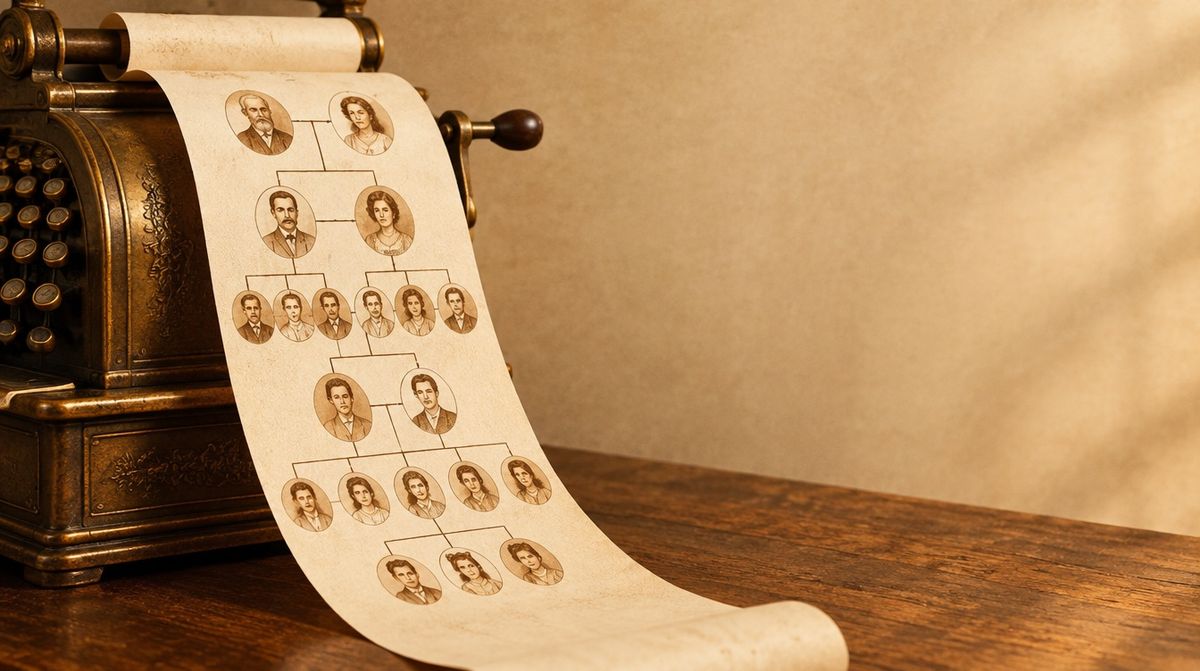
The report is the trade's standard product, and the big firms describe it the same way. Price Genealogy's hiring guide says you receive a written report of what was researched, which records were found and which were not, the analysis behind each conclusion, the questions that remain and recommendations for future research. With it come full citations, a research calendar of every source searched, copies of the documents, and pedigree and family group sheets, the standard ancestor and household charts. Legacy Tree Genealogists' FAQ lists a research report, the sources searched, documents and family tree charts, printed and digital, in a keepsake binder and on a private web page, as of October 2026. The Association of Professional Genealogists, the trade body, adds research plans, evidence evaluation, translation and help writing a family history.
That is a good product, and I want to be fair to it. A printed report survives any software. A lineage society, which admits you on a proven line of descent, or a citizenship office wants a document chain in that form. And a careful account of what was not found is honest work.
A report also keeps the record apart from the claim: conclusion in the text, citation in a footnote, copy in a separate section. And it is finished the day it is printed: when a new record turns up or a conclusion turns out wrong, nothing in the binder changes.
My report has the same shape. The difference is where it lives: one layer of a case file, with the record image under every claim, and the start of what you receive rather than the end. The price side is in How much does it cost to hire a genealogist?
Do I get the actual documents?
Copies, yes. Originals, no; the archive keeps them. The question is which copies, and when.
Every package includes a digital copy of every record I use, with its archive and page or image number. In the 1700s and 1600s packages, official paper copies are included wherever the archive will release them; some offices release records only to family, and some take months, so paper can arrive after the rest of the case. In the 1900 and 1800s packages, a paper copy is ordered only after you approve it, at the archive's own fee plus $10 handling. The detail is on the pricing page.
Expect gaps, labeled. In File 001, the original 1828 will of Padre Ballí is missing from the Matamoros archive; what survives is a typescript at the Texas General Land Office and a certified copy recorded in Cameron County in 1909. The copy in the file is the typescript, and the file says so.
What is a case vault, and what is a private family website?
The case vault is your family's file kept as a set of linked notes rather than one document. Each scanned record has its own note: the citation at the top, the image under it, a transcription of the lines that matter. Each fact links to the record that proves it, and each record links back to every fact that cites it; open a will and you see everything that rests on it. The deliverables page shows screenshots of the real vault behind File 001, not a mockup: one record with the six places that cite it, the whole file drawn as a map, and the case board with the question in the middle. How to do the same with folders and a text editor is in How do you organize your genealogy research?
The private family website is the finished form, built for the family rather than for me. A family tree you can click through, a page for each ancestor listing every fact with the record behind it, a timeline, the places they lived, the records themselves, and a page of open questions. One link for the whole family, on any phone, and password-protected if you want it that way.
Both are included from the 1800s package up, from $2,500 with $625 to start. On the 1900 package and the Discovery assessment they are add-ons: the vault from $250, the website from $300.
What does a finished file look like?
The one I can show you is the sample family site, built from the public records of File 001, the Padre Ballí case. Every fact on it is real. A client's site is the same thing, private.
Four generations, eight people, six records
Four generations: the Padre's grandparents, Nicolás Ballí and María Josefa Guerra, named in his mother's 1798 will; his parents, José María Ballí and Rosa María Hinojosa; the Padre and his two brothers; and his nephew Juan José Ballí, named on the 1828 island survey cover. Eight family members, six primary records, four open questions, counts printed at the top of the page.
A badge on every fact
Open any person's file and each fact carries one of four badges. Verified means a primary record, one made at the time, is in hand. Published means a secondary source, such as the Handbook of Texas, says it. Reported means someone reported it and it is being traced to a record. Unknown means it has not been found.
The Padre's birthplace is verified, in his own words in his will. His birth date is unknown, with the ceiling the records allow: he signed marriages as a priest in January 1807, and canon law, the church's own rules, set 24 as the minimum age, so no later than 1783. His two brothers are on the tree without names, badged reported, because a family historian reports three sons and no record on the site names them yet. A report would leave the brothers out or put them in. The site shows the gap, and what kind of gap it is.
The records, readable
The records page holds the six documents behind every verified badge, each cited to its archive. The four with scans open full size: the 1807 Reynosa marriage register with his signature, the April 1829 burial entries from the Matamoros parish book, the 1828 will typescript, the island survey file. Nobody in the family has to take my word for a date; the page is there.
The open questions
The last page lists what is not proven: when he was born, narrowed from "177?" to no later than 1783; who his two brothers were; where the original 1828 will is; where the 1828 survey map is. For the birth date it names the next record to check, his ordination file in the archdiocesan archive in Monterrey. A report ends with recommendations. This page stays open, and when a question closes, the fact and its record move onto the tree.
Against the standard report
Put the same material in the trade's format and you get a narrative with footnotes, a pedigree chart with two empty boxes, and a records appendix, in a binder. It would be accurate. Written before the Matamoros register was read page by page, it would also have printed April 16, 1829 as the Padre's death date, because every history gives that date. No reader of the binder could have seen that April 16 was a burial. On the site, the burial page sits under the fact. When the April 11 entry that already calls him the deceased was found, the fact changed, and the record that changed it is one click away. That is the argument for a file over a report; the dated log is on the case page.
What do the deeper packages add?
Every package includes the sourced report, the research trail, and digital copies of every record. The list grows with depth; the figures are from the pricing page.
- Back to about 1900, both sides, from $900 with $225 to start: the three items above. Paper copies per document. Vault, website, binder, Ancestry tree and DNA are add-ons.
- Back to the 1800s, both sides, from $2,500 with $625 to start: adds the case vault and the private family website, and errors in your existing tree found and documented.
- Back to the 1700s, one or two lines, from $5,500 with $1,375 to start: adds the printed binder, physical documents, your Ancestry tree verified and corrected, and AncestryDNA tied into your file, billed in four parts as the research reaches 1800, 1700 and delivery.
- Back to the 1600s, one line, $6,500 with $1,625 to start: the same set, about twelve generations.
- The flagship, both sides to the 1600s, $9,500 with $2,375 to start: everything, plus the written family narrative and the custom-designed website, which are add-ons everywhere else from $1,500 and $1,000.
The printed binder is your records and photos, organized to page through; on the 1900 and 1800s packages it is an add-on from $150. The nearest published comparison is Legacy Tree's BASIC25: 25 research hours for $3,200 with a printed report, documents and binder, as of October 2026. The 1800s package, from $2,500, is both sides of your family to a stated depth, with the vault and website.
Starting works the same at every depth. You pick the package and add-ons at checkout; your card is authorized, not charged. Within two business days you get the exact scope and total in writing, and the payment is captured only when we have both said yes, you to the scope and me to the case. Otherwise the hold is released.
Can I keep working on the tree after delivery?
Yes, and you should. The digital copies, the vault and the website are yours. If a verified Ancestry tree is in your package, it lives in your own Ancestry account. The open-questions page already names the next record to check. The research trail stops you from repeating my dead ends.
What I can't do is keep the file alive for you. A website nobody adds to goes stale the way a binder does; the difference is that it can be added to. And if what you want is paper, say so; a printed report with footnotes is a legitimate thing to want.
That is what the money buys. See it before you decide: the deliverables page has the real vault behind File 001 and the link to the sample site. See what a finished case looks like.
Questions people also ask
What is in a genealogy research report?
The industry standard is a written report of what was researched, which records were found and which were not, how each conclusion was reached, what is still open, and what to try next. With it come citations, a list of every source searched, copies of the records, and pedigree and family group sheets. Price Genealogy describes its report that way, and Legacy Tree's FAQ lists a report, the sources searched, documents and charts, as of October 2026. My report has the same shape, but it is one layer of a case file rather than the whole delivery, and the record image sits under each claim it supports.
Do I get the actual documents?
You get copies; the originals stay in the archive, for everyone. Every package includes a digital copy of every record I use, with its archive and page or image number. Official paper copies are included in the 1700s and 1600s packages wherever the archive will release them, and some take months to arrive. In the 1900 and 1800s packages each paper copy costs the archive's own fee plus $10 handling, ordered only after you approve it; the detail is on the pricing page.
What is a private family website?
A website built for your family and nobody else, with a family tree you can click through, a page for each ancestor listing every fact with the record behind it, a timeline, the places they lived, the records themselves, and a page of open questions. It is one link the whole family can open on a phone, and it can be password-protected. The sample family site on my own site is built from the public records of File 001, so you can click through a real one.
What is a printed family binder?
Your records and photos, printed and organized in a binder you can page through and hand to someone at the table. It is included in the 1700s and 1600s packages, and it is an add-on from $150 on the 1900 and 1800s packages. It is an output, not the filing system; the digital copies and the vault are where the file lives.
Can I keep working on the tree after delivery?
Yes. The digital copies, the vault and the website are yours, and if a verified Ancestry tree is in your package it lives in your own Ancestry account. The research trail tells you which searches found nothing, so you don't repeat them, and the open-questions page tells you where to dig next. What I can't do is keep the file alive for you after delivery; a new question later starts the way every case does, with a written scope.
Sources
- Legacy Tree Genealogists, Frequently Asked Questions (checked October 7, 2026)
- Association of Professional Genealogists, Why Hire a Professional
- Price Genealogy, How to Hire a Professional Genealogist and What to Expect
- Skeleton Files, Packages and Pricing
- Skeleton Files, What You Actually Receive, the deliverables section of the case archive
- Skeleton Files, The Ballí Family Archive, sample family site
- Skeleton Files, File 001, The Padre Ballí Birthdate