Because the records change around 1800. Before 1850 the US census named only the head of each household; civil registration, the government's own record of births, marriages and deaths, came later; and under both sit church books that are often unindexed, kept in the next parish over, or gone. Most walls at 1800 are a change in the records, not the end of the line.
On November 7, 1850, a census taker in Springfield, Illinois, wrote four lines for one household: Abram Lincoln, 40, attorney at law; Mary, 28; Robert, 7; and Catharine Gordon, 18, born in Ireland. Ten years earlier, a household like it would have been one name and a row of tally marks.
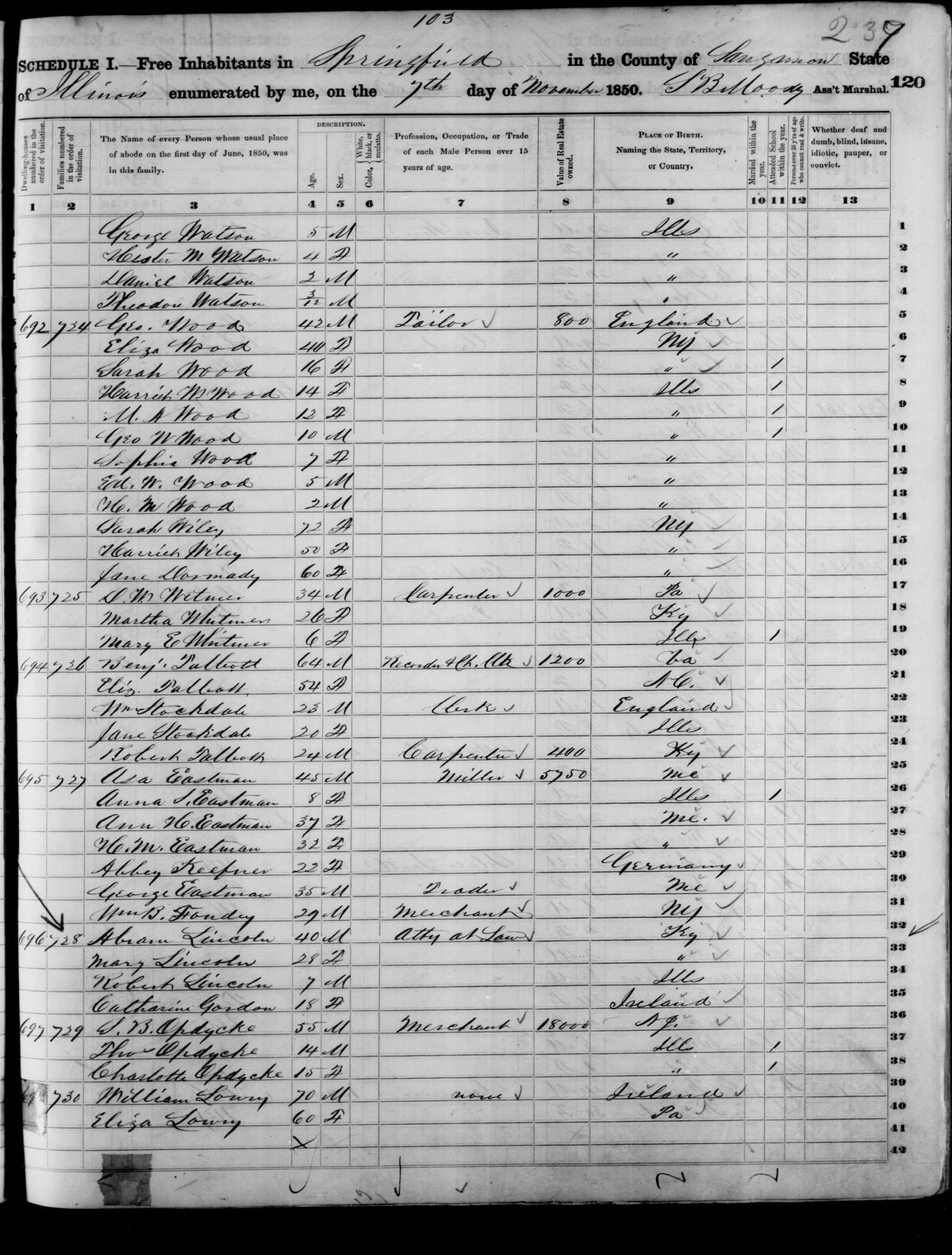
Read the heading of column 3: it asks for the name of every person whose usual home on June 1, 1850 was in the family. The National Archives says the 1850 census was the first to record each person's name, specific age and place of birth.
Why do the records change around 1800?
From 1790 through 1840, the National Archives says, the census named only free heads of family and totaled everyone else by sex, age group and free or enslaved status. Here is Oyster Bay, New York, in 1790: one name per line, then five columns of numbers.
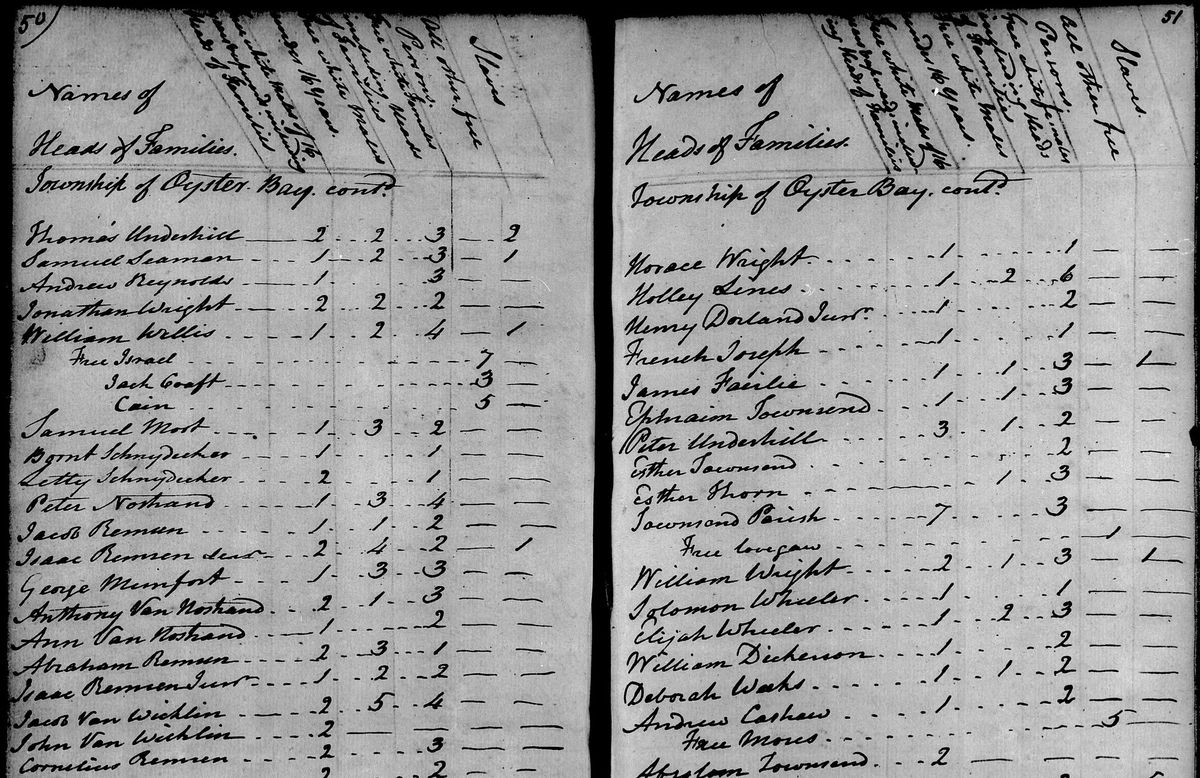
Example: One name, nine people
- The record: the first line on the left-hand page, Thomas Underhill.
- It states: two free white males 16 or older, two under 16, three free white females and two enslaved people.
- It doesn't prove: who the women are, whether the boys are his sons, or how old anyone is.
- Next: look where people are named: town and church records, deeds, wills.
Sometimes the whole schedule is gone. No 1790 returns are known to survive for six states, Virginia among them, the FamilySearch wiki says; for Virginia, state enumerations of 1782 to 1785 stand in.
Civil registration starts late almost everywhere: 1837 in England and Wales, per Findmypast; after 1859 in Mexico, per the Nuestros Ranchos guide; and in the United States, Genealogy Explained says, the early twentieth century. Where each country's records run out is in how far back you can trace your family tree.
Under both sit church registers, written one event at a time. England and Wales have them from 1538, per Findmypast. In the Catholic world, the Council of Trent's decree of November 11, 1563, told priests to keep a marriage book and to write godparents' names in the baptism book. Some parishes were ahead of it: Villasayas, in Soria, Spain, began its first baptism book in 1534.
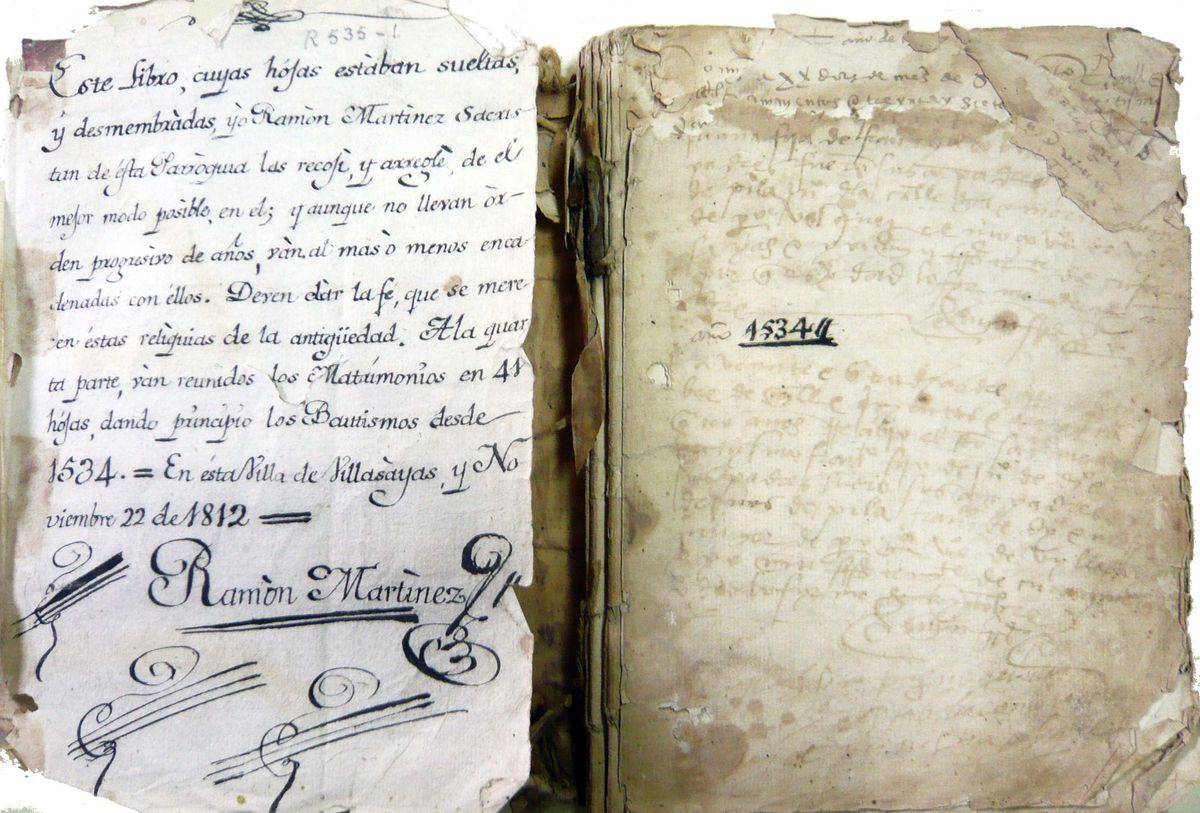
Read the left-hand note: the sacristan warns that the leaves do not run in strict order of years.
Records can also stop at the door of a household. The 1850 and 1860 slave schedules name only the owner and tally the enslaved by age and sex, and the first federal census to name all Black Americans was 1870, the National Archives says. For those families the wall is often 1870, not 1800: see what is the 1870 brick wall.
What records exist before civil registration?
More than most people search. The habit that stalls at 1800 is looking for one person's birth record; the habit that gets past it is looking for every record that names the family:
- Church registers. A baptism names the parents and usually the godparents; a marriage, the witnesses and often the parents; a burial, a date and sometimes an age.
- Wills and probate. A will names a spouse and children and sometimes a parent; probate, the court paperwork around a death, can name every heir.
- Land, tax and court records. Land passing quietly from one man to another can show who the father was when no record says so, the Dutch Genealogy blog notes.
- Pension and military lists. The 1840 census named pensioners of the Revolution and other service and gave each one's age, per the National Archives.
- Marriage dispensations. When the Church had to permit a marriage between relatives, the file records how they were related, per Nuestros Ranchos.
"…a missing record for a birth, marriage, or death is never a brick wall." The Family History Guide blog
The record you want is one record. The family left dozens.
Example: A deed that names the neighbors
This is an undated deed abstract, a copy of a deed that, the note at the bottom says, was recorded in the Middlesex County, Massachusetts, registry of deeds, book 17, page 316.
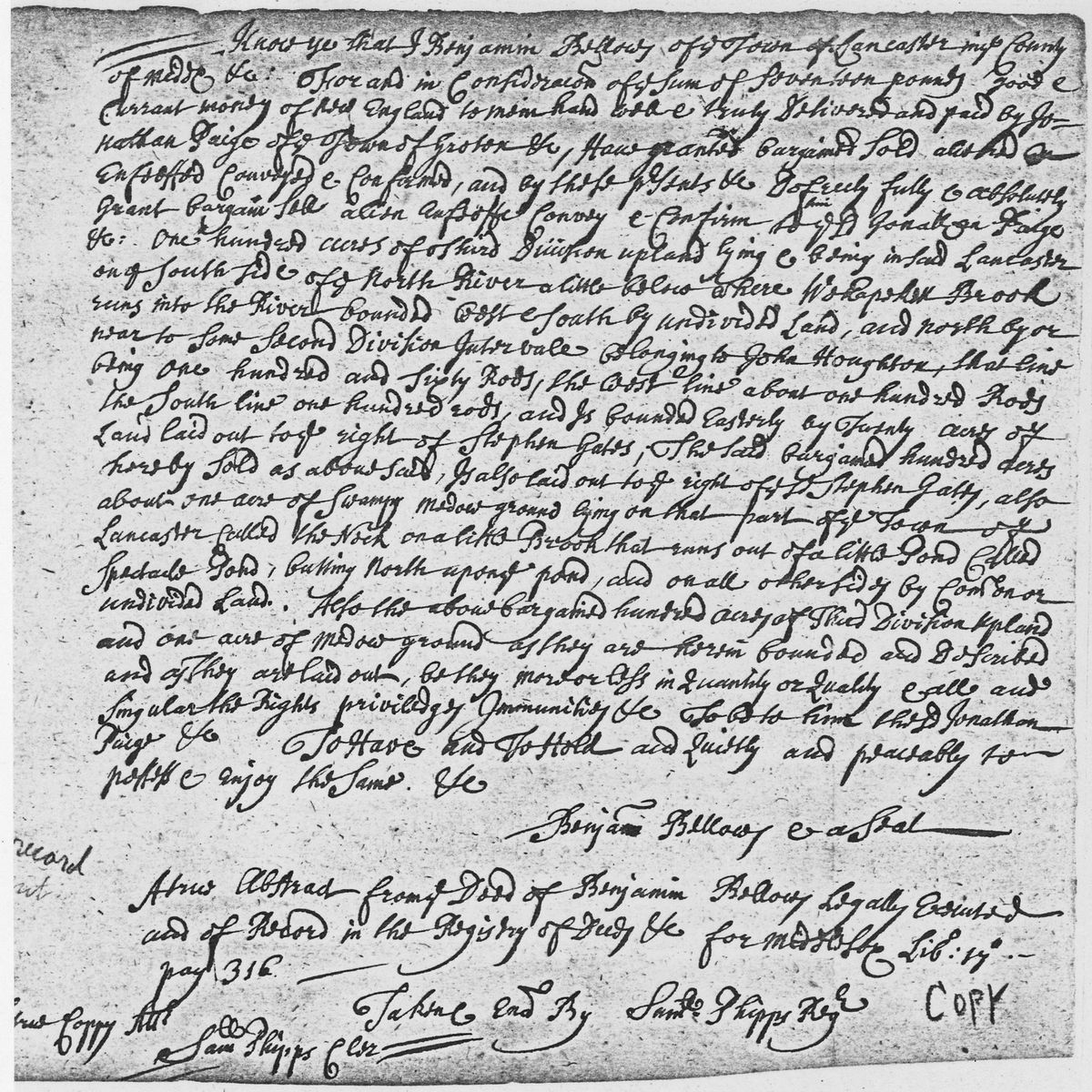
- It states: Bellows sold 100 acres on the south side of the North River to Paige, and the boundaries name two other men, Houghton and Gates.
- It doesn't prove: who Bellows's parents were, or how any of these men were related.
- Next: the FamilySearch wiki says to plat your ancestor's land, meaning map it out, and run the deeds of each neighbor.
What is FAN-club research?
FAN stands for friends, associates and neighbors, the circle of people around an ancestor. Evidence Explained's QuickLesson on the principle puts it plainly: when your ancestor left no document with the answer, it is often in the records of the people around them.
It works before 1800 because people moved in groups, as the FamilySearch wiki puts it, and because witnesses were often close relatives, the Dutch Genealogy blog notes, so godparents' surnames are often a shortlist of the mother's family. In the QuickLesson's own case, an 1853 marriage record in Leake County, Mississippi, naming only "Mary Smith" was traced to her likely family through the county's road orders and the 1850 census. Telling one Mary from another is in how to tell if a record is your ancestor.
Example: A will and its witnesses
This is Shakespeare's will, dated March 25, 1616.
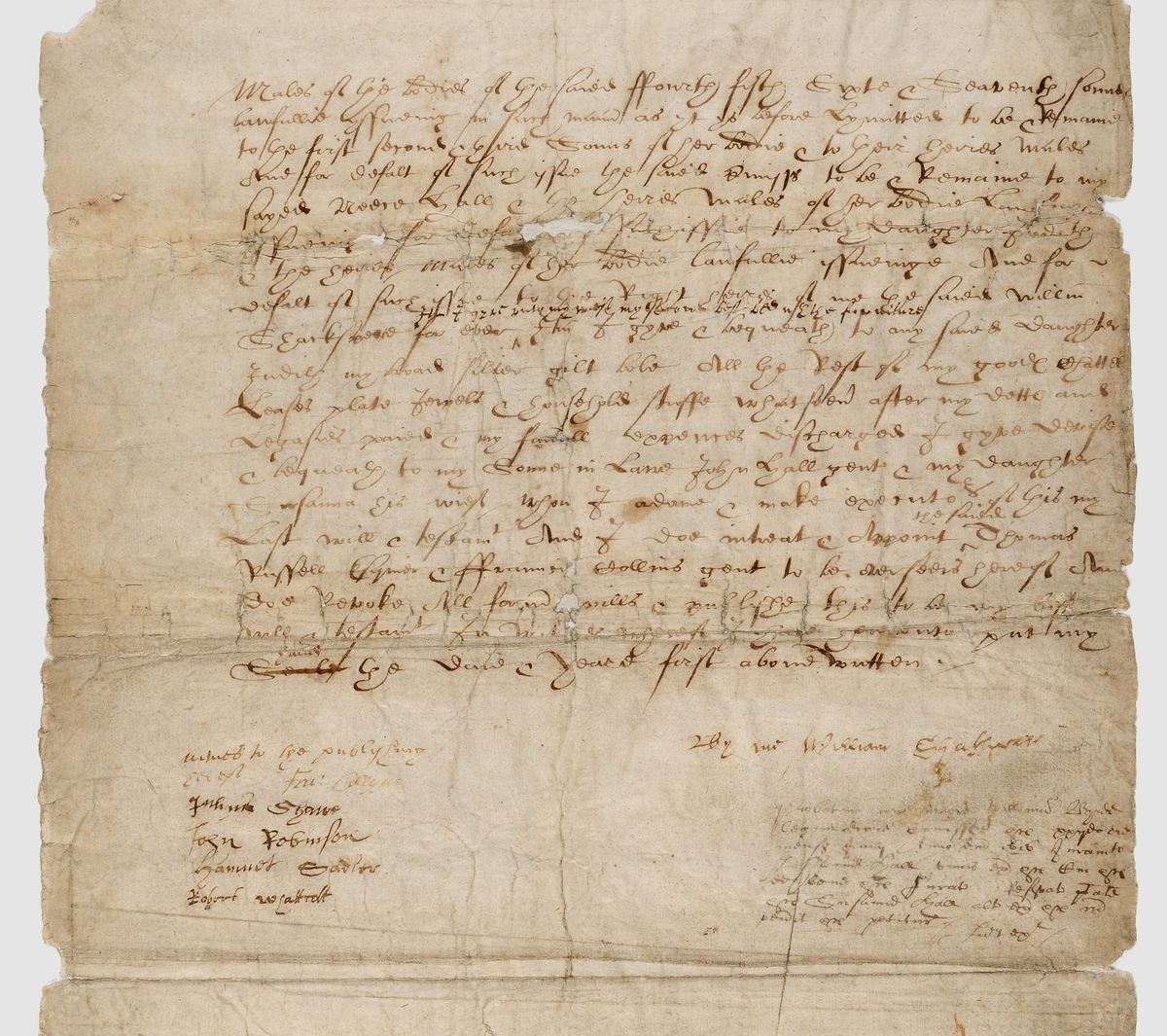
- It states: the rest of his goods go to his daughter Susanna and her husband, John Hall, who are named executors, the people who carry out a will; his wife, Anne, appears once, for the second-best bed; five witnesses are named, one of them his lawyer, Francis Collins.
- It doesn't prove: his age. No birth date is recorded anywhere; the parish register shows a baptism on April 26, 1564, and April 23 became the celebrated birthday by working back from it, the Shakespeare Birthplace Trust says.
- Next: treat the witnesses and executors as the first names to research.
Example: Aert Ton, Gelderland, 1737
Aert Ton married in Heerewaarden, a village in Gelderland, on May 19, 1737, and neither his marriage nor his burial record names his parents. The Dutch Genealogy blog's plan starts with his children: read their baptisms for witnesses, watch their names for the grandparents', and search the village's unindexed court records for deeds, wills and estate divisions. The plan itself admits naming patterns will not settle it here, so witnesses and court records carry the weight.
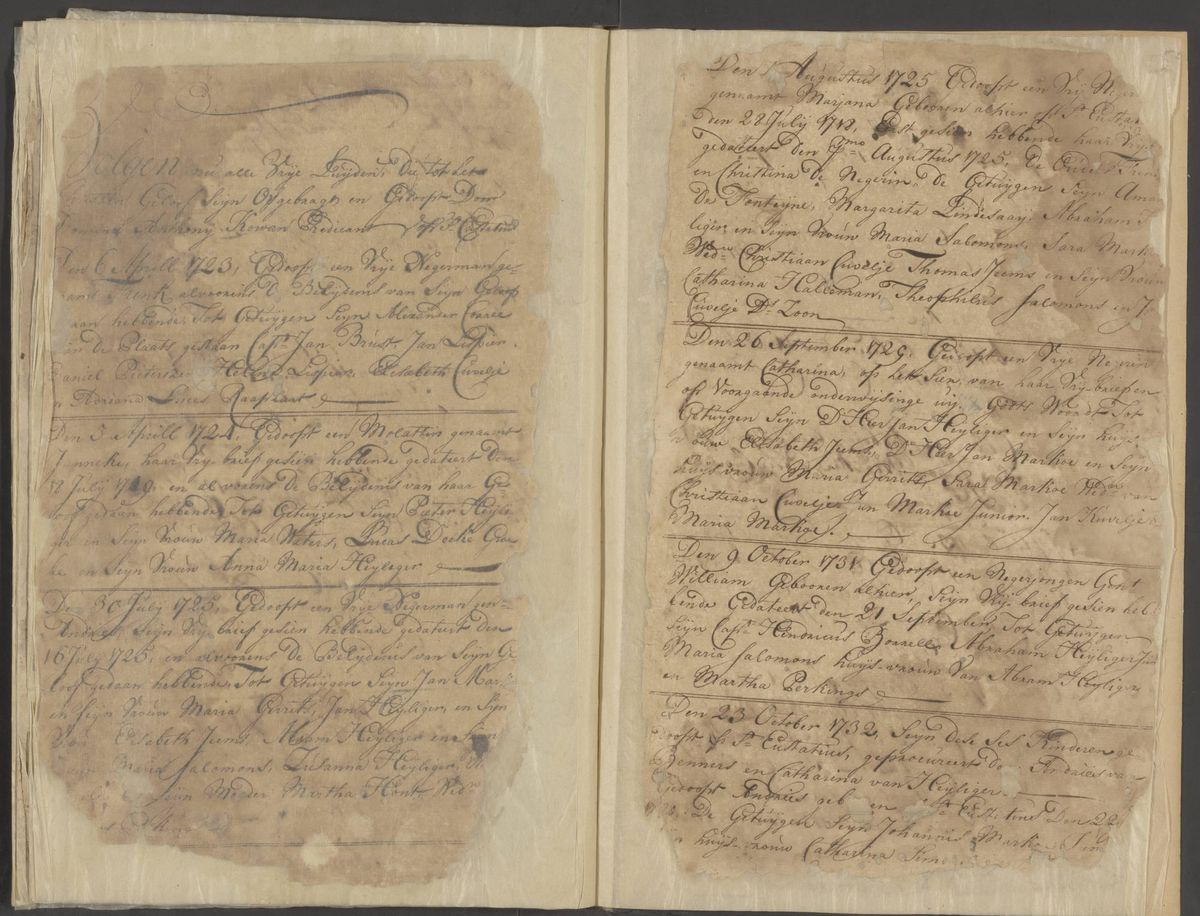
Look at the entry dated 1 August 1725 at the top of the right-hand page. After the person baptized comes a long list of witnesses, several of them couples marked "en seyn vrouw," "and his wife." Witnesses were often close relatives, the Dutch Genealogy blog notes, so a list like that is where the research starts.
Try this in 10 minutes, on the ancestor you are stuck on:
- List every name that touches the family, from godparents to the man who sold them land.
- Draw a timeline of every documented event and mark the gaps.
- Search the gaps in the next parish over before you blame a fire.
- Research the children for clues about the parents.
- Change the record type before you change the place.
How do you go around a record that no longer exists?
When a record is gone, you work around it. Here is the method on a real wall, from File 001, my open case on the birth year of Padre José Nicolás Ballí, the priest Padre Island is named for. His baptism was likely lost when a flood destroyed Reynosa in 1800. The record holders don't allow their page images to be republished without permission, so the case page transcribes them.
Example: Five steps around one flooded page
1. The burial, 1829. The burial book of Nuestra Señora del Refugio in Matamoros is digitized but unindexed, so I read it page by page. The date the Handbook of Texas prints as his death is his burial date; the register calls him el finado, the deceased, five days earlier. It gives no age.
2. The will, 1828. The original is no longer in the Matamoros archive, which confirmed that in September 2026, but a typescript, a typed copy, at the Texas General Land Office survives. In it he names his parents in his own words. It states no age.
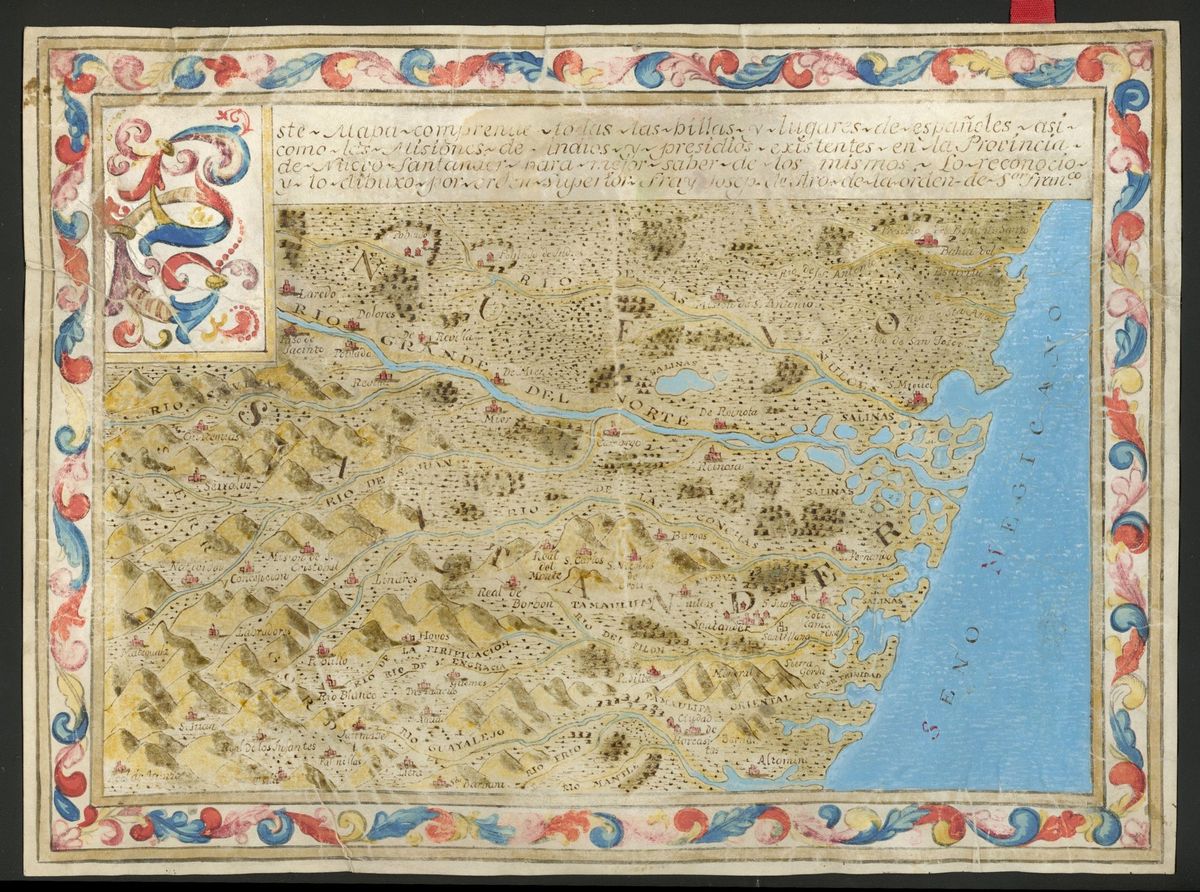
3. A dated signature, 1807. The Reynosa marriage register for 1790 to 1810 is free online through the UTRGV Digital Library, and it holds his signature as interim priest, spelled both "Bally" and "Ballí" on one page. Canon law, the Church's own legal code, set the minimum age for ordination at 24, unless he was granted an exception, so he was most likely born by 1783. Reading a book like that is the subject of how to find Mexican ancestors for free.
4. The record that had to exist. Canon law required a baptismal certificate before ordination, so his ordination file should hold proof of his age. It may sit in the archive of the Archdiocese of Monterrey, whose director invited me to consult it in person, or in Guadalajara's. I don't know yet whether the file survives.
5. The FAN club. His mother's 1798 will names his grandfather, a Nicolás Ballí, which the researcher who indexed the Reynosa books confirmed independently. He also pointed me to an earlier will, cited in the Texas Supreme Court's 1944 opinion in State v. Balli, and to a shipwreck. The wreck is still a lead: nothing ties it to the steamer Anson, lost in 1850 with Cameron County claim papers.
None of these is the baptism. Together they are a documented life with a documented ceiling, built around a page that flooded.
Can DNA get me past 1800?
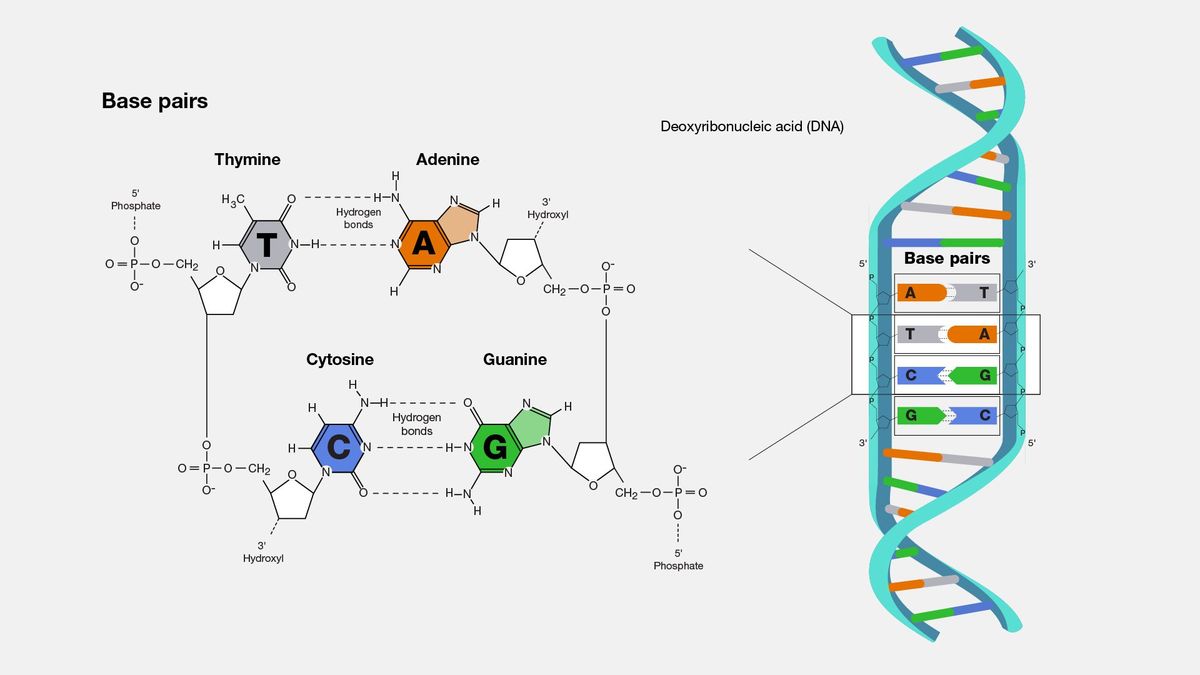
Sometimes, and rarely on its own. The standard consumer kit is an autosomal test, which reads the DNA you inherit from both parents, and Genealogy Explained puts its useful reach at about six to eight generations, roughly 150 to 200 years: right around 1800. Y-DNA, which follows the direct paternal line, and mitochondrial DNA, the direct maternal line, reach further but on one line only, and they mostly return deep origins, not a name.
The DNA Painter blog follows one hunt for the parents of a fourth-great-grandfather, James Moore, a stonemason who married in Havant, Hampshire, in 1806 and died in 1836. His age is 51 in the burial entry, 56 in a death notice and 39 in a Freemasons' register of 1819, so he was born between 1779 and 1785. DNA gave one confirmed match and no help from Y-DNA or mitochondrial DNA, so the plan is parish registers and three candidate fathers.
In my experience DNA chooses between candidate families once the records have produced them. Whether to test at all is in do you need a DNA test for genealogy.
When is it a true wall, and what can a professional do?
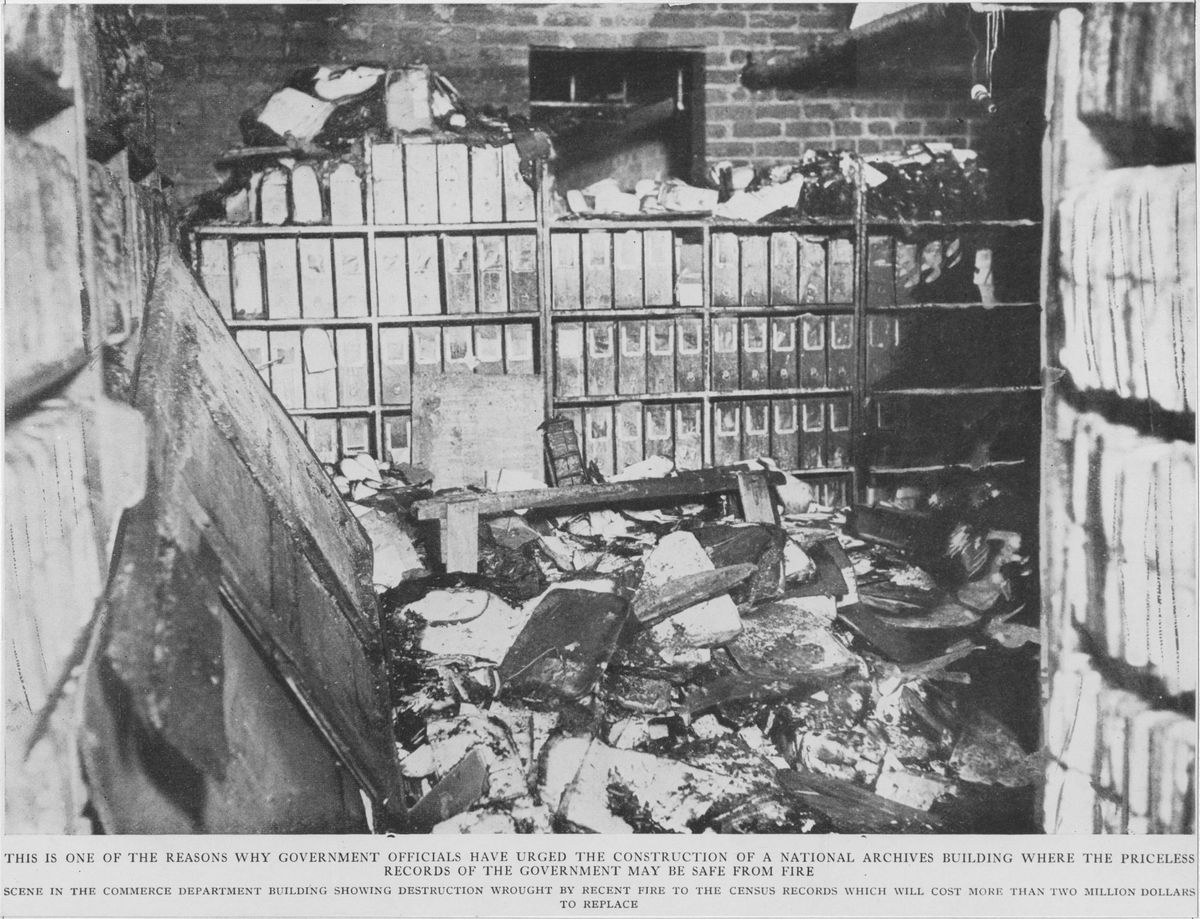
A true wall is a record that is gone along with every substitute, or an ancestor nobody had reason to write down by name. The Family History Guide adds that research before 1700 usually means new scripts and a new language, not a wall. Records do vanish: on January 10, 1921, a fire in the basement of the Commerce Department building in Washington burned and soaked the census schedules stored there. The census director estimated that a quarter of the 1890 census was destroyed and half of the rest damaged, and at least 6,160 names are indexed on the fragments that survive, the National Archives says.
Ireland's early censuses went the same way. On June 30, 1922, an explosion and fire at the Public Record Office of Ireland, in Dublin's Four Courts, left only the outer wall standing, and the National Archives of Ireland says most of the 1821 to 1851 returns were lost. Some county fragments survive, so check before you give up. Many records called lost were only misplaced, the Nuestros Ranchos guide warns, so write to the parish, then look for duplicates in other archives.
What hiring buys is the parts that cost time: whole books read page by page, Spanish read in the original, knowing which record had to exist and which archive should hold it, and a record of every search, dead ends included. What no professional can buy is the page that flooded in 1800. The timeline, the FAN list and most online census and deed searches you can do free.
That is why a wall starts with the $300 Discovery assessment on my pricing page: a brick-wall check and a written research plan, credited in full toward any package. If there is a way around, the deep packages are built for it: one or two lines into the 1700s from $5,500, one line into the 1600s for $6,500, and the flagship, both sides into the 1600s, for $9,500, each billed in four equal parts: at the start, at 1800, at 1700 and on delivery.
If a line hits a true wall, billing stops at the last milestone reached and you keep everything found. At checkout your card is authorized, not charged; it is captured only when you accept the written quote and I accept the case. Otherwise the hold is released.
If you'd rather have this done, start with the $300 Discovery assessment; it's credited toward any package. You get the brick-wall check and the written plan before anything larger is on the table. Start with the Discovery assessment
Questions people also ask
Why does the US census stop naming everyone before 1850?
Because from 1790 through 1840 the census taker wrote down only the name of the head of each household and counted everyone else by age and sex, according to the National Archives and the FamilySearch research wiki. The 1850 census was the first to list every free person in the household by name, with age, sex, color and birthplace. So a family that is easy to follow in 1850 becomes tally marks a decade earlier, and the parents of someone born around 1810 have to be proven from other records, usually church books, wills and deeds.
What records exist before civil registration?
Church registers of baptisms, marriages and burials are the backbone, reaching 1538 in England and Wales and, across the Catholic world, the Council of Trent's decree of 1563, which told parish priests to keep a marriage book and to write godparents' names in the baptism book. Beside them sit wills and probate, deeds and tax lists, court and town records, church council minutes, military and pension lists, and marriage dispensations. Each was written for a different reason, and that is the point. When the one record you want is missing, the family usually appears in several of the others.
What is FAN-club research?
FAN stands for friends, associates and neighbors, meaning the godparents, witnesses, executors, in-laws and next-door households around your ancestor. The idea, laid out in Evidence Explained's QuickLesson on the FAN principle, is that when your ancestor left no record with the answer, the answer is often in the records those people left. In that lesson, an 1853 Mississippi marriage record that named only "Mary Smith" was traced to her likely family through the county's road orders and the 1850 census. Before 1800 the method works because people moved in groups and witnesses were often relatives, so the names around an entry are a shortlist of the family.
What if the parish book was destroyed?
First confirm it is destroyed and not misplaced, misfiled or sitting in another archive as a duplicate, which the Nuestros Ranchos guide to Mexican church records says happens often. Then go to the records that had to repeat the same facts, such as a burial for the death, a will for the parents, a marriage entry for the spouse's family, and any file where the law required proof of age or birth. On the Padre Ballí case the baptism was likely lost in a flood in 1800, so the burial, the 1828 will and a dated 1807 signature stand in for it, the ordination file is still to be found, and the signature alone gives a documented ceiling on his birth year.
Can DNA get me past 1800?
Sometimes, as a check on the paper, and rarely on its own. The standard autosomal test is useful for about six to eight generations, roughly 150 to 200 years by Genealogy Explained's estimate, which puts 1800 at the edge of its reach. Y-DNA and mitochondrial DNA go further but only on the direct paternal or maternal line, and they mostly tell you deep origins, not a name. The practical use is choosing between candidate families once the records have produced candidates.
Sources
- National Archives, "1790-1890 Federal Population Censuses, Part 1" (introduction to the census microfilm catalog)
- National Archives, Prologue, "First in the Path of the Firemen: The Fate of the 1890 Population Census" (Spring 1996)
- National Archives catalog, "Photograph of Commerce Department Building" (March 1921), local identifier 64-NAD-264
- National Archives catalog, "Benjamin Bellows Deed" (John F. Kennedy Library, Historical Documents Collection)
- National Archives catalog, "1850 Census: Illinois: Saline and Sangamon Counties" (microfilm M432, roll 127; Springfield, dwelling 696, family 728, image 243)
- National Archives catalog, "New York" (First Census of the United States, 1790, microfilm M637, roll 6; Oyster Bay, pages 50 and 51, image 395)
- National Park Service, Lincoln Home National Historic Site, "Lincoln Chronology"
- FamilySearch Research Wiki, "United States Census 1790"
- FamilySearch Research Wiki, "United States Census 1840"
- FamilySearch Research Wiki, "United States Census 1850"
- FamilySearch Research Wiki, "Solving Tough Research Problems: Overcoming Brick Walls"
- Findmypast, "How to Trace Your Ancestry"
- Genealogy Explained, "How Far Back Can You Trace Your Family Tree?"
- Nuestros Ranchos, "Guide to Mexican Church Records"
- The Council of Trent, Twenty-Fourth Session, 11 November 1563, trans. J. Waterworth (London, 1848), Hanover Historical Texts Project
- Archivo Diocesano de Osma-Soria, first book of baptisms of Villasayas, 1534 to 1812 (photograph on Wikimedia Commons, public domain)
- The Family History Guide blog, "When Is a Brick Wall Not a Brick Wall?" (September 6, 2020)
- Internet Shakespeare Editions (University of Victoria), "Shakespeare's will"
- The National Archives (UK), "William Shakespeare" (will at PROB 1/4)
- Shakespeare Birthplace Trust, "When Was Shakespeare Born?"
- Evidence Explained, "QuickLesson 11: Identity Problems and the FAN Principle"
- Dutch Genealogy, "Ask Yvette: A Research Plan for an 18th-Century Brick Wall Ancestor"
- Dutch Genealogy, "Baptismal record"
- Nationaal Archief, baptism book of the Dutch Reformed church on Sint Eustatius, 1709 to 1740, scan NL-HaNA 1.05.13.01 247 0057 (on Wikimedia Commons, CC0)
- National Archives of Ireland, "Census Records 1821-1891"
- National Archives of Ireland, "Public Record Office of Ireland: The Story of a Building"
- Skeleton Files, File 001, The Padre Ballí Birthdate
- UT Arlington Libraries, Virginia Garrett Cartographic History Library, "Este Mapa [Nuevo Santander Mexico]" by Father Joseph de Haro
- Genealogy Explained, "How Many Generations Does DNA Go Back?"
- National Human Genome Research Institute, Talking Glossary, "Base Pair"
- DNA Painter blog, "DNA isn't helping much with this brick wall"
- Skeleton Files, Packages and Pricing