When it matches on more than the name. A record is about your ancestor when the name, the date, the place and the relationships on the page agree with what you already know from records you trust. I want three of those four to line up, from records that did not copy each other, before it goes under a person in my file.
On September 12, 1918, Louis Armstrong signed a draft registration card in New Orleans that gives his birth date as July 4, 1900. He believed it. Later the New Orleans music historian Tad Jones found a baptismal record at Sacred Heart of Jesus Church that points to August 4, 1901.
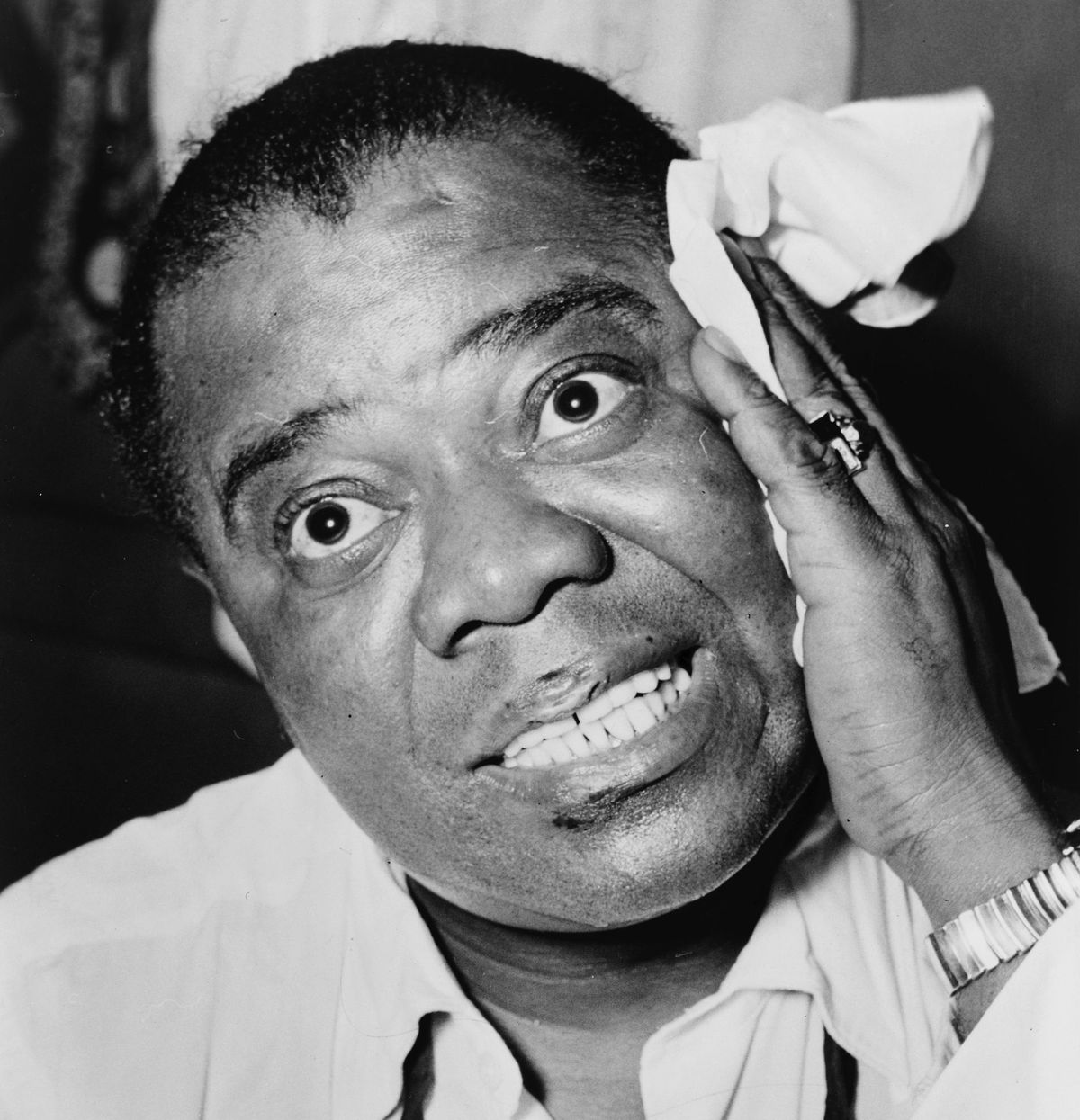
So which record is right? I trust the one made closest to the event by someone with no reason to shade it, and even then I call it a pointer, not a verdict.
What are the four checks for matching a record?
FamilySearch's beginner's guide to searching records lists them: names, dates, locations and relationships.
- Name. Not the same name, a logical variation of it. The guide's own example is a record that says James for an ancestor you know as Jim. Spelling, nicknames and a middle name used as a first name are all normal.
- Date. The guide says dates that are relatively close may be a match if the rest of the record fits. A year or two of drift is ordinary, as Armstrong's two birthdays show; the Census Bureau's 1910 report blames age errors on people who did not know their exact age, answers given by someone else, and ages deliberately misstated. A decade is a different person until proven otherwise.
- Place. The place should match, or sit near the places the family is known to have lived. A move you cannot explain is a flag, not a disqualifier.
- Relationships. Do the parents, spouse, children or household on the page fit the family you have? This check does the most work. A name can be shared and a date can be close, but a wife, three children and a mother-in-law in the same house are hard to duplicate.
Records that copy each other count once: a death certificate and the obituary written from it are one source, not two.
Try this in 10 minutes on one record you have been meaning to check.
- Write down what you already know about the person before you open the record. That tests the record against your file, which is the difference between research and copying someone else's tree.
- Open the image, not just the index (the typed list of names). FamilySearch's search instructions say the images often contain additional information and clues not found in the indexed data.
- Mark each of the four checks as agrees, close, conflicts or silent, then find a second record, made by someone else, that agrees on at least two.
- Log the result as attached or unresolved, with the page, the date and what you typed.
Example: Alvin York's draft card
This is one of about 24 million World War I draft registration cards at the National Archives: Alvin Cullum York's, from June 5, 1917, the first registration day, for men aged 21 to 31.
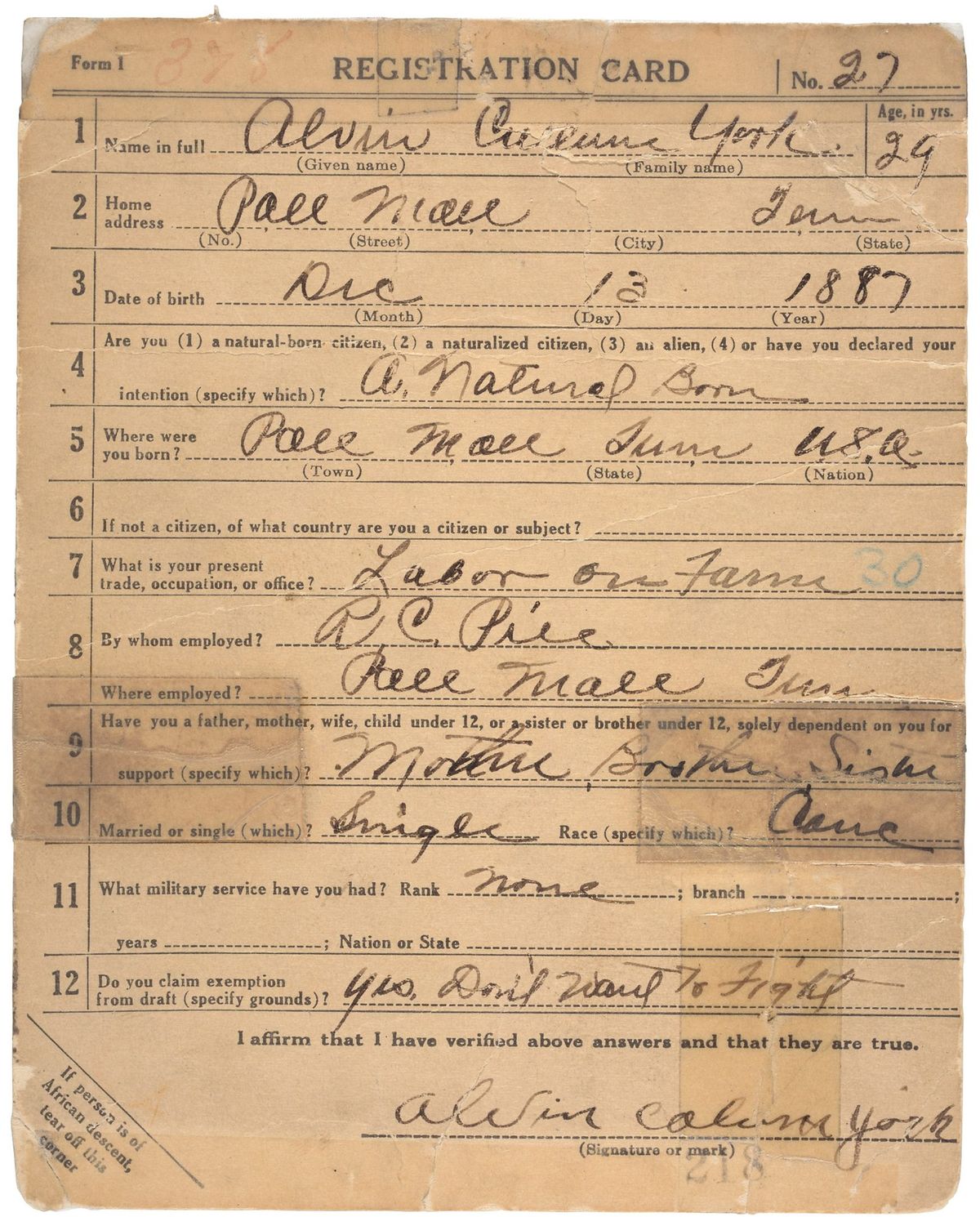
Check the age box and line 3: the card says 29, and a man born on December 13, 1887, was 29 on June 5, 1917, which fits. Lines 2 and 5 put him at Pall Mall, Tennessee, home and birthplace. On line 12, asked whether he claimed exemption from the draft, he answered yes and wrote "Don't want to fight."
By his own affirmed answers, it shows a man of that name was born there on that date and lived there in 1917. It does not prove who his parents were: line 9 lists "Mother, Brother, Sister" as dependents without naming anyone. The 1900 census records birth month and year, so that is where I would look next.
How do I search with name variants and wildcards?
Spelling is the first wall. The person named in an old record rarely wrote it; a priest, a clerk or a census taker wrote what he heard. The best-known version is the story that an official at Ellis Island changed your family's name.
The USCIS page on immigrant name changes takes apart a typical retelling: an immigrant who only smiled when asked his name, so the clerk wrote down "Smiley." Its answer, in one line:
"In fact, passenger lists were not created at Ellis Island. They were created abroad..." From the USCIS Genealogy Notebook.
The inspector already held that list, and USCIS says inspectors were not to change a name unless the immigrant asked or the list was wrong. Names did change, just later: USCIS says immigrants tended to change them within five years of arriving. The National Park Service's page for Ellis Island researchers traces other spelling differences to the shipping company that wrote the name or a modern transcriber reading hard handwriting.

Searching for variants means typing less, not more. The FamilySearch guide says to enter as little as brings up a reasonable number of results, so I start with a surname, a place and a decade.
A wildcard is a symbol that stands in for letters you do not know, so it covers the spelling you cannot predict. On FamilySearch the asterisk (*) stands for multiple characters and the question mark (?) for exactly one. Its 2014 post on wildcards adds that in most cases you need at least three real letters of the name, and that you can use up to four asterisks; Hans?n finds Hansen and Hanson.
Ancestry's rules differ: the asterisk covers zero to five characters, the question mark one, every search needs at least three non-wildcard letters, and the first and last character cannot both be wildcards. For the Padre, Ball* catches Bally, Ballí and Balli in one search.
What if two people have the same name in the same town?
Then you have two people, and your job is to keep them apart, not to pick one. The Evidence Explained lesson on identity problems reports at least 17,995 women named Mary Smith in the United States in 1850.
My tools, in order:
- Count households. Two households in the same census year are two people, whatever the trees say.
- Use the people around him. Genealogists call this the FAN club: friends, associates and neighbors, meaning the spouse, the children, the godparents, the witnesses and the brother who signs the deed. A name can be shared; a whole circle rarely is. It is also why skipping the siblings is such an expensive beginner mistake.
- Run the timeline. One man cannot be buried in 1829 and sign a deed in 1831. Put every dated event for the name on one line and see where it splits.
- In Spanish records, use the second surname and the grandparents. Two men with the same first name and father's surname but different mothers are two different men as soon as a page names the mother. A baptism that names the grandparents, as Mexican entries sometimes do, can settle it.
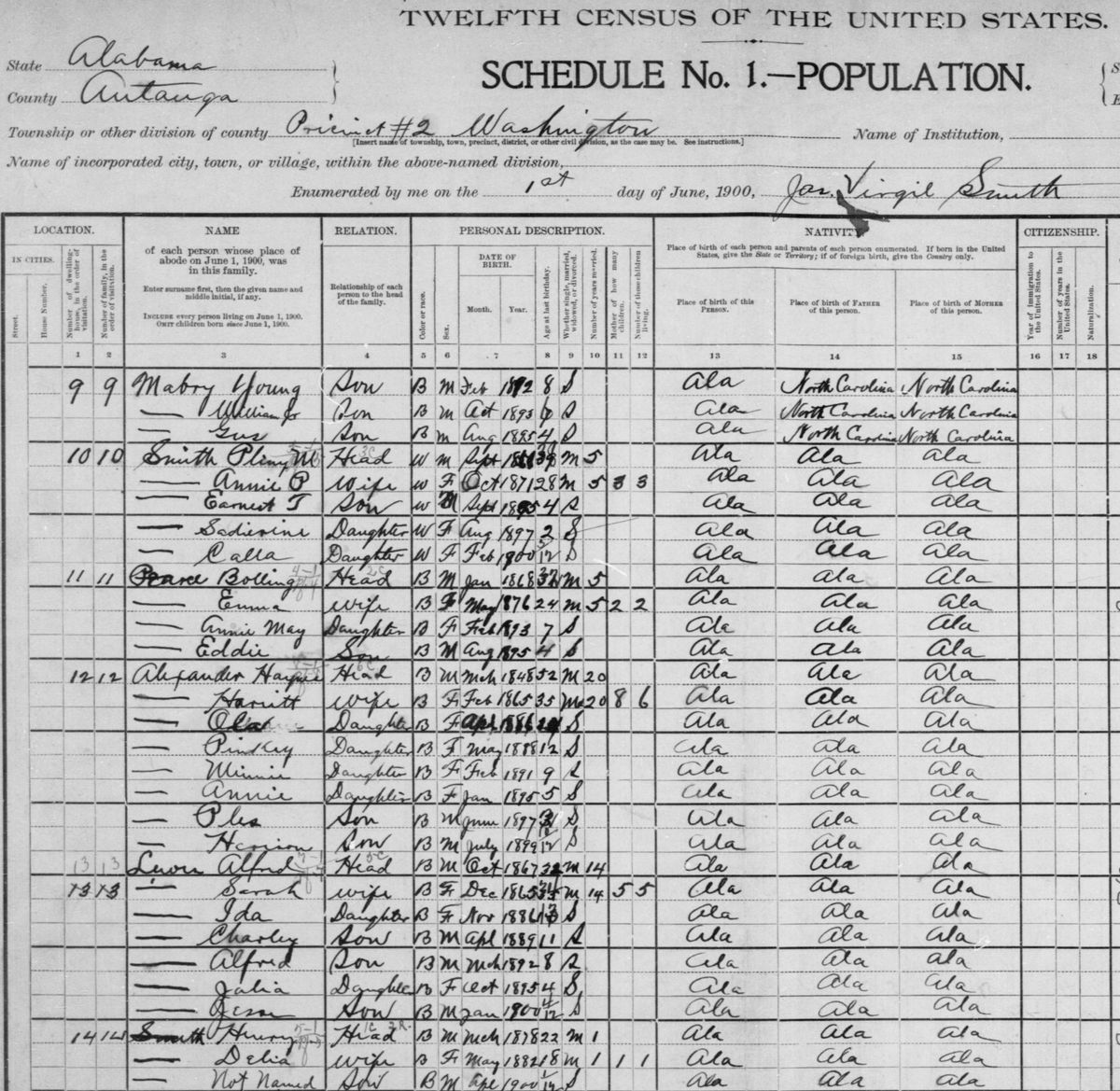
Here is counting households on a 1900 census page from Autauga County, Alabama. Column 2 numbers the families, and the National Archives' transcription lists a Smith heading two of them, 10 and 14. Columns 7 and 8 give birth month and year beside the age: in family 11, Bolling Pearce's January 1868 and age 32 fit the census date of June 1, 1900.
Example: Mary Smith of Leake County
The Evidence Explained lesson works through a real case. In November 1853, in Leake County, Mississippi, a Mary Smith married a widower named James Boyd. The license, bond and return (the officiant's report) give no age and no parents. Beyond the couple, they name only the man who cosigned the bond, James's cousin, and the justice of the peace.
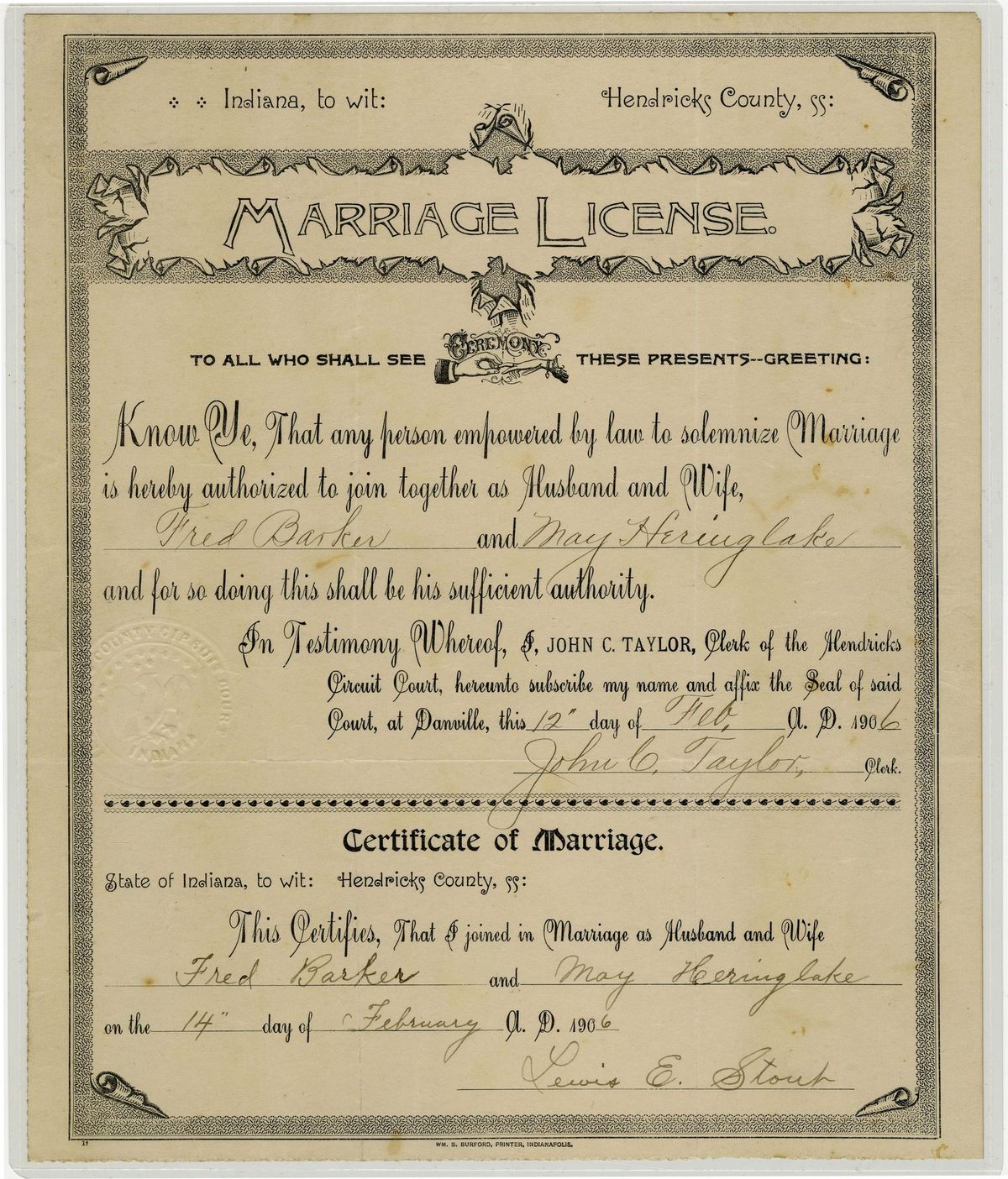
It proves a Mary Smith married James Boyd, not which one, so the lesson studies James's circle. Four months later, the county's Police Court, the board that ran road work, put James, his brothers Franklin and Andrew, and three men named Smith on one road crew. Land records place a William Smith within a mile of James. The 1850 census of that neighborhood shows a Smith household with an unmarried Mary of marriageable age and all three Smiths from the road crew, two doors from the justice of the peace who later married the couple.
The lesson calls the result a likely birth family, built from clues that prove nothing alone. When the records will not let you separate people, say so in the file. "Unresolved, two candidates" is an honest entry. A merged man with two wives and eleven children is the error that costs the most to undo, and The Ancestor Hunt's checklist for online trees asks the question that catches it: "Are relationships clearly supported?"
How did I sort out the Ballí names in a real case?
Padre José Nicolás Ballí is the priest Padre Island is named for, and nobody has documented when he was born. That hunt is File 001, my public case, and the family is a same-name puzzle.
- Two Nicolás Ballís. His grandfather was also named Nicolás Ballí. His mother's 1798 will names the grandfather, and the researcher who indexed the Reynosa parish books confirmed it independently.
- A nephew with two names. The case page calls the Padre's nephew Juan José Ballí; the 1827 survey record names him Juan Ballí.
- Too many brothers. That researcher told me the Padre had two brothers, not the three or four some online trees give him.
Example: the burial entry no index had
The priest's burial entry was never indexed, so no name search finds it. I read the burial book of Nuestra Señora del Refugio, in Matamoros, page by page until I reached April 1829. What identified the entry was not the name alone. It was the rites, the parish's highest, an entierro mayor with vigil; the cause of death, apoplejía, a stroke, which I have found in no published source; and the date, April 16, 1829.
April 16 is the date the Handbook of Texas and other histories print as his death. But an entry five days earlier already calls him el finado, the deceased, so April 16 is the burial, and that correction is filed with the Texas State Historical Association and the National Park Service. The entry gives no age, so it cannot fix his birth year. I can't show the page, because the record holders don't allow their images to be republished; the case page transcribes it.
I found the burial entry on August 30, 2026. Two days later, in the Reynosa marriage register, I found his signature on marriages he performed in January and February 1807: "Yo el Br. D. Nicolas Bally, Cura interino" (I, Bachelor Don Nicolás Bally, interim parish priest). He spelled his name both Bally and Ballí on that one page, in his own hand, which is why indexes scatter him.
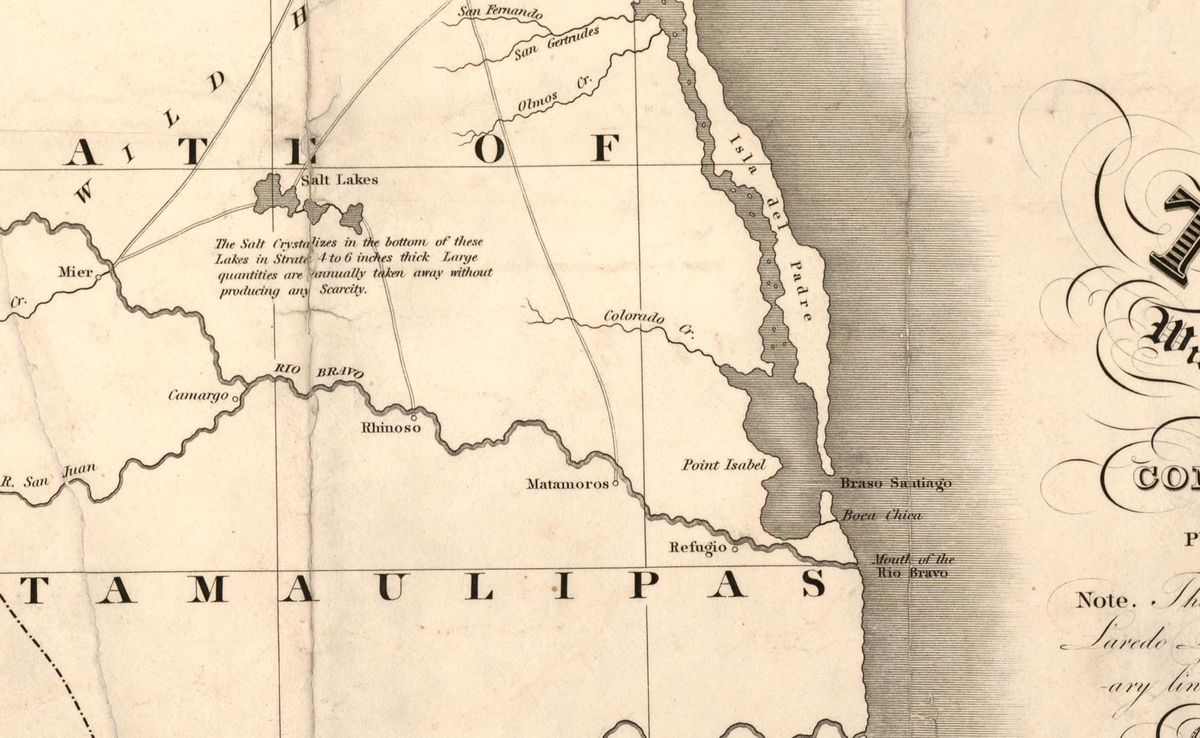
Place names wander too. The typescript of his 1828 will at the Texas General Land Office calls his birthplace the Villa de Reinosa; Stephen F. Austin's 1830 map, published the year after the Padre died, has Rhinoso; modern writing says Reynosa. Three spellings, one town.
What's the difference between an indexed and an unindexed record?
An index is a typed list of the names, dates and places on a set of pages, made so a search box can find them. The image is the page itself. Only indexed collections answer a name search; FamilySearch's Browse Images collections are unindexed, grouped into browse points you click through, image by image. Its search instructions add that many records are not yet indexed, especially those outside the United States.
So "no results" often means "not indexed," not "not there." Both Ballí finds came from turning pages: find the place in the catalog, pick the book by date range, land near your years, and read every entry in your window. The index was never going to say "this one is the priest." The page did.
Example: page one of a 1754 county docket
In 1939 Farm Security Administration photographer Marion Post Wolcott photographed the first page of a Granville County, North Carolina, court docket, the court's book of its cases. The left page is a hand-written index to lawsuits; the right page opens the court of June 4, 1754.
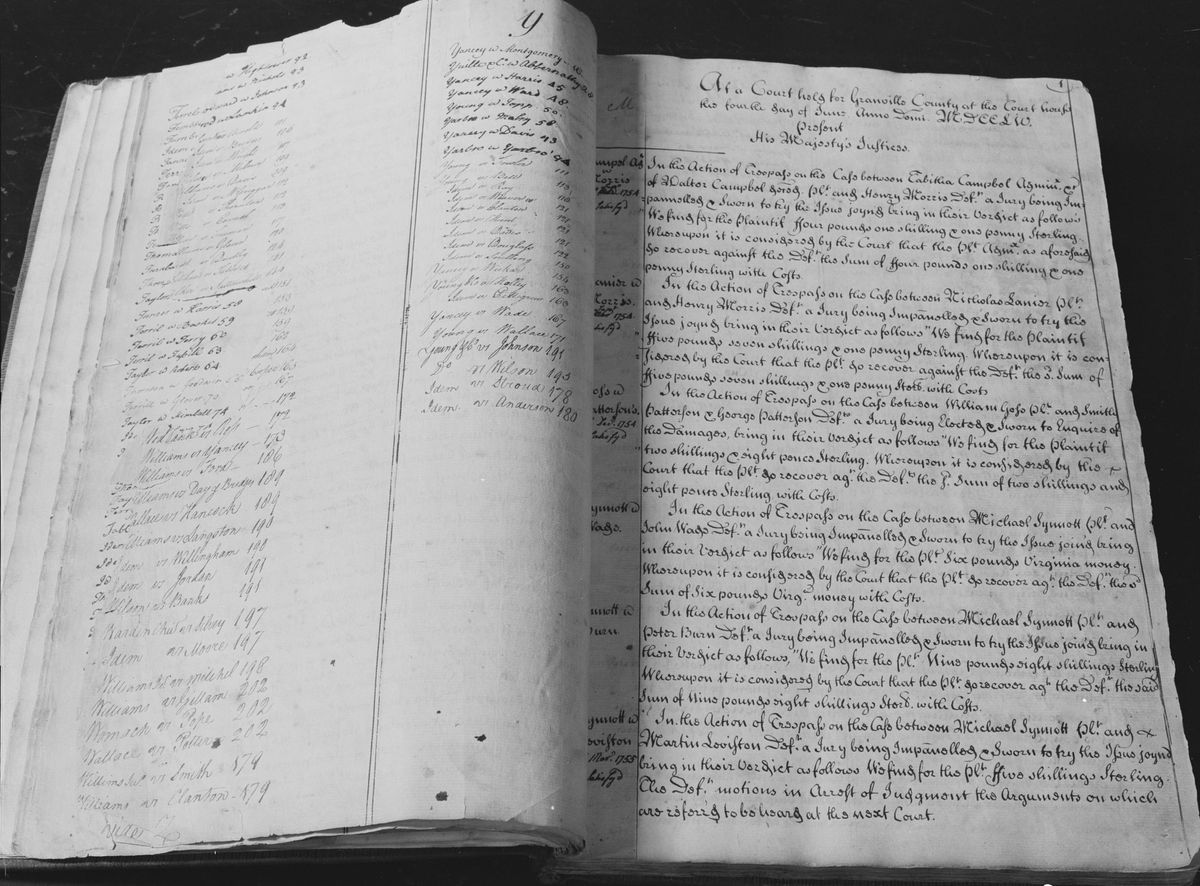
The first entry is a lawsuit by Tabitha Campbell, administratrix (the person a court appoints to settle a dead person's estate) of Walter Campbell, against Henry Morris. The jury found for her, and the court ordered Morris to pay four pounds, one shilling and a penny sterling.
It proves a Walter Campbell had an estate to administer and a Tabitha Campbell was handling it. It does not say she was his widow, or how old either was. Next: the courthouse's wills and estate books.
What do I do when nothing comes up?
A newcomer asks in a thread on r/Genealogy from 2018 what to do when every site turns up nothing new on an ancestor. My order:
- Search with less. Drop the first name, widen the year by five on each side, drop the place.
- Search the way a clerk heard it. Wildcards, the mother's surname, the Spanish form of the name, the nickname.
- Search for someone else in the household. The record that names your person is often filed under a sibling, a spouse or a parent.
- Check whether the collection is indexed. If it is Browse Images, the search box was never going to find it. Browse.
- Check whether the record can exist. Civil registration, the government's own record of births, marriages and deaths, started on a different date in each place, and before it the church book is often the only record. The Padre's own baptism was likely lost when a flood destroyed Reynosa in 1800; no search finds a page that is gone.
- Write the empty search down. Collection, what you typed, the date: one line in your research log. A dead end you logged is a result; a dead end you forgot is next year's repeated search.
- Go sideways. When the record types for that place and time are exhausted, work the FAN club or a substitute record: tax lists, land, probate (court records of dead people's estates), all kept in county books like these.

A record can also be gone for good. On January 10, 1921, a fire in the Commerce Department building destroyed most of the 1890 census. The National Archives says the surviving fragments cover over 6,160 people in 10 states and the District of Columbia, so a missing 1890 entry usually means the page burned, not that your ancestor was not there.
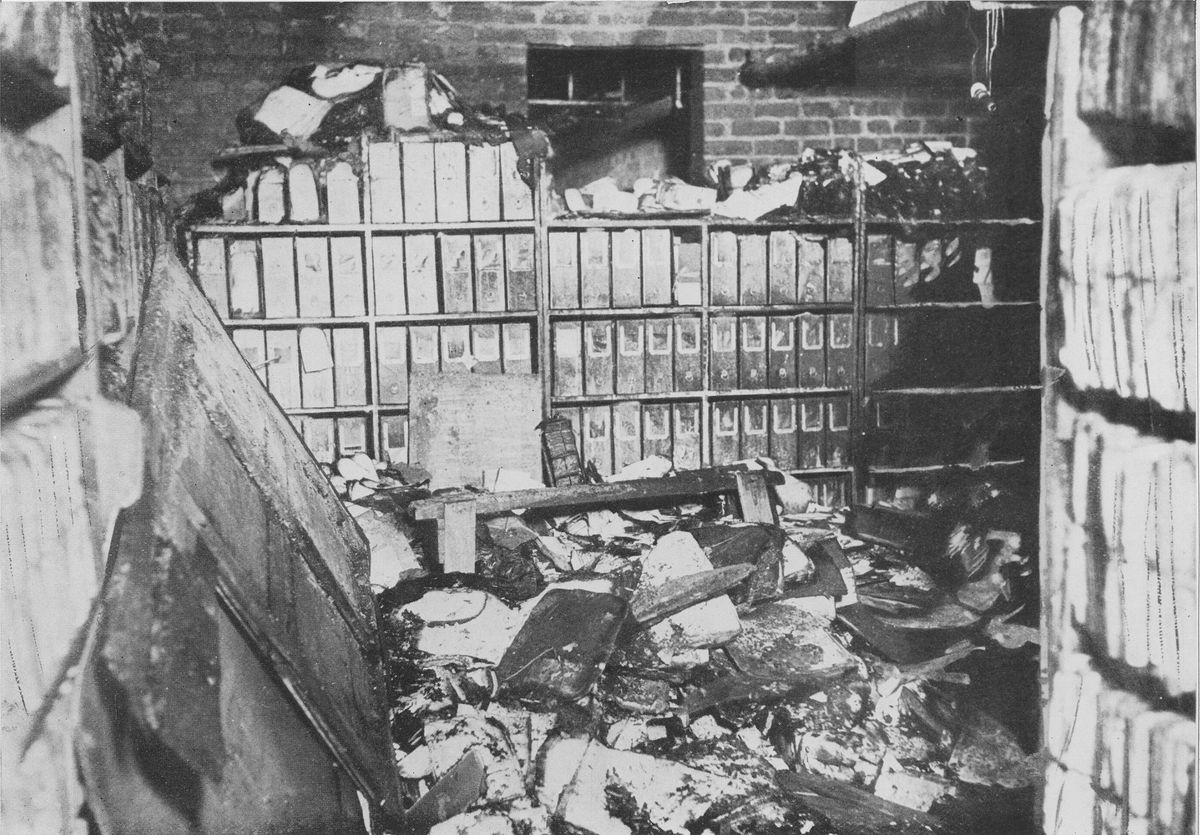
When a record is gone, a copy can still answer. The original of the Padre's will is no longer in the Matamoros archive, but a typescript survives at the Texas General Land Office and a certified copy was recorded in the Cameron County deed records in 1909.
On hiring, honest both ways. You can do most of this free: FamilySearch costs nothing, and the checks and the log cost only time. What I add is the Spanish, the reading of whole books when the index fails, and a log of every search, empty ones included. What I cannot add is a page that flooded in 1800, or a clean split between two namesakes the records never separate.
On a tree that already exists, the first job is finding the merged men and the wrong-person records. The 1800s package includes finding and documenting those errors before anything is built on them.
If you'd rather have this done, start with the $300 Discovery assessment; it's credited in full toward any package. You get a brick-wall check and a written research plan before you commit to anything larger. Start with the assessment.
Questions people also ask
What are the four checks for matching a record to my ancestor?
Name, date, place and relationships, the four that FamilySearch's beginner's guide to searching records lists. The name can be a logical variation such as Jim for James, the date can be a little off, and the place should match or sit near the places the family is known to have lived. The relationships on the page, parents, spouse, children, household, are the check that does the most work. I want three of the four to agree, from records that did not copy each other, before the record goes under a person.
How do I search with name variants and wildcards?
Type less, not more, and let wildcards cover the spelling you cannot predict. On FamilySearch an asterisk stands for multiple characters and a question mark for exactly one, and you need at least three real letters of the name. On Ancestry the asterisk covers zero to five characters, the question mark one, every search needs at least three non-wildcard letters, and the first and last character cannot both be wildcards. Search the surname with a place and a decade before you add a first name.
What if two people have the same name in the same town?
Then you have two people and your job is to keep them apart, not pick one. Two households in the same census year are two people. Separate them with the people around them, the spouse, the children, the godparents and the witnesses, and with a timeline, because one man cannot be buried in 1829 and sign a deed in 1831. If the records never let you separate them, label the link unresolved and leave it, which is better than a merged man with two sets of children.
What is the difference between an indexed and an unindexed record?
An index is a typed list of the names on the pages, made so a search box can find them. Only indexed collections answer a name search; FamilySearch labels its unindexed collections Browse Images, and you find a page in them by clicking through groupings it calls browse points, then reading. Many records are not indexed yet, especially outside the United States, so no results often means not indexed rather than not there.
What do I do when nothing comes up?
Search with less, then with wildcards, then for someone else in the household, because the record that names your person is often filed under a sibling's or a spouse's name. Check whether the collection is indexed at all, and whether the record could exist for that place and year. Write the empty search down, with the collection and what you typed. A dead end you logged is a result; a dead end you forgot is next year's repeated search.
Sources
- A Beginner's Guide to Searching Records (FamilySearch Blog)
- Search instructions for Historical Records (FamilySearch Help Center)
- How do I find an image in an unindexed collection in Historical Records? (FamilySearch Help Center)
- Searching with Wildcards in FamilySearch (FamilySearch Blog, April 10, 2014)
- Searching with Wild Cards (Ancestry Support)
- Questions to Ask Before Accepting an Online Tree (The Ancestor Hunt)
- A thread on r/Genealogy, "Newbie questions" (December 2018)
- File 001, The Padre Ballí Birthdate (Skeleton Files case log)
- When is Louis Armstrong's birthday? (Louis Armstrong House Museum)
- Louis Armstrong's Birthday (WWNO, Music Inside Out)
- World War I Draft Registration Cards (National Archives)
- Notable Registrants of the World War I Draft (National Archives at Atlanta)
- World War I Draft Registration Card for Alvin C. York, 1917 (National Archives identifier 596217)
- World War I Draft Registration Card for Louis Armstrong, 1918 (National Archives identifier 596218)
- Thirteenth Census of the United States, 1910, Volume 1, Population, General Report and Analysis (U.S. Census Bureau)
- Immigrant Name Changes (USCIS Genealogy Notebook)
- How to Trace Your Immigrant Ancestors, Getting Started (National Park Service, Ellis Island)
- 1900 census, Autauga County, Alabama, Enumeration District 3, Sheet 1B (National Archives identifier 89304455)
- QuickLesson 11, Identity Problems and the FAN Principle (Evidence Explained)
- Fred Barker and May Heringlake marriage license, Hendricks County, Indiana, 1906 (Indiana State Library, Genealogy Division)
- Map of Texas with parts of the adjoining states, by Stephen F. Austin, 1830 (Library of Congress)
- First page of the minute docket of Granville County, North Carolina, photograph by Marion Post Wolcott, 1939 (Library of Congress)
- Records vault, Granville County Courthouse, Oxford, North Carolina, photograph by Marion Post Wolcott, 1939 (Library of Congress)
- 1890 Census (National Archives)
- Photograph of fire damage to census records in the Commerce Department building, March 1921 (National Archives identifier 18519812)