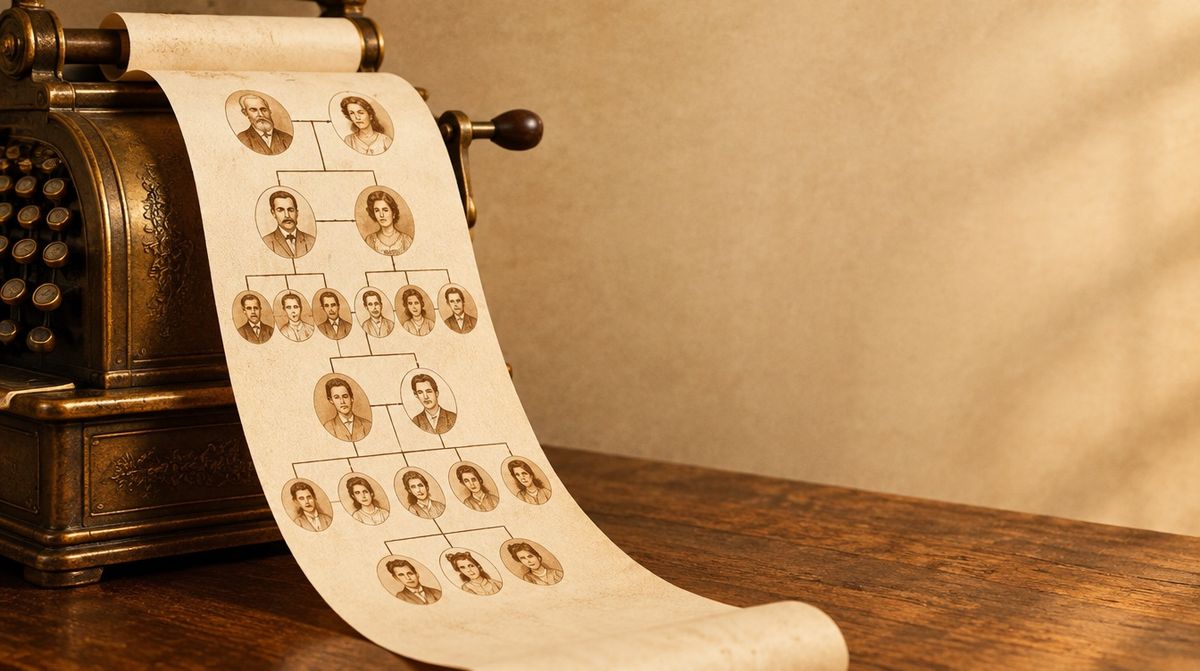
For a month or two at a time, usually yes. As a standing yearly charge, usually no. It depends on whether your family was in US records between roughly the 1850 census and the 1950 one, where Ancestry's indexed records are deepest, and whether you have the hours. On October 20, 2026, the cheapest plan was $24.99 a month.
On April 1, 2022, the National Archives opened the 1950 census, and its own page says it is free to search, by name or by location. This is one sheet of the Census Bureau's 1950 map of Houston, where each orange number marks an enumeration district, the patch of streets one census taker covered.
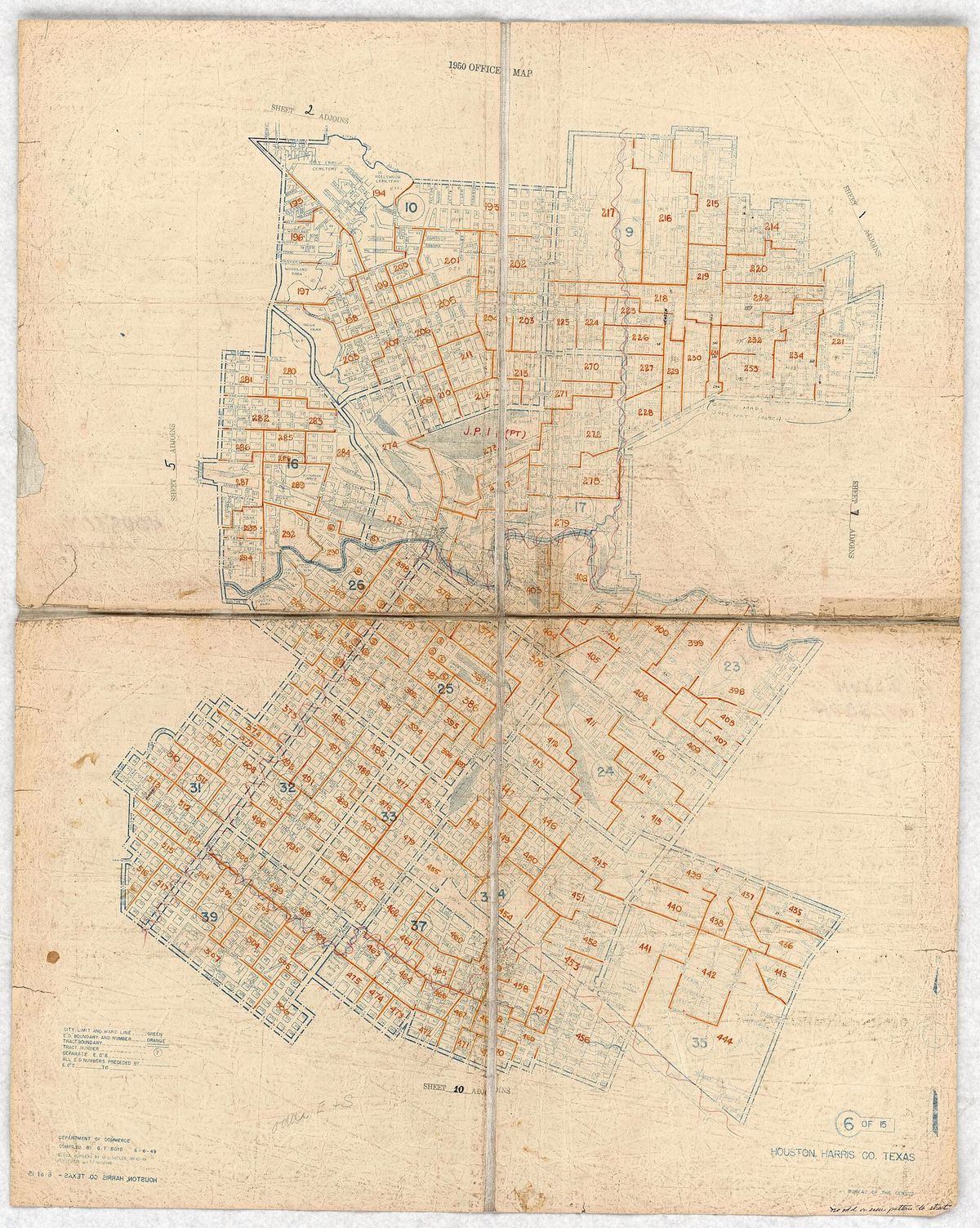
That map is why the free census site is my first stop. Software built both the National Archives' name index and Ancestry's, and the Archives says its index is not 100-percent accurate. If a relative seems missing, search by location before you decide the census missed them.
What can I do on Ancestry without paying?
More than the ads suggest. Family Tree Magazine keeps a guide to using Ancestry free, updated in August 2026; these are the routes I'd point to:
- Build a tree. The tree builder is free, and Ancestry's help page says canceling a membership doesn't delete your trees. One commenter in a July 2021 thread on r/Genealogy keeps a tree there with no active membership.
- Browse the card catalog. It lists more than 33,000 collections by the magazine's count, so you can see which ones cover your county and years before you pay.
- Read record previews. A search in a paid collection returns a partial index line (the searchable list that points to a record): a name, a year, a place. Enough to know the record exists, not enough to read it.
- Use the free collections. The magazine lists the 1880 US census among the free index collections and says the 1950 census is free to view with a free account. Ancestry's plan page describes a limited free set that includes select census, marriage and immigration collections.
- See your DNA matches. The magazine says you can view results and contact matches without a subscription once you have bought a kit. A September 2024 thread on r/Ancestry opened with a user complaining that more match detail now costs a subscription.
What the free account doesn't do is open the record image in a paid collection. That image is what you are deciding about, so here is one.
Example: one sheet of the 1910 census, Lufkin, Texas
This sheet is from the 1910 census: Lufkin, an incorporated town in Angelina County, Texas, enumerated April 20, 1910. Columns 12 to 14 give each person's birthplace and each parent's, to the state or country. Columns 10 and 11 give a mother's children born and children living.
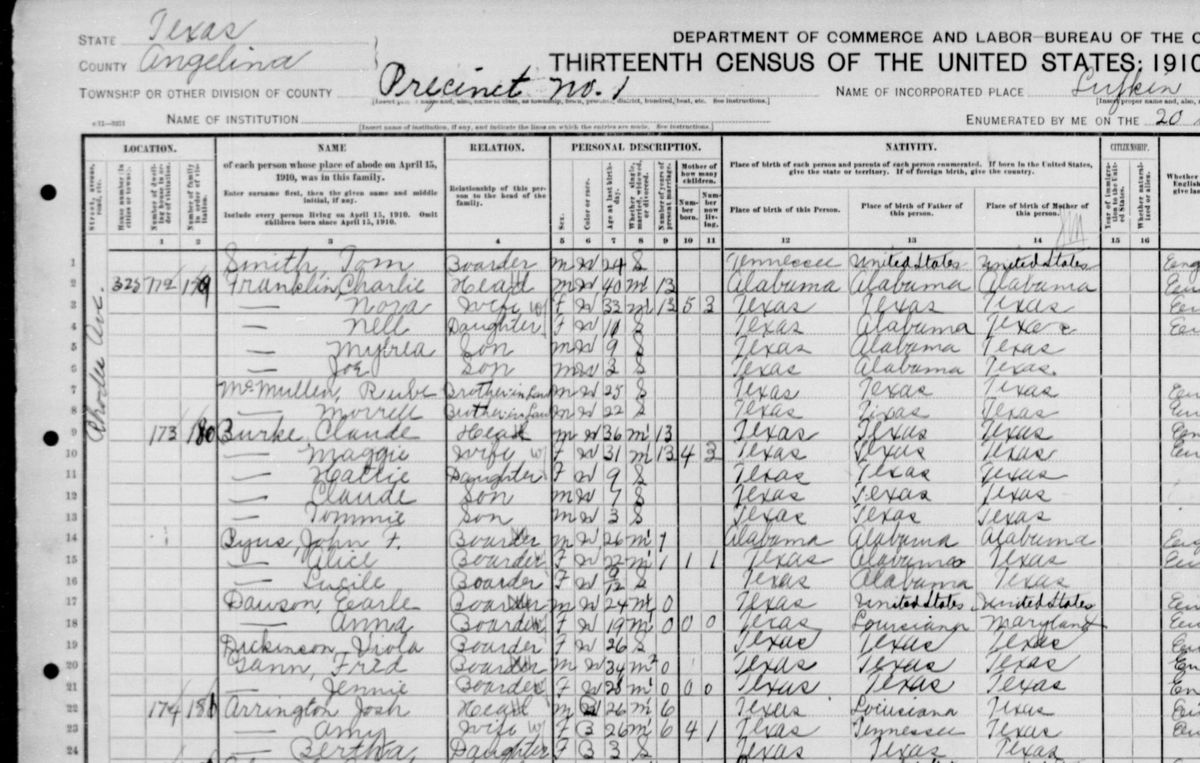
Ancestry sells images like this one by subscription. The National Archives' online catalog has this sheet free, though in my search the Texas sheets there covered only a few counties, so don't count on finding your own family.
In the household that starts on line 22, the wife's line says four children born and one living, and one child, a 3-year-old daughter, is listed under her. The sheet doesn't say who the other three were or what happened to them. A baptism or a burial record might.
The sheet proves who was counted in that house on April 15, 1910, the date printed in the column headings, and what someone told the census taker. A census is a snapshot, and it goes stale. The 1900 census counted people as of June 1, 1900, and the hurricane struck Galveston on September 8, 1900. The National Park Service says between 6,000 and 8,000 people in the city died, and a 1900 sheet can't tell you who lived through it.
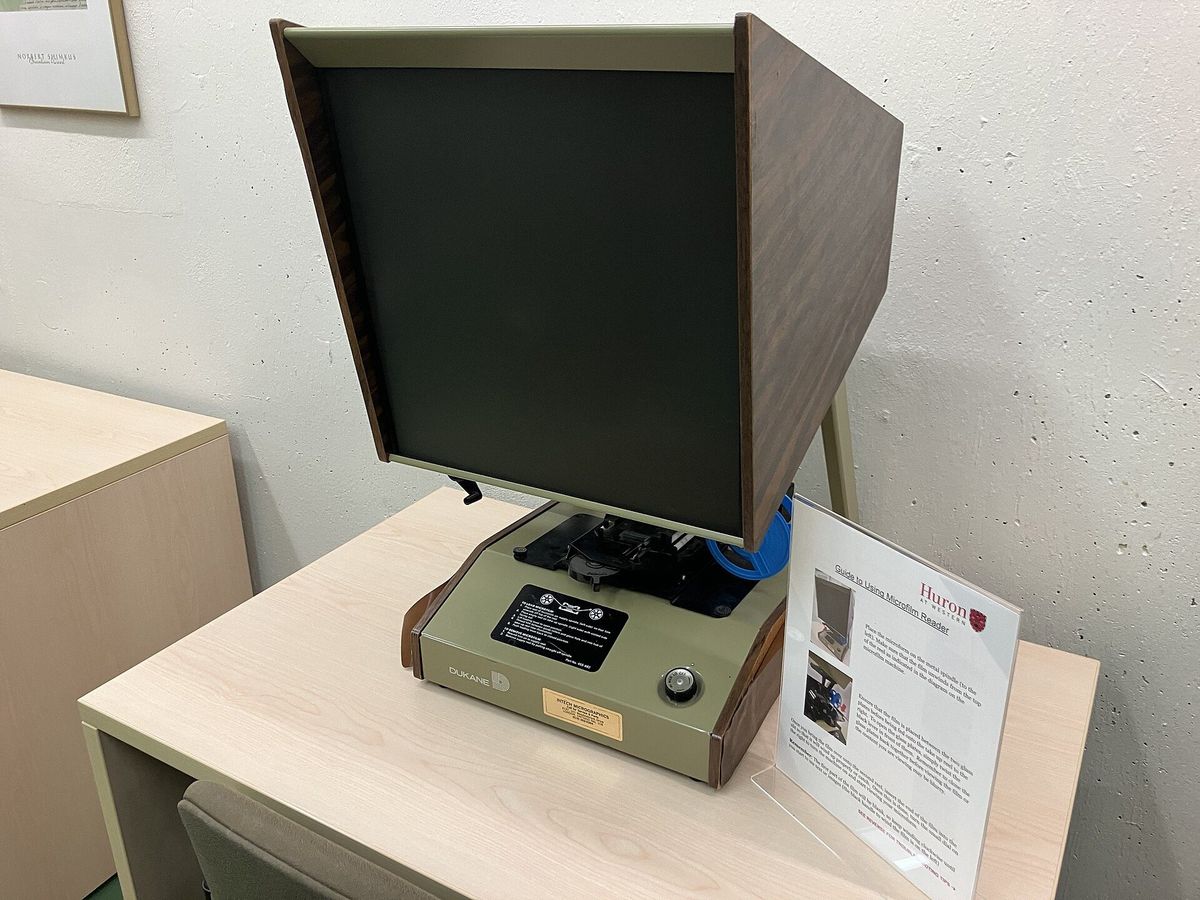
The Archives' catalog says this sheet comes from its microfilm publication T624, the 1910 census. Ancestry's page for its 1900 collection says its images come from the Archives' T623, 1,854 rolls. Microfilm is a roll of photographed pages, read through a machine like this one. I don't know whether your library keeps the rolls, so ask.
Can I use Ancestry free at the library?
Often, yes; it was the top answer in three of the four threads I read. Ancestry Library Edition is the version libraries buy. The Topeka & Shawnee County Public Library's guide, dated May 22, 2025, says it is for in-library use only. Commenters in the 2021 and 2023 threads said their libraries let them use it from home.
Remote access is a moving target. Durham County Library in North Carolina announced on November 24, 2021 that its temporary pandemic access from home would end December 30. Ancestry's help page says what you see depends on the access your library provides.
In Houston, the library's Family History Research Center sits on the Clayton Library campus at 5300 Caroline Street. Its page lists Ancestry.com and Fold3 among its subscription databases but doesn't say which work from home with a MYLink library card, so I would call first.
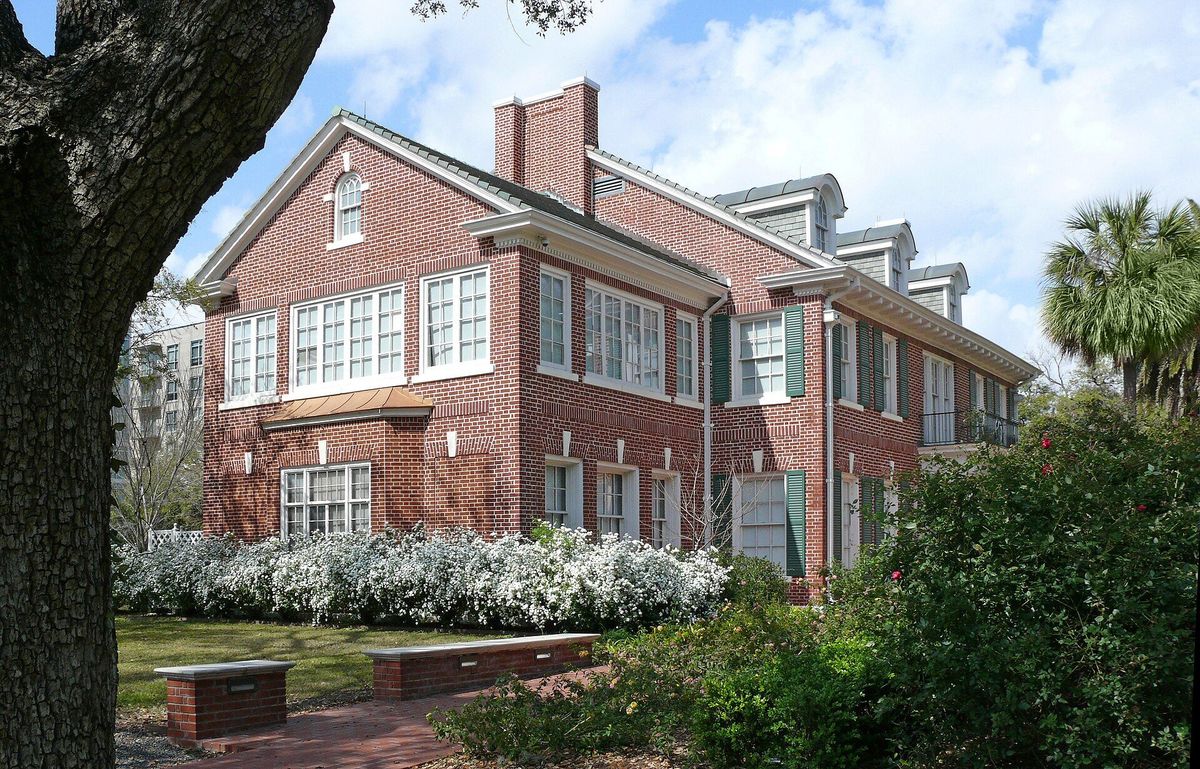
The National Archives does the same on a bigger scale. Its Online Databases page says Ancestry.com and Fold3 are free from Archives.gov links while you are at a National Archives facility, and carry a fee from anywhere else.
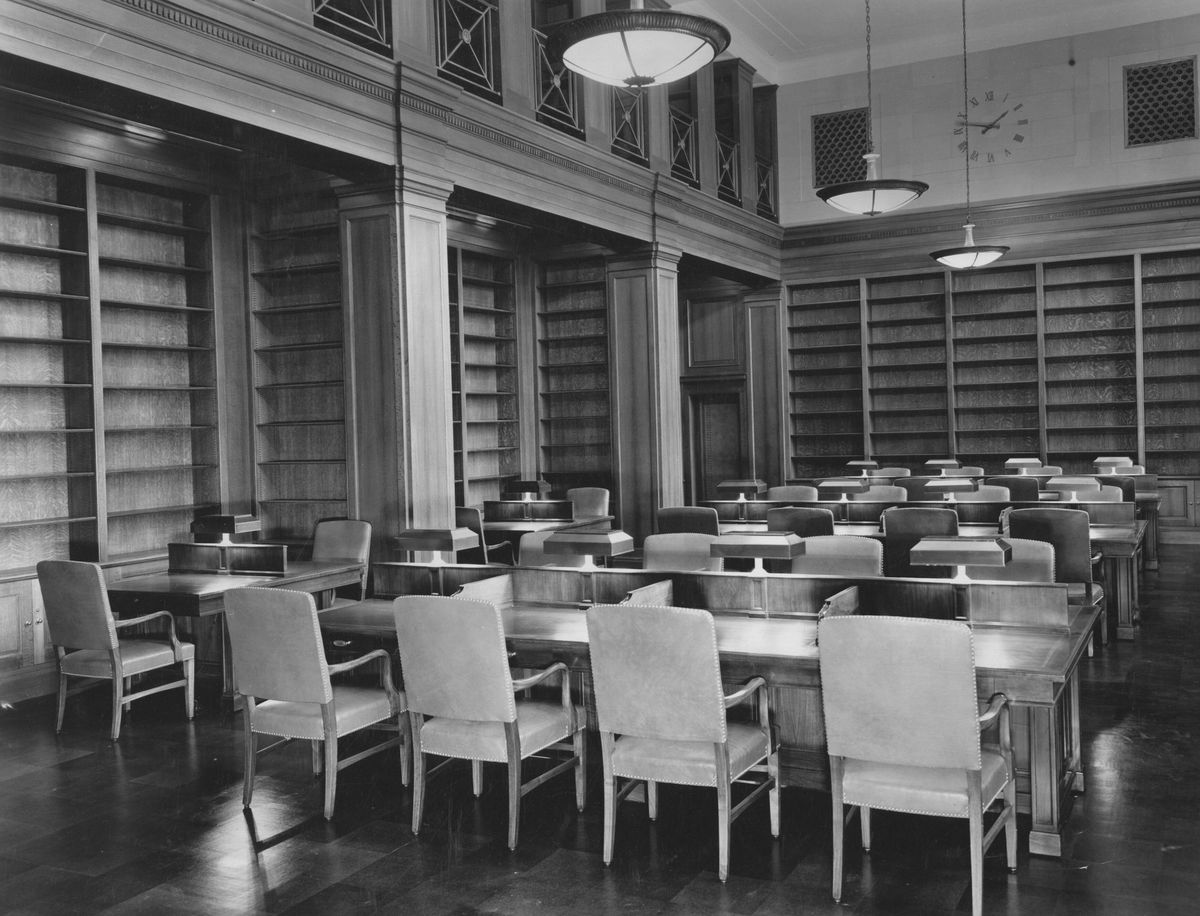
What the library edition leaves out is a community report I haven't confirmed with Ancestry: no sign-in to your own tree or DNA, no messaging, and some collections missing, newspapers among them. Treat that as a pointer. People in the threads work in two tabs, a free personal account and the library edition, and attach downloaded images by hand. Slower than accepting a hint (Ancestry's suggested match), and better: a record you type is one you looked at.
What does Ancestry cost right now, and how does the free trial work?
These prices come from Ancestry's own plan page on October 20, 2026, which showed a sale ending at 10 a.m. Eastern that morning. They change, so open the page before you believe me:
- U.S. Discovery, all US records: $24.99 a month, or $119 for six months up front (sale price $59).
- World Explorer, US and international records: $39.99 a month, or $179 for six months (sale price $84).
- All Access, which adds Fold3 (military records), Newspapers.com Publisher Extra and four extra accounts: $59.99 a month, or $269 for six months (sale price $129).
For a Texas census sheet like the one above, the cheapest plan is enough, because U.S. Discovery covers all U.S. records.
Every plan auto-renews, and a sale price renews at list price. The plan page says to cancel at least two days before renewal; the terms say two business days for a monthly plan, so count the longer one. A six-month plan paid up front can be refunded in full in its first 14 days, but only in your first subscription term and only if it didn't start with a trial.
The trial is two weeks of whichever plan you pick, and it needs a payment method on file. Ancestry's help article says canceling during the two free weeks ends the trial at once, with no charge. So cancel on day thirteen and day thirteen is your last day.
The renewal terms say to cancel at least two days before the trial ends, and they allow one free trial per user. So a trial is about twelve usable days; take it when you have time to spare. Sale reports fill the 2023 thread, so never pay list price in a hurry.
Should I subscribe for a month, a year, or not at all?
The January 2020 thread asked the exact question: sign up for a month, work hard, then carry on alone? The top reply made a fair point, that a deadline makes you rush. My answer is the sprint, with the list built first.
Try this in 10 minutes, before you pay anything:
- Search a relative who was alive in 1950 by name and place on the National Archives' 1950 census site.
- Search the same person in a free FamilySearch account; its blog says it is free of charge to everyone.
- Search Chronicling America, the Library of Congress's newspaper collection, for the surname and town.
- Search Ancestry's free index and write down every record it previews that the other three lacked.
Then run the sprint:
- Finish the free month in how to start family history for free: the interview, the home papers, FamilySearch, the free censuses. A 2021 commenter described exactly this: keep a list, and buy one month of Ancestry when the list gets long enough.
- Buy the month when the list is long and the calendar is clear, and cancel the same day. Ancestry says you keep your benefits until the period ends, so canceling on day one costs only the renewal.
- Download every image and write the citation. Your tree stays on Ancestry after you lapse. The ability to open the records does not.
A year makes sense for the 2021 commenter who was on the site almost every day. The 2023 poster, who expected a few hours a month and would have paid $15, was right to balk at $40; at that pace the library or the sprint wins.
Not at all, if your family's records aren't there. For a Texas and Mexico line, the records that matter most are Catholic parish registers, on FamilySearch and in regional digital libraries. Is FamilySearch really free? covers that side, and how to find Mexican ancestors for free the rest.
The cleanest price test I know: FamilySearch's blog said in 2015 that its Texas Deaths, 1890 to 1976 collection holds more than 4.5 million records, and that a certificate there generally shows the cause of death, the physician, the funeral home and the burial place. The state sells the first certified copy for $20.00. Order one when you need a legal document; for research, the free image usually does the job.
What would the month be for? Records Ancestry holds in bulk. Its yearbook collection says it added 11,557,060 records on August 7, 2026, and its city directories cover 1822 to 1999. I can't say no free site has them, only that I'd check first.
Example: a city directory page, Corsicana, Texas, 1889
A city directory is a book of residents, usually with an address and a trade. Ancestry says its directories were indexed by software, not transcribed. The Library of Congress has the Official Directory of Corsicana, Texas, for 1889 online.
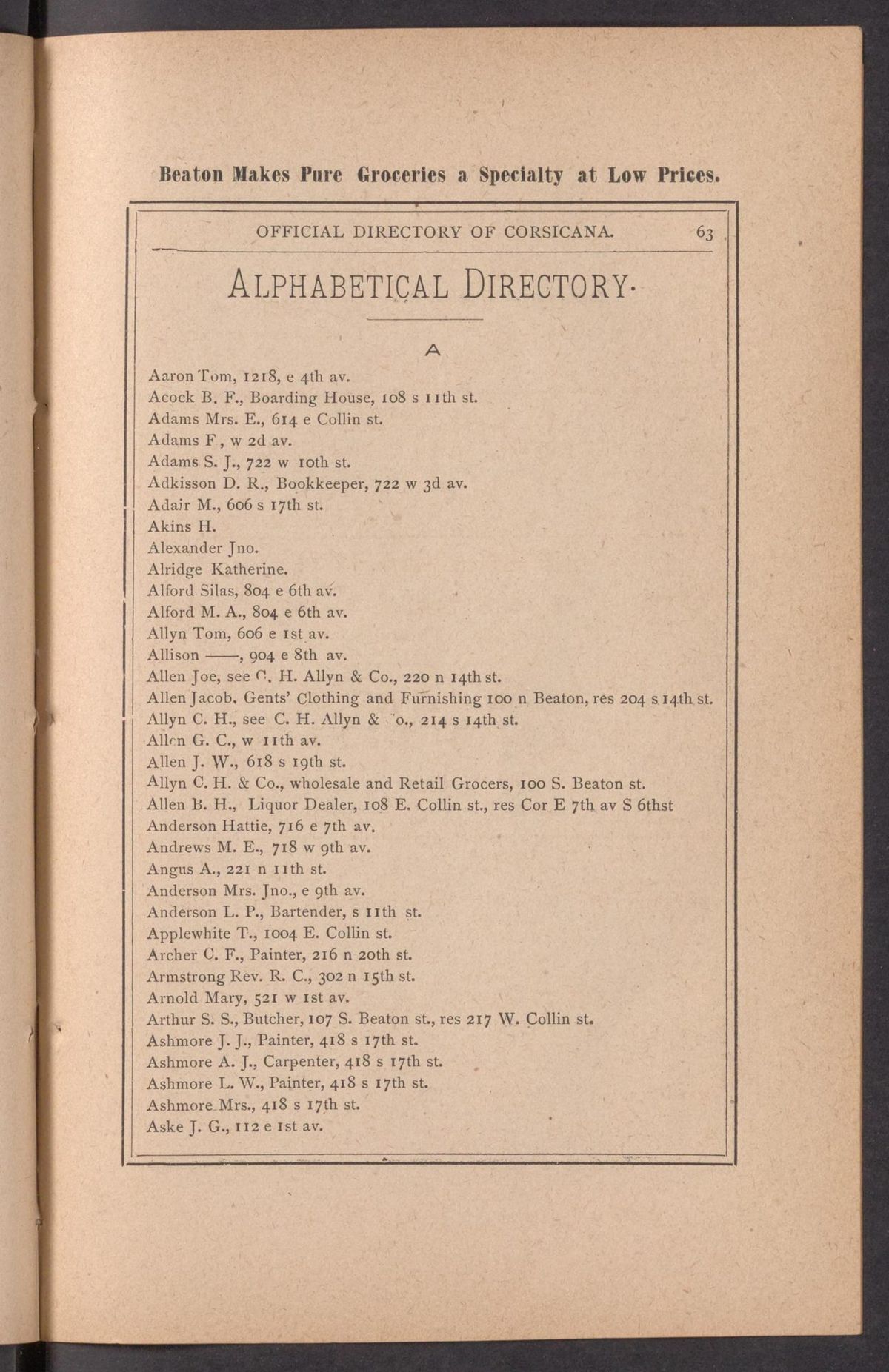
Look at the Ashmores at the bottom. The page doesn't say who is married to whom, but it points to a household you can test against other records. Much of the next census, 1890, burned, as Ancestry's 1900 collection page notes, so directories can fill part of the gap.
Example: a newspaper page, Houston, September 11, 1900
For newspapers, try Chronicling America first. The Library of Congress says it holds millions of pages published through 1963, and I found the Houston Daily Post for September 9 through 14, 1900, there. All Access adds Newspapers.com Publisher Extra; I'd read the free pages first.
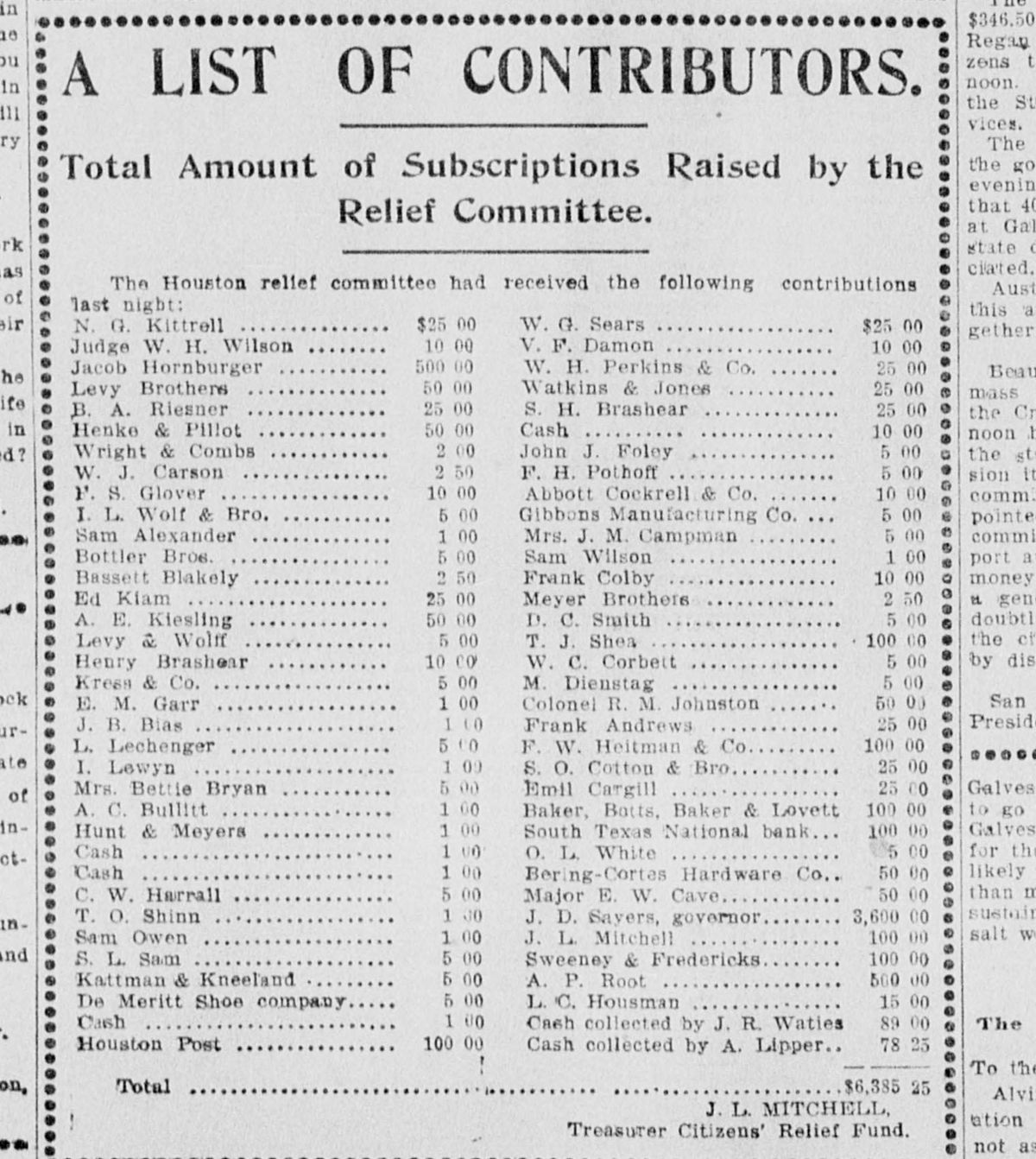
That list names the people and firms who gave to Houston's storm relief fund, down to a total of $6,385.25. It doesn't say where they were born or whom they married. Next, look for the same names in the 1900 census.
Example: a hint that points the wrong way
In 2019 a professional genealogist described Ancestry's potential-parents suggestion for a man named William, who married Sarah in 1790. It offered the parents most public trees showed. But two baptisms of William and Sarah's children called him the son of Joseph. She corrected her tree, and Ancestry kept offering Benjamin's parents as Joseph's.
A blogger counted 400 of his own record hints in 2016 and judged 347 right and 39 wrong. That is why I open every record image, and why other people's trees are leads, not proof.
What did a real case cost in subscriptions?
File 001 is my open hunt for the birth year of Padre José Nicolás Ballí, the priest Padre Island is named for. Every record so far is public, so here is the subscription bill.
Example: the burial entry, Matamoros, April 1829
I found it by reading the digitized burial register of Nuestra Señora del Refugio parish page by page on FamilySearch. It was unindexed, so no search box would have surfaced it. It showed that the death date in the Handbook of Texas is actually his burial date, though it gives no age, so it can't fix his birth year. Cost: a free account and hours of pages.
Example: his signature, Reynosa, 1807
The UTRGV Digital Library puts the Reynosa marriage register online free. His name and rubric (the flourish under a signature) appear twice, on marriages he performed in early 1807. Canon law set a minimum age of 24 for ordination, so the latest likely birth year is about 1783, unless he was granted an exception. Cost: nothing.
Example: the 1828 will
The typescript (a typed copy) sits in his 132-page island file at the Texas General Land Office, scanned and online. He names his parents in his own words. The original is missing from the Matamoros archive, which the archive confirmed in September 2026. Cost: nothing, plus a letter and a wait.
Example: a 1944 court opinion
State v. Balli, decided by the Texas Supreme Court in 1944, cites an earlier will of his from 1811. It also quotes the state's land commissioners on papers lost in the steamer Anson's wreck in November 1850. Cost: nothing.
Subscription total: $0. Now the other side. The free route cost time nobody would bill a hobbyist for, letters to two archives, and a dead end.
The one record that would close the case, his ordination file, may survive in the archdiocesan archive in Monterrey, and no subscription reaches it. For a line like this, Ancestry is beside the point. For a family in Ohio in 1900, its search would find in minutes what unindexed images cost in hours. I use both sites.
Is a year of Ancestry cheaper than hiring someone?
Yes, by a lot. At the October 20, 2026 list prices, a year of U.S. Discovery is $299.88 month to month, or $238 as two six-month plans. A year of World Explorer is $479.88 month to month, and a year of All Access is $719.88.
Against that, my 1900 package on the pricing page is from $900 for both sides of your family back to about 1900, with $225 to start and the balance on delivery. The 1800s package is from $2,500, with $625 to start. The $300 Discovery assessment is credited in full toward any package. At checkout your card is authorized, not charged; it is captured only when you accept the written scope and total and I accept the case.
So a year of the cheapest subscription is a third of my cheapest package. A subscription buys access, and your hours do the work. A package buys the hours and a written result: every person tied to the record that proves them, with a trail that includes the dead ends.
If you have the hours and the line sits in US records, subscribe for the month and keep the $900. If you have started three times and quit, or the line crosses a border or a language, the $299.88 buys a year of not getting there. I can't produce a record that burned or was never written, and my pricing page says depth is a target, not a promise. What professionals charge has figures to compare against mine.
The honest sequence is the free month, then the sprint, then an assessment if the sprint ends at a wall. Most people never need the third step.
If you'd rather have this done, start with the $300 Discovery assessment; it's credited toward any package. It tells you what is possible before you commit to anything larger. Start with the Discovery assessment.
Questions people also ask
What can I do on Ancestry without paying?
Build and keep a tree, browse the card catalog to see which collections cover your places and years, read the index previews that tell you a record exists, search the free collections, and see your DNA matches if you bought a kit. What you can't do is open the record image in a paid collection. That image is the product, and it is what the subscription decision is about.
Can I use Ancestry free at the library?
Many public libraries subscribe to Ancestry Library Edition. At Topeka's library it is in-building only, on the library's computers; some libraries let cardholders use it from home and some don't, so ask yours. People in the threads report that it searches the records but won't sign into your own tree or DNA, so download the images and attach them to your tree yourself.
What are the cheaper alternatives?
FamilySearch first. It is free and carries many of the same US records, plus browsable images that were never indexed. Then the library edition, then a one-month Ancestry plan when your list of records to pull is long. People in the threads also name WikiTree, offline software such as RootsMagic and Gramps, national and state archives, and MyHeritage for German lines; those are pointers, not things I have tested for you.
Should I do a one-month research sprint?
Yes, after the free work is done and your list is long. On October 20, 2026, a month of U.S. Discovery was $24.99; prices change. Cancel the day you buy it, because Ancestry's cancellation page says you keep your benefits until the period ends and canceling only turns off renewal. Download every image before the month runs out.
What happens when I cancel the free trial early?
It ends immediately. Ancestry's own help article says that if you cancel during the two free weeks, the trial ends at once and you are not charged, and its renewal terms say to cancel at least two days before the trial ends. So treat the trial as twelve working days, not fourteen, and know that if you don't cancel, the plan you picked starts billing. The terms allow one free trial and one paid trial per user.
Sources
- Ancestry, Become a member, subscription plans and prices (checked October 20, 2026)
- Ancestry Free Trials, Ancestry Help (checked October 20, 2026)
- Canceling a Membership, Ancestry Help (checked October 20, 2026)
- Ancestry Renewal and Cancellation Terms (checked October 20, 2026)
- Searching on Ancestry at a Library or School, Ancestry Help (checked October 20, 2026)
- 1950 United States Federal Census, Ancestry collection page (checked October 20, 2026)
- 1900 United States Federal Census, Ancestry collection page (checked October 20, 2026)
- U.S., City Directories, 1822-1999, Ancestry collection page (checked October 20, 2026)
- U.S., School Yearbooks, 1900-2016, Ancestry collection page (checked October 20, 2026)
- 8 Free Ways to Use Ancestry.com, Family Tree Magazine (updated August 2026)
- Quick Guide to Ancestry Library Edition, Topeka & Shawnee County Public Library (May 22, 2025)
- Ancestry Library Edition Returns to Library Building Only Access December 30, Durham County Library (posted November 24, 2021)
- Family History Research Center, Houston Public Library (checked October 20, 2026)
- Online Databases, National Archives (page last reviewed September 12, 2024; checked October 20, 2026)
- 1950 Census, National Archives (checked October 20, 2026)
- 1950 Census Enumeration District Maps, Houston, Harris County, Texas, National Archives Catalog (NAID 48301885)
- Photograph of the West Search Room of the National Archives Building, January 6, 1936, National Archives Catalog (NAID 74228264)
- Texas, ANGELINA County, Enumeration District 3, Sheet No. 9A (1910 census, Lufkin Town), National Archives Catalog (NAID 91612528; checked October 20, 2026)
- Search Census Records Online and Other Resources, National Archives (checked October 20, 2026)
- 1900 Census Instructions to Enumerators, U.S. Census Bureau (checked October 20, 2026)
- Galveston Hurricane of 1900, National Park Service (checked October 20, 2026)
- Official directory of Corsicana, Texas, for 1889, Library of Congress
- Chronicling America, about this collection, Library of Congress
- The Houston Daily Post, September 11, 1900, page 8, Library of Congress (Chronicling America)
- Why a Free FamilySearch Account Is a Great Idea, FamilySearch Blog (May 12, 2023)
- FamilySearch's Top 10 Most Searched Record Collections, Collection 8, Texas, Deaths, 1890-1976, FamilySearch Blog (March 5, 2015)
- Costs and Fees, Texas Department of State Health Services, Vital Statistics (checked October 20, 2026)
- How Accurate Are Ancestry.com Hints?, Genea-Musings (September 20, 2016)
- Public online trees, friend or foe?, English Ancestors (February 20, 2019)
- Is an Ancestry.com subscription worth it?, a thread on r/Genealogy (July 2021)
- Is Ancestry worth it? Can it be had much cheaper?, a thread on r/Genealogy (July 2023)
- Ancestry.com alternatives?, a thread on r/Ancestry (September 2024)
- Advice for a complete beginner, a thread on r/Genealogy (January 2020)
- Skeleton Files, Packages and pricing
- Skeleton Files, File 001, The Padre Ballí Birthdate