Almost certainly yes, and almost certainly you can't prove it. If you have European ancestry, the math says everyone alive about a thousand years ago who left descendants is your ancestor, kings included. Showing that line on paper, one parent-child record at a time, is a separate job, and for most families the honest answer is no.
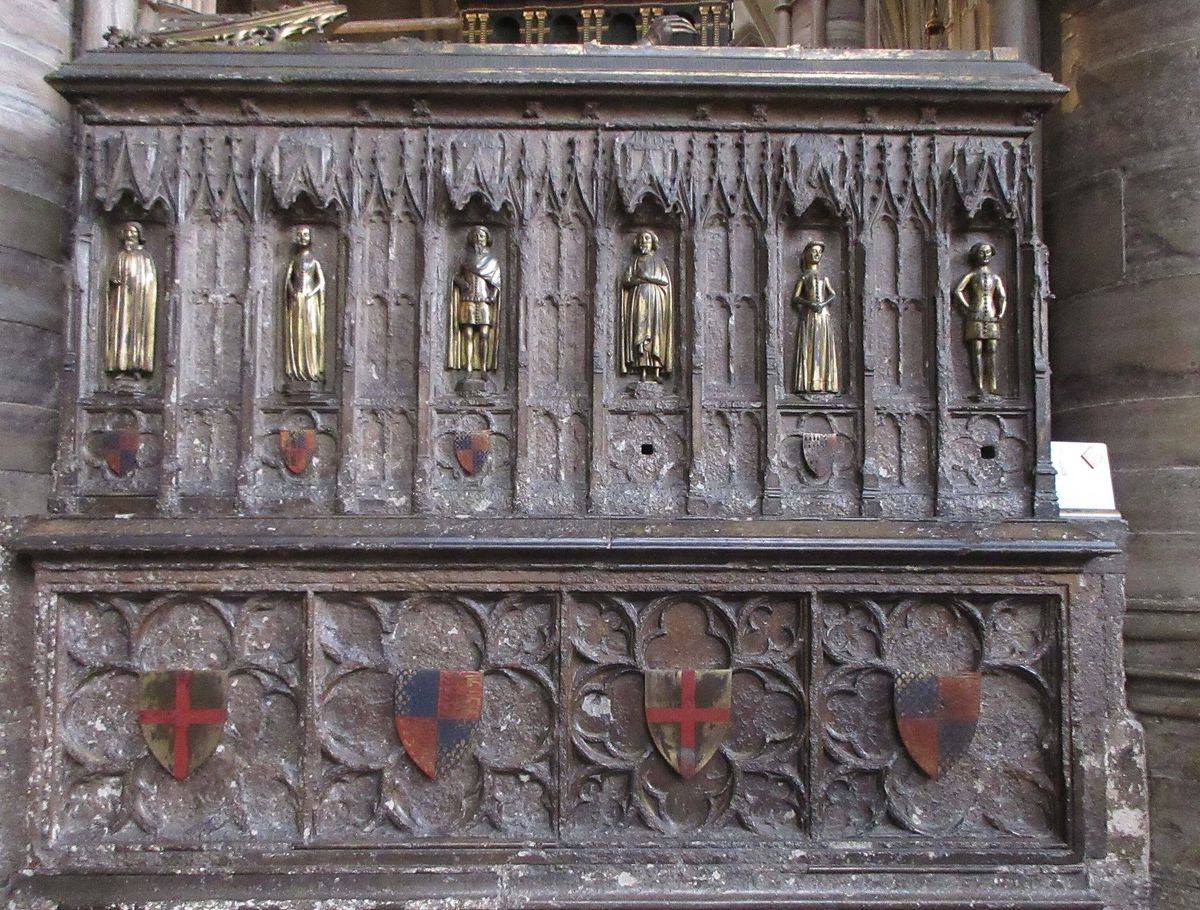
Walk up to the tomb of Edward III in Westminster Abbey and count the small bronze figures set into its side. Figures of six of the twelve children he had with Queen Philippa are still there, according to the Abbey's page on the king. Who Do You Think You Are? Magazine reports that his legitimate and illegitimate descendants are believed to number more than four million.
Why does the math say you're descended from royalty?
Because the number of ancestors you have doubles with every generation back, and the number of people who existed does not. The Larimer County Genealogical Society's chart of ancestor counts runs from 1,024 at ten generations to 1,048,576 at twenty and 1,073,741,824 at thirty.
The only way out is that the same people fill many of those slots. Your ancestors married cousins, often distant ones, and each such marriage folds two branches into one. Genealogists call this pedigree collapse, and the society's page says there are always duplicates; what pedigree collapse is shows it in a real tree.
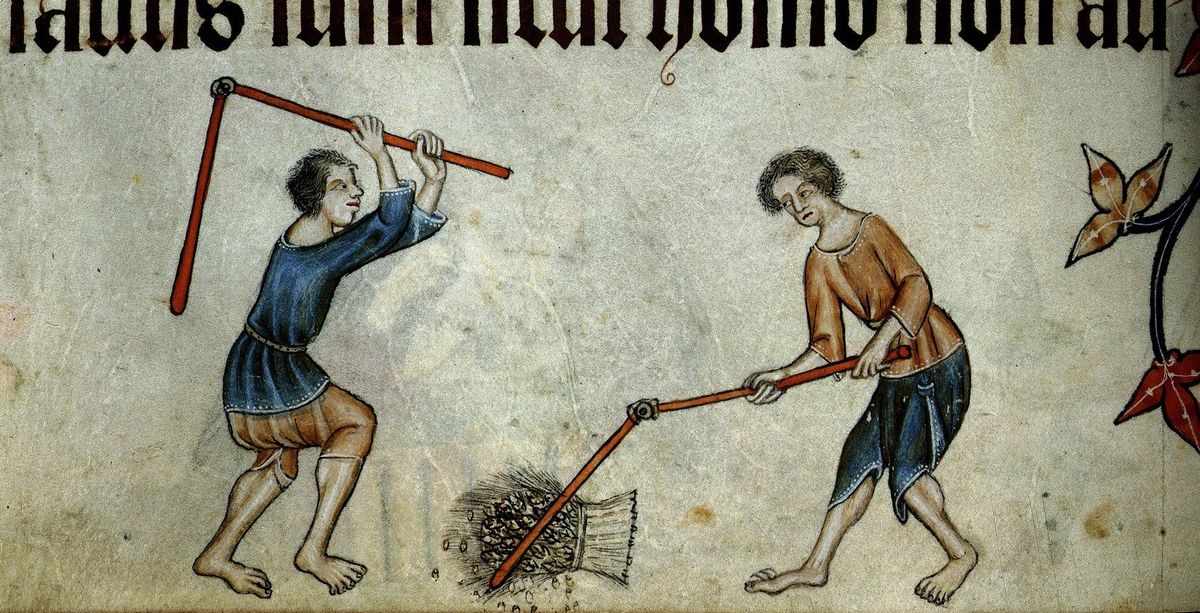
Most of the people filling those slots were not kings. The British Library's catalog of the Luttrell Psalter, a prayer book made in Lincolnshire between 1325 and 1340, lists plowing, sowing and weeding scenes in its lower margins. One shows two men threshing grain with flails.
Example: Forty generations, in numbers
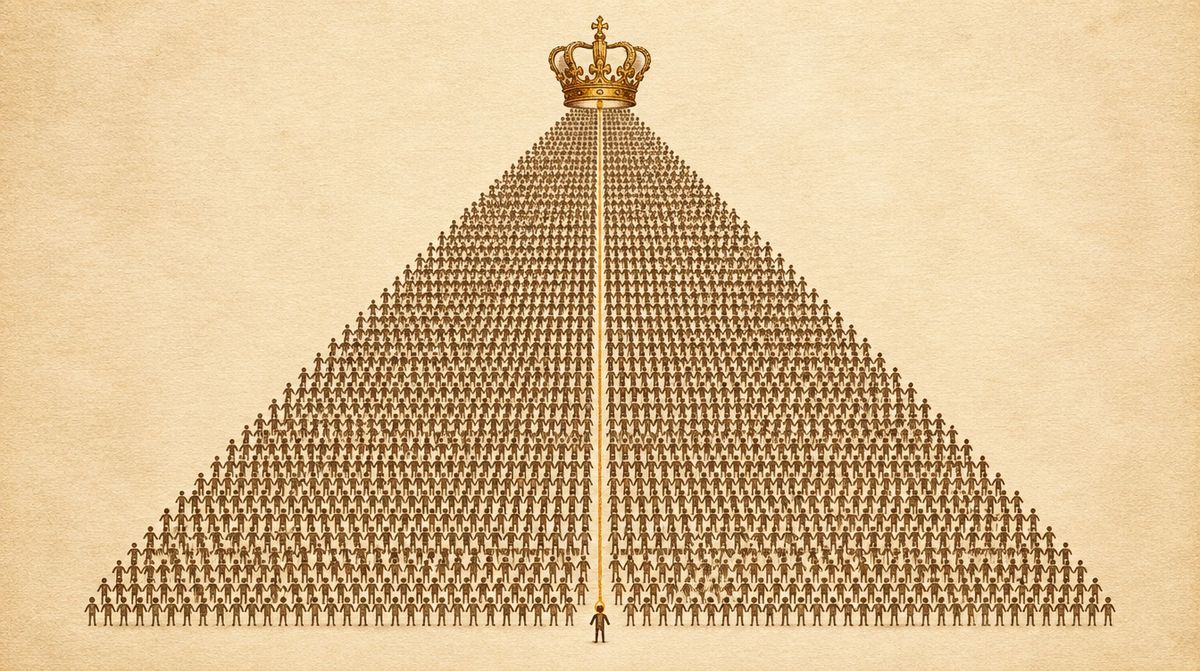
Charlemagne died in 814, roughly forty generations ago at the 29 to 33 years a generation that MyHeritage's guide says recent research supports. Double one forty times and you get 1,099,511,627,776, about 1.1 trillion slots. Census Bureau estimates put the whole world at about 220 million people around the year 800, so each person alive then would fill about 5,000 slots on average. That is my arithmetic, not a measurement.
A 2004 paper in Nature went further. Its two models, which allow for social groups and geographic isolation, put the most recent common ancestor of everyone alive only a few thousand years back. Among people who lived more than a few thousand years before that ancestor, every person alive today has exactly the same set of ancestors.
Is everyone descended from Charlemagne?
If you have European ancestry, the math says yes. A National Geographic piece describes a 1999 model by a Yale statistician, which a 2002 magazine article applied to Europeans: the most recent ancestor shared by all Europeans lived only about 600 years ago.
About a thousand years ago, in that model, roughly 20 percent of the adults then alive left no line at all, and each of the other 80 percent is a direct ancestor of every living European. Charlemagne left descendants, so under the model he is an ancestor of every living European, and the piece says ancestry is less a tree than "a web-like tapestry."
That was mathematics until 2013, when a study in PLOS Biology, covered by NBC News, used the DNA of 2,257 Europeans to estimate that two people from opposite ends of Europe still share millions of common genealogical ancestors from the last 1,000 years.
Even Charlemagne's face is a guess. Albrecht Dürer painted the portrait that still shapes how people picture him around 1511 to 1513, almost 700 years after Charlemagne died. The Germanisches Nationalmuseum, which displays it on loan from the city of Nuremberg, says in its catalog that no true-to-life contemporary portrait existed for Dürer to copy, and that the crown, mantle and sword shown were all made after Charlemagne's death.
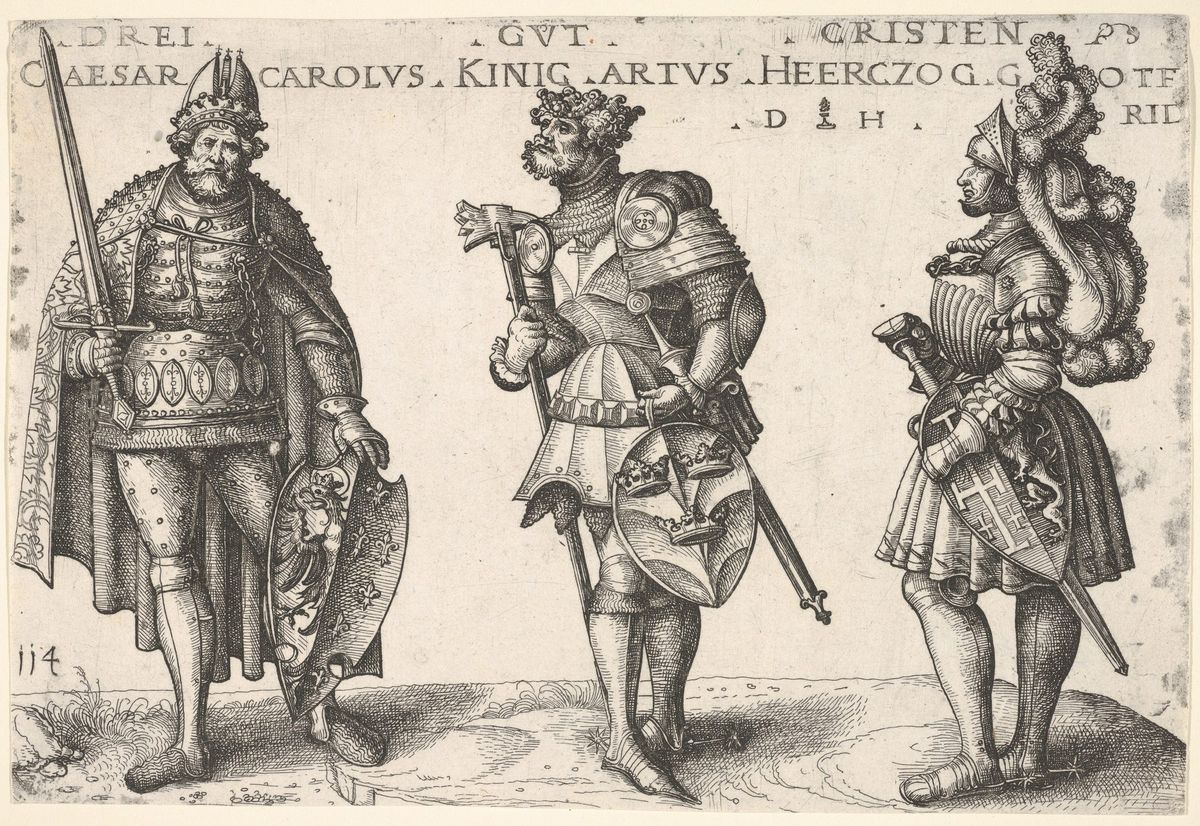
Dürer was not the only artist guessing. In an etching of about 1516 by Daniel Hopfer, after Hans Burgkmair, the figure at the left is labeled Caesar Carolus, and the Metropolitan Museum of Art titles the print as showing Charlemagne. He wears a crown, a cloak and armor, and he holds a sword and a shield bearing an eagle and fleurs-de-lis.
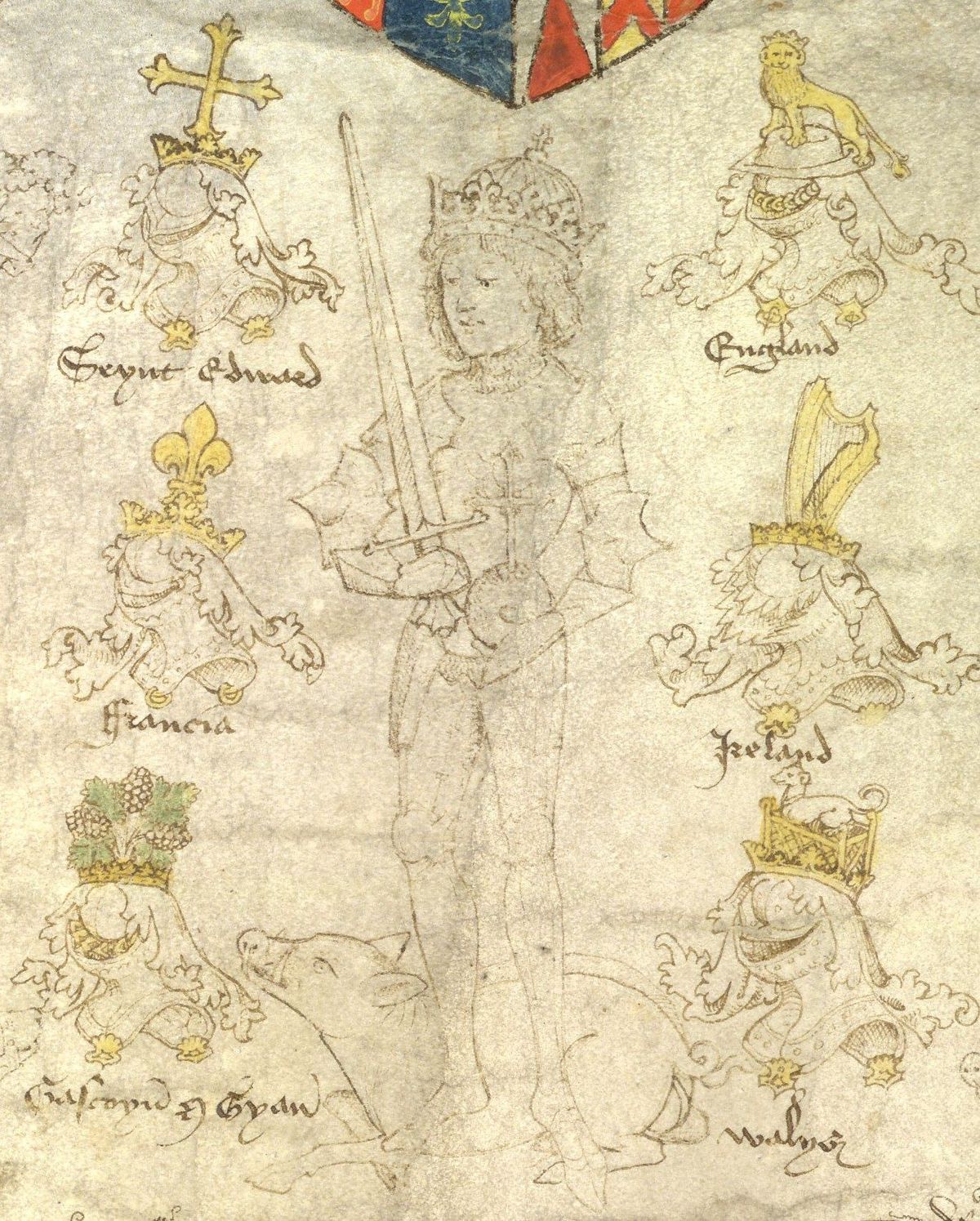
People in the 1480s were already drawing the line. The Rous Roll, made about 1483 by a priest named John Rous, is an illustrated roll of the Earls of Warwick, according to the British Library's catalog, and after the drawings comes a large diagram of the descent of the Anglo-Saxon and English kings from Charlemagne. That is the catalog's description; I haven't checked the diagram.
Being descended from Charlemagne, in this sense, is like being made mostly of water: true of everyone, and no information about your family in particular. The question that matters is whether you can show the line.
What is a gateway ancestor?
A gateway ancestor is the person in your tree through whom a documented royal line enters; the magazine defines one as an ancestor "who links your family to nobility." Nobody proves a royal descent one generation at a time from themselves to a king. The upper generations of noble families were worked out and published long ago, in the heralds' visitations (county-by-county surveys of noble and gentry families and their coats of arms, made from the early 1500s to the late 1600s) and in peerages like Burke's.
Findmypast's guide describes the two-part job: trace your own family back as far as the records allow, then connect your ancestors to known royal genealogies. The magazine adds: take some lines back to the 17th century, use probate records (the court paperwork around a will, which names children and in-laws), and follow the female lines. It also warns that the heralds' pedigrees may not always be accurate, because families wanted noble ancestry and heralds could not easily check their claims.
For American families there is a shortcut, a compendium of immigrants whose royal lines have been worked out. One is The Royal Descents of 900 Immigrants, now in its second edition (October 2022), which treats 993 immigrants. Its author wrote in a 1999 note that new discoveries were then "slightly outnumbering disproofs."
Example: A page of Burke's Peerage
Burke's Peerage is a printed directory of noble families. Its 31st edition, from 1869, is free on the Internet Archive, and its introduction has a section called The Royal Family. At the top of page xx it prints Thomas of Brotherton, Earl of Norfolk; his daughter Margaret; and her daughter Elizabeth, who married John, Lord Mowbray, and was grandmother of Margaret de Mowbray, wife of Sir Robert Howard. Of that Howard the page says:
from whom the Dukes of Norfolk derive. (Burke's Peerage, 1869, page xx)
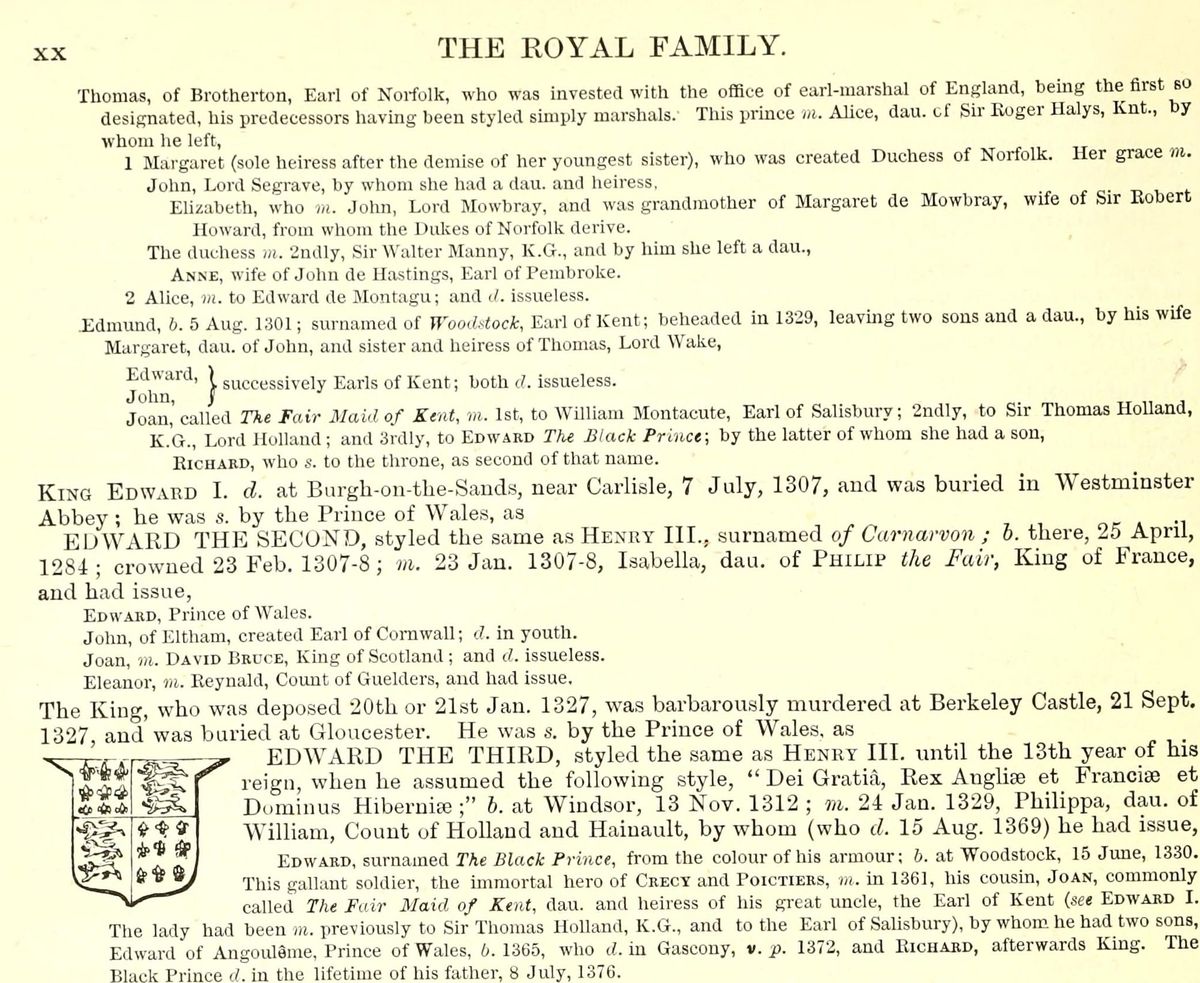
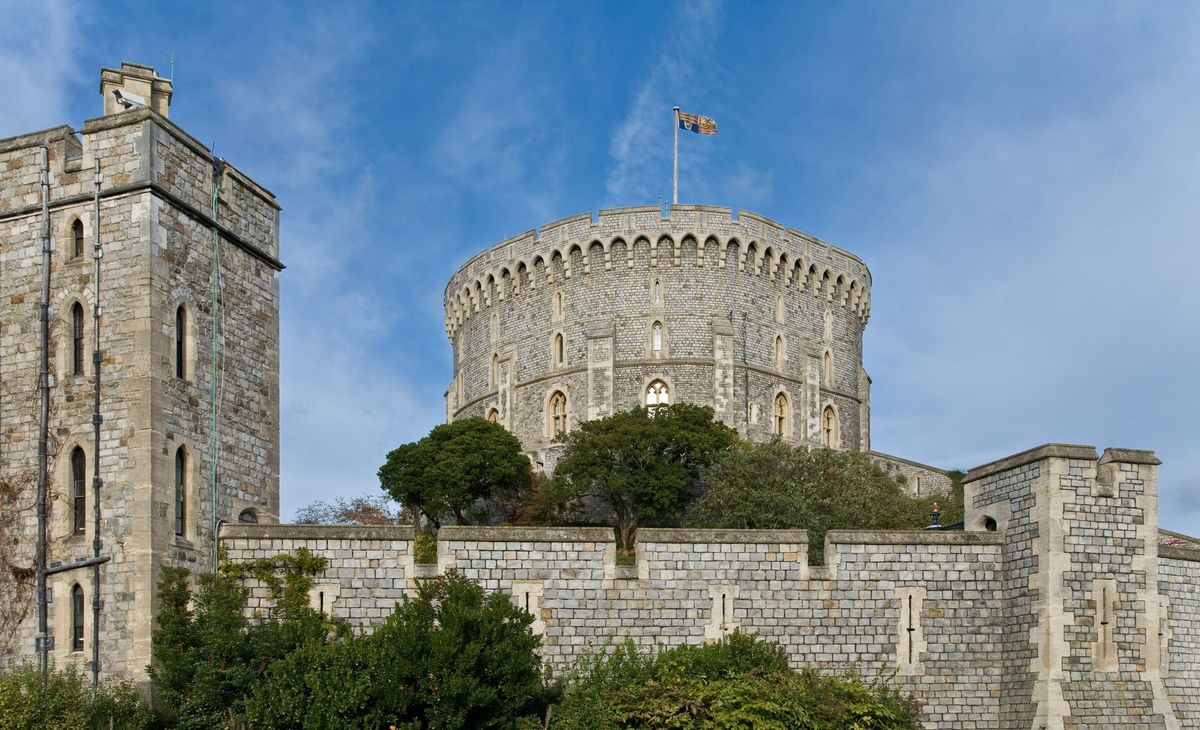
Lower down, the page says Edward III was born "at Windsor, 13 Nov. 1312."
What the page states: three links, no dates for the middle generations, no sources. What it proves: that a Victorian compiler printed these links, not that any record made at the time names these parents and children. Next, use it as a map and look for the wills, monuments and church records behind each link.
What is the difference between being descended and proving it?
Descended is a statement about the whole population. Proved is a statement about documents, one record for each generation.
The Mayflower Society shows the standard at scale. To join you must prove direct lineal descent from a passenger who stayed to establish the colony, and its Silver Books project, which began in 1959, exists mainly to verify lineages. Even so, the Society says the books sometimes need corrections, which must come with clearly cited evidence.
Example: Three Virginia governors and a monument in Westminster Abbey
In St. Edmund's Chapel at Westminster Abbey, a wall monument stands near the grave of Katherine Knollys, who died on 15 January 1569. Its inscription, transcribed by the Abbey, says she and "the Lord Hundesdon her brother" were children of William Carey and Lady Mary, daughter of Thomas Boleyn, Earl of Wiltshire, and sister to Queen Anne. The Abbey counts sixteen children, and one daughter, Anne, married Thomas, Lord De La Warr.
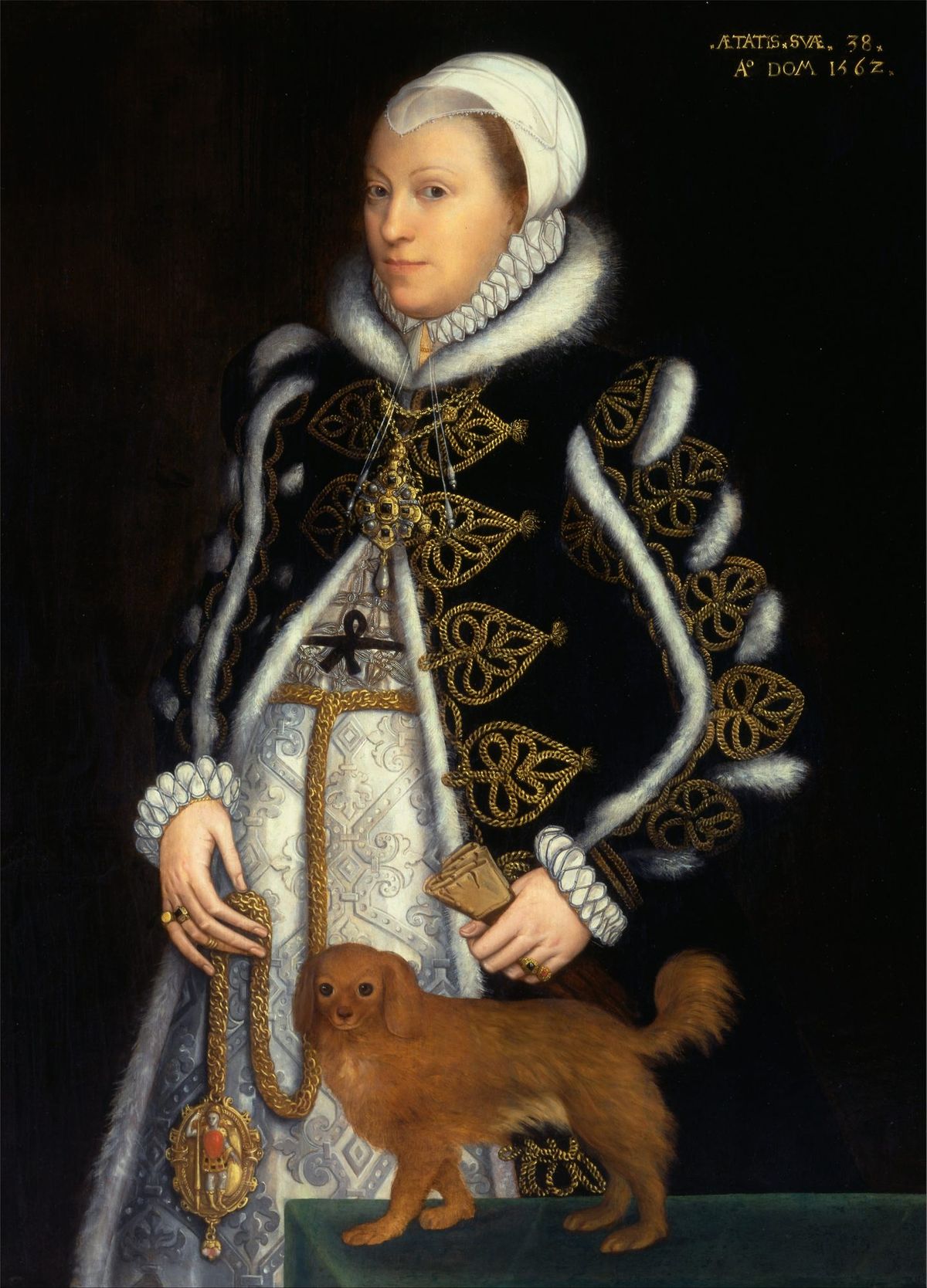
Encyclopedia Virginia names Thomas West and Anne Knollys West as the parents of the Lord De La Warr who governed Virginia in 1610 and 1611, and says two of his brothers also served as governor. Its list dates Francis West to 1627 to 1629 and John West to 1635 to 1637. Delaware Bay, and through it the state of Delaware, was named for the eldest of the three, Delaware's environmental agency says.
That makes three Virginia governors who were great-grandsons of Mary Boleyn. Above her, the line runs into print: Burke's 1869 edition says her mother Elizabeth was a daughter of Thomas, Duke of Norfolk (page 862), and its Norfolk entry (page 828) carries the Howards back to Thomas of Brotherton, eldest son of Edward I by his second wife. From John West to Edward I is twelve parent-child steps.
The monument proves that whoever commissioned it named Katherine's parents. It proves nothing about Virginia or about you, and I don't know whether any reader's family connects to the West brothers. If yours claims to, the English half is already in print and on a monument; your work is the American half: wills, deeds, tax lists. Some Virginia counties lost records to war and fire, and the Library of Virginia keeps copies of lost documents found in other courts' files.
Example: One proven link, in my own file
The line I am working in public belongs to Padre José Nicolás Ballí, the priest Padre Island is named for; the full log is on the case page. His will of 6 August 1828, a typescript (a typed copy) at the Texas General Land Office, calls him, in translation, a native of the Villa de Reinosa and legitimate son of Don José María Ballí and Doña Rosa María Hinojosa. That proves his birthplace and parents in his own words. It gives no age, so it gives no birth date.
His burial entry of 16 April 1829 proves his death. His mother's 1798 will, also at the Land Office, names an older Nicolás Ballí, whom the researcher who indexed the Reynosa registers identified as the Padre's grandfather; in my file that is a pointer, not a link. His baptism was likely lost when a flood destroyed Reynosa in 1800, so I am going around the gap, through his ordination file.
Three documents, one proven link, one pointer and one open gap: that is the price of one documented generation, and thirty generations need thirty links. The math says the ancestor is there. The records decide whether you can name him.
How do I check a royal line someone sent me?
Start at the bottom and climb. Every generation needs a record, made at the time, that names both parent and child. Find the first generation without one; everything above it is a theory, however famous the names. How to tell if a record is your ancestor covers the traps.
Try this in 10 minutes:
- Copy the line into a list, one row per generation, and beside each row write the record that names the parent: a baptism, a will, a census page. If the only answer is another tree, write "tree."
- Circle the first row marked "tree" or left blank. Everything above the circle is a theory.
- Find the row where a farmer with a baptism and a burial acquires a father with a coat of arms.
- Subtract the earliest birth year from the latest and divide by the number of generations. Far above 29 to 33 years each is a flag; 1900 back to 1066 in twenty generations is nearly 42.
If the link at the jump is another online tree, you have a lead and nothing more; I wrote about why copied trees fail. If it is a published pedigree, check which one and when it was compiled.
Example: A slip in Burke's
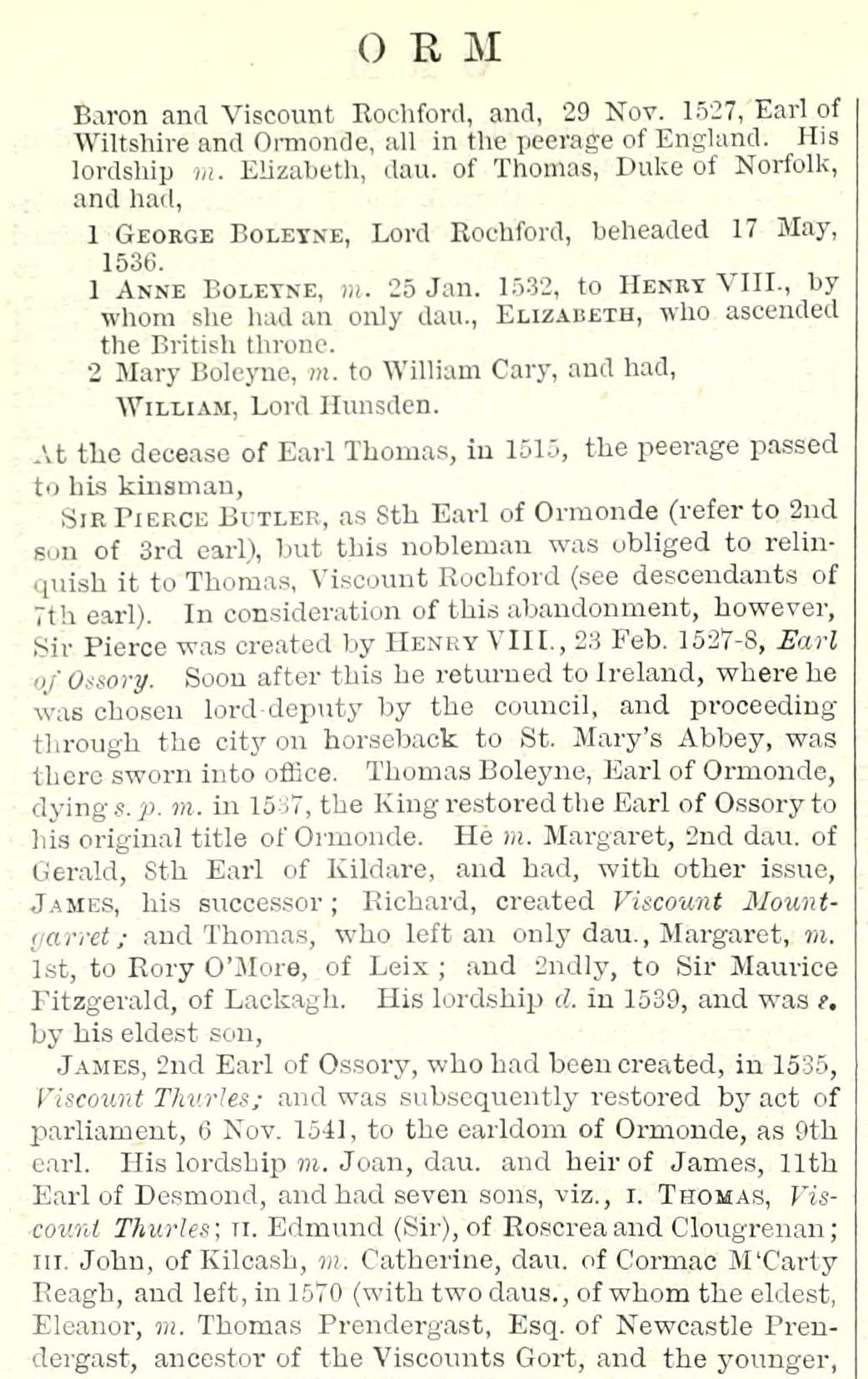
Printed pedigrees slip too. Page 862 of the same edition, in the Ormonde entry, says Mary Boleyne married William Cary "and had, William, Lord Hunsden." The Abbey's page on Lord Hunsdon calls him Henry Carey (1526 to 1596), only son of William Carey and Mary, and the monument names a second child, his sister Katherine. One slip does not sink Burke's; it shows that a printed pedigree is a lead, to be checked against a record made nearer the time.
Example: Gustave Anjou
Perhaps the most notorious royal line made to order belongs to Gustave Anjou, born in Stockholm in 1863. From 1890, when he reached New York, until he died on Staten Island in 1942, wealthy East Coast families hired him to connect them to European royalty. The National Genealogical Society's magazine says he invented connections where there were none and produced fake documents to back them; two articles in 1991 laid out the fraud and his real parentage. Test any royal line from a hired pedigree-maker bottom-up, link by link.
Can a genealogist prove a royal line for you?
Sometimes, and no honest one will promise it before looking.
You can do a lot yourself: read printed pedigrees such as the 1869 Burke's, free on the Internet Archive; check your immigrant against a compendium like The Royal Descents of 900 Immigrants (2022); and prove your own generations from the bottom up. A professional adds speed and judgment about where records sit.
What I can do is build the documented part: your line back as far as the records survive, every parent-child connection tied to its record, the dead ends written down. One direct line into the 1600s, about twelve generations with every link proven, is $6,500 on the pricing page, billed in four equal parts, $1,625 to start and the rest as the research reaches 1800, 1700 and delivery; the 1500s and earlier are quoted case by case. How far back a tree can go explains where the records run out.
What I can't do is manufacture the link. If your line reaches a farmer in 1680 and the registers that would name his parents burned, it stops there, whatever the arithmetic says about the king above him. Depth is a target, not a promise: if a line hits a true wall, billing stops at the last milestone reached and you keep everything found.
A royal-line question is what the Discovery assessment is for: a brick-wall check and a written research plan. At checkout your card is authorized, not charged. After a short call you get the exact scope and total in writing, and the payment is captured only when we have both said yes; if either of us says no, the hold is released.
Are you descended from royalty? Yes, in the way everyone is; proving it is a different job, done one record at a time. If you'd rather have that part done, start with the $300 Discovery assessment; it's credited in full toward any package. Start with the assessment.
Questions people also ask
Is everyone descended from Charlemagne?
If you have European ancestry, almost certainly. A 1999 model by a Yale statistician showed that anyone alive about a thousand years ago who left descendants is an ancestor of every living European, and a 2013 DNA study of more than 2,000 Europeans found the same pattern in shared genetic segments. Charlemagne died in 814, about forty generations ago, and left descendants, so he qualifies. Proving your particular line to him on paper is a different and much rarer thing.
How many ancestors do I have in 30 generations?
On paper, 1,073,741,824 in that generation alone, because the count doubles with each generation back, from 1,024 at ten generations to 1,048,576 at twenty. At about thirty years a generation, thirty generations is roughly nine hundred years, and the whole world then held only a few hundred million people; the Census Bureau's compilation of estimates gives 254 to 345 million for the year 1000. The gap is closed by pedigree collapse, in which the same ancestors fill many slots because your ancestors married distant cousins. The slots are real; the distinct people are far fewer.
What is a gateway ancestor?
A gateway ancestor is the person in your own tree through whom a documented noble or royal line enters. The generations above the gateway have usually been worked out in published pedigrees such as the heralds' visitations or Burke's Peerage; the generations below are yours to prove, one record at a time. Finding one means tracing your line back, often into the 1600s, until it meets a family that appears in one of those published works. A shared surname is not a gateway.
Can I trace my line to Adam and Eve?
No. A senior royalty research specialist, answering a reader's question in 1984 (FamilySearch reprinted the answer in 2013), wrote that in thirty-five years and hundreds of pedigrees he had never seen one to Adam that could be documented, and that no connected European pedigree can be verified before the Merovingian kings, about AD 450 to 752. The lines that bridge the gap he judged to rest on questionable tradition or outright fabrication. If you find one on a shared tree, FamilySearch's own advice is to correct it and ask the contributor for sources.
Why are online royal lines usually wrong?
Because they are copied rather than proven. Most contain a jump where an ordinary family with records is attached to a noble one without any document naming both parent and child, and the jump is then copied from tree to tree. Some rest on pedigrees compiled centuries ago, when families wanted noble ancestry and the heralds recording it had little way to check what they were told. The fix is to find the first generation with no contemporary record and treat everything above it as a theory.
Sources
- National Geographic, "Charlemagne's DNA and Our Universal Royalty" (May 7, 2013)
- NBC News, "All Europeans are related if you go back just 1,000 years, scientists say" (May 7, 2013)
- PLOS Biology, "The Geography of Recent Genetic Ancestry across Europe" (May 7, 2013)
- Nature, "Modelling the recent common ancestry of all living humans" (September 30, 2004)
- U.S. Census Bureau, "Historical Estimates of World Population"
- Larimer County Genealogical Society, "How Many Ancestors Do You Have?"
- MyHeritage Blog, "Counting Generations for Genealogists" (February 20, 2025)
- Who Do You Think You Are? Magazine, "Are you descended from royalty?" (January 5, 2024)
- Findmypast, "How to find out if you're related to royalty"
- Westminster Abbey, "Edward III and Philippa of Hainault"
- Westminster Abbey, "Katherine Knollys"
- Westminster Abbey, "Henry Carey, Lord Hunsdon & Family"
- Encyclopedia Virginia, "Thomas West twelfth baron De La Warr (1576–1618)"
- Encyclopedia Virginia, "Governors of Virginia"
- Delaware DNREC, "Murderkill River? Slaughter Beach? Exploring the Etymology of Delaware's Places"
- Library of Virginia, "Finding What Was Lost: The Lost Records Localities Digital Collection" (March 1, 2013)
- Germanisches Nationalmuseum, Objektkatalog, Gm167, Albrecht Dürer, "Kaiser Karl der Große"
- The Metropolitan Museum of Art, Daniel Hopfer, after Hans Burgkmair, Three Worthy Christians (Charlemagne, King Arthur, and Geoffrey of Bouillon), ca. 1516, object 51.501.386
- British Library Archives and Manuscripts Catalogue, Add MS 48976, "The Rous Roll"
- British Library Archives and Manuscripts Catalogue, Add MS 42130, "The Luttrell Psalter"
- Sir Bernard Burke, A Genealogical and Heraldic Dictionary of the Peerage and Baronetage of the British Empire, 31st edition (1869), Internet Archive
- Yale Center for British Art, "Katherine Knollys (née Carey), Lady Knollys" (B1974.3.22)
- American Ancestors (NEHGS), "Royal Descents, Notable Kin, and Printed Sources: The Best Printed Sources for Medieval Forebears of Colonial Immigrants" (October 15, 1999)
- American Ancestors (NEHGS), The Royal Descents of 900 Immigrants to the American Colonies, Quebec, or the United States, Second Edition (October 2022)
- General Society of Mayflower Descendants, "Join"
- General Society of Mayflower Descendants, "The Mayflower Families Silver Books Project"
- NGS Monthly, "Genealogical Fraud"
- FamilySearch Blog, "I Have My Family Tree Back to Adam and Eve" (January 10, 2013)
- FamilySearch Blog, "I Have My Family Tree Back to Adam and Eve," Part 2 (May 8, 2013)
- Skeleton Files, File 001, The Padre Ballí Birthdate
- Skeleton Files, Packages and Pricing