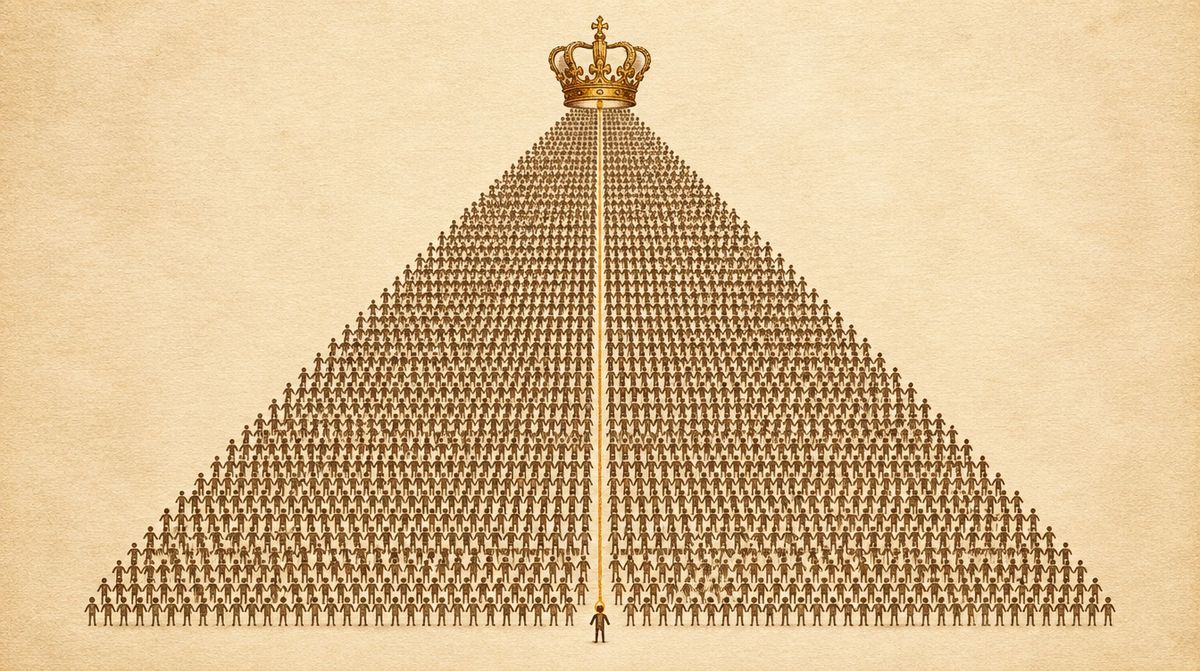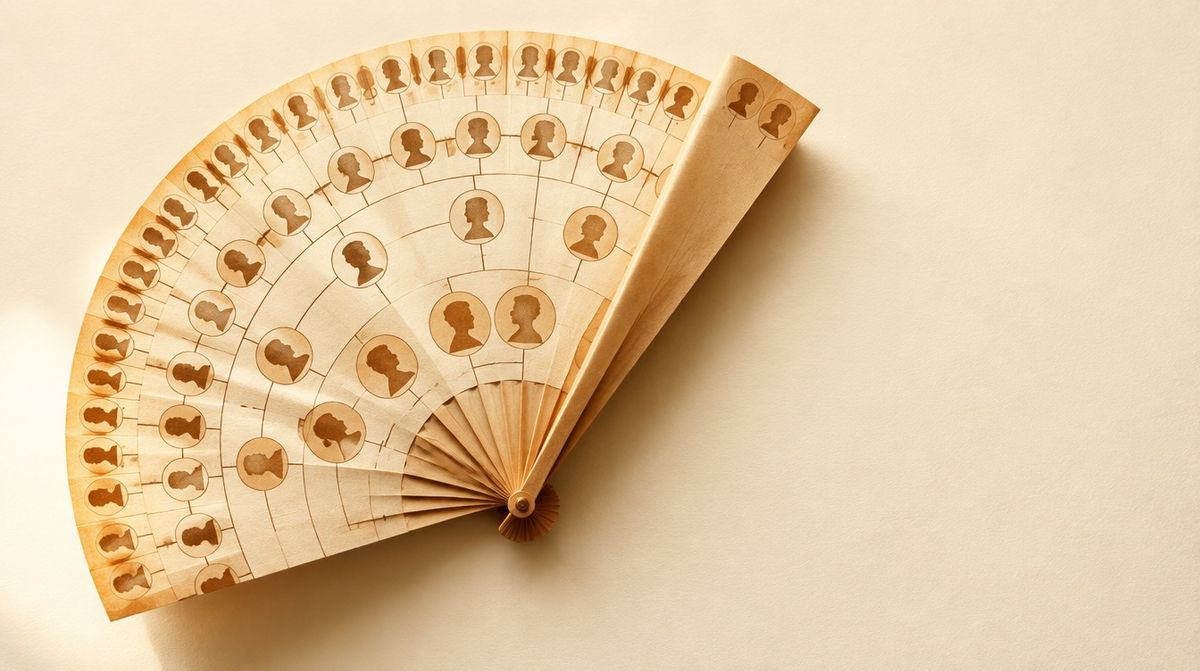
Pedigree collapse is what happens when two of your ancestors were related to each other: their shared ancestors then fill more than one slot in your family tree, so you have fewer distinct ancestors than the doubling math predicts. Everyone has it. The only questions are where it starts in your family and whether it shows on paper.
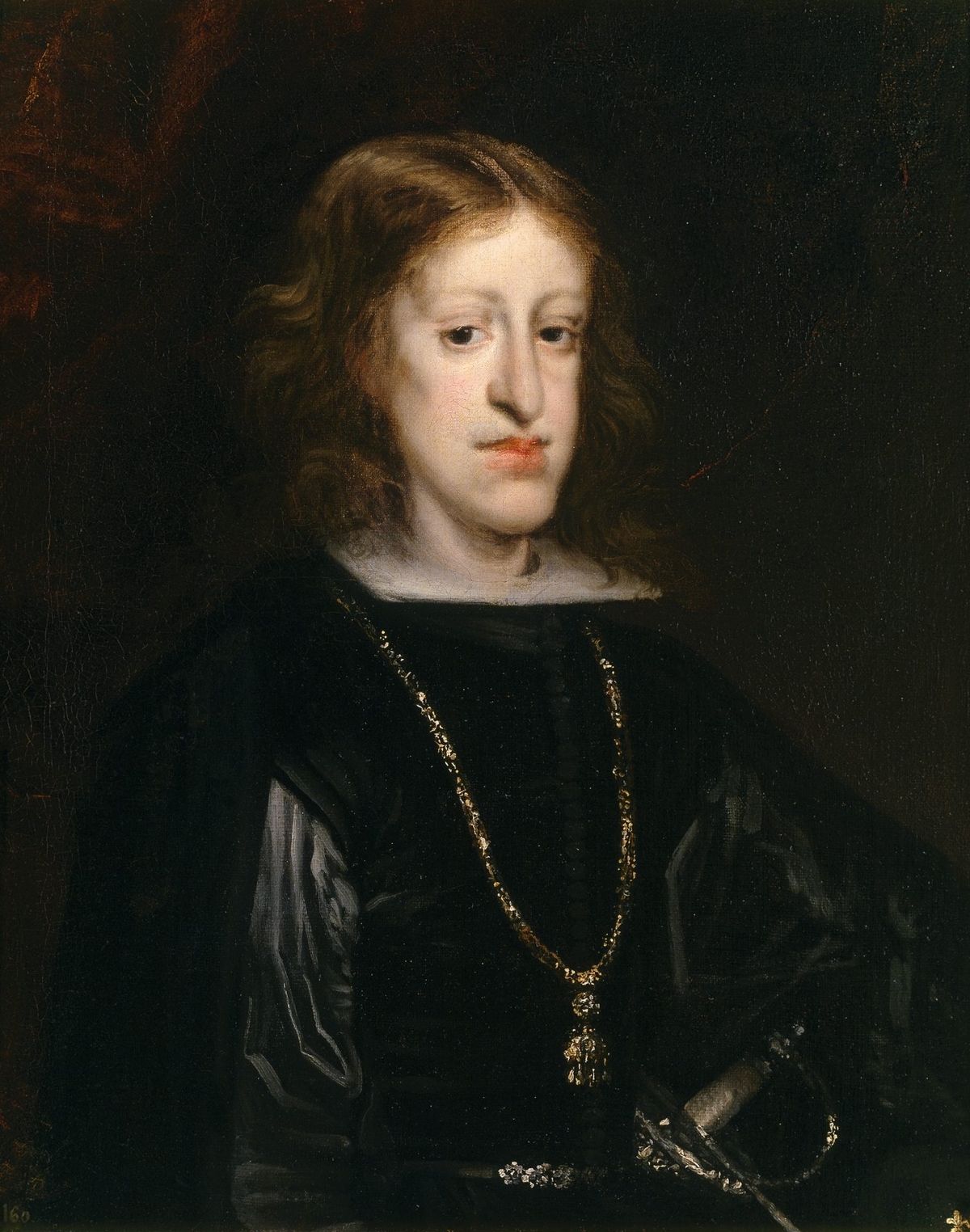
Charles II, the last Habsburg king of Spain, died in 1700 with no children. In 2009 a research team rebuilt his pedigree, 16 generations deep and more than 3,000 people, and calculated his inbreeding coefficient: the chance that both copies of a gene he carried came from one ancestor. It was 0.254, about the figure for a child of a brother and sister. His parents were an uncle and his niece.
Why does everyone have pedigree collapse?
Because the slots in a pedigree double every generation and the number of people who ever lived does not. A pedigree is the chart of your direct ancestors: two parents, four grandparents, eight great-grandparents. The tenth generation back holds 1,024 slots, as Family Tree Magazine's explainer counts it.
At about thirty years a generation, generation 30 sits near the year 1100 for someone born in 2000 and holds 1,073,741,824 slots, while the U.S. Census Bureau's estimates put the whole world at 301 to 320 million people in AD 1100. At generation 40, about the year 800, the slots pass a trillion against 220 to 224 million people alive.
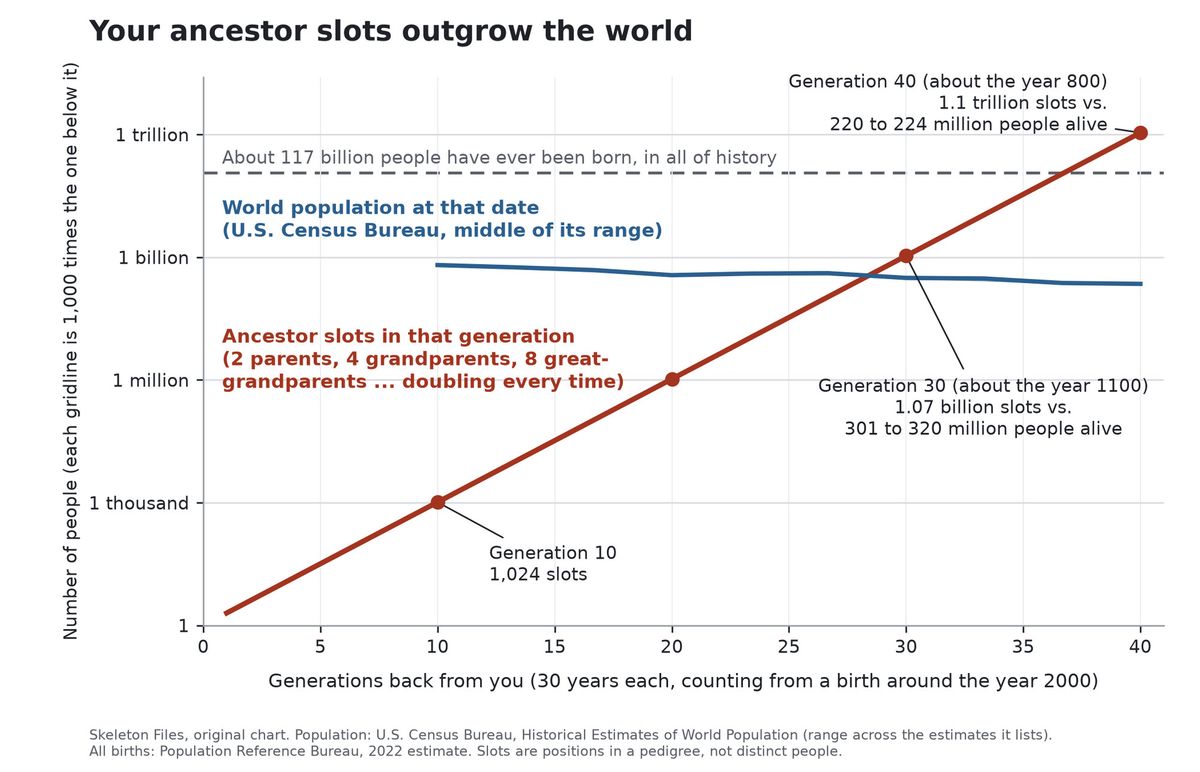
Take a hypothetical, not a claim about anyone: a person born around 1990 whose every ancestor lived in the American colonies has 4,096 slots twelve generations back, about 1630. The Census Bureau's table of colonial population estimates counts 4,646 white and Black people in all of the colonies that year.
So the arithmetic is right and its assumption is wrong. Doubling assumes every ancestor is a different person, and each marriage between relatives folds two branches into one. Far enough back the chart is a web, not a tree: a 2004 paper in Nature modeled it and found, in its models, that the most recent common ancestor of everyone alive lived only a few thousand years ago.
It is also why, with European roots, you are almost certainly descended from Charlemagne and almost certainly can't prove it, the subject of whether you're really descended from royalty.
What does pedigree collapse look like in a real family?
Example: Charles II of Spain, a pedigree 16 generations deep
The record is the research pedigree behind that 0.254, published in PLoS ONE. Of the 11 marriages the Spanish Habsburg kings made, 9 were between third cousins or closer, including two uncle-and-niece marriages. Philip IV's marriage to his niece Mariana produced Charles II.
What it states: an uncle-niece marriage alone predicts 0.125. His was double that because his ancestors had been repeating for generations; his mother's own figure was already 0.155, and for most of the kings the numbers were not settled until the pedigree reached ten generations deep.
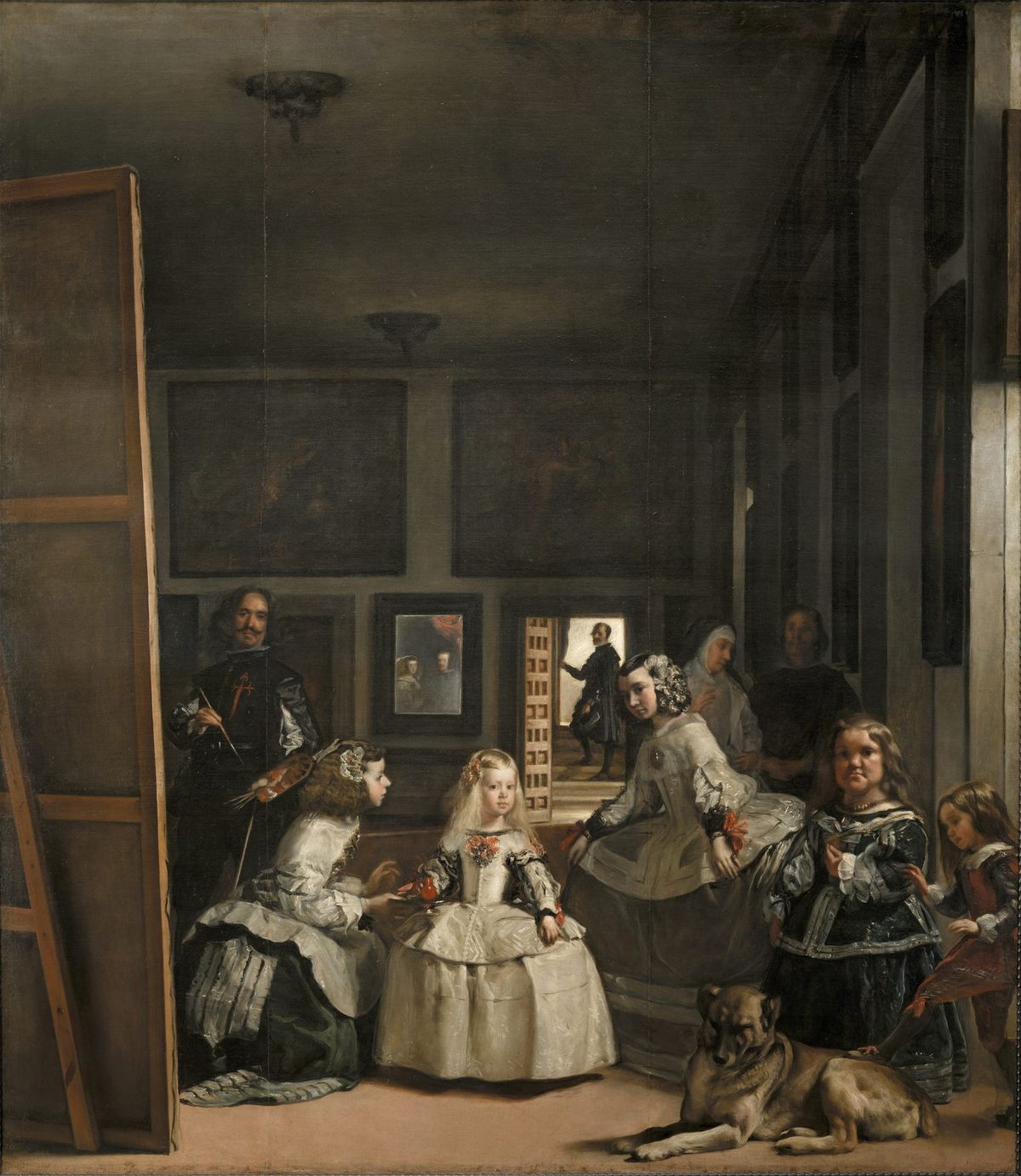
You can see the family in Velázquez's Las Meninas, now in the Prado. The girl at the center is the Infanta Margarita, born in 1651, daughter of Philip IV and Mariana, according to the National Trust's catalog entry for a copy; Charles II was her little brother, born ten years later.
What it does not prove: that the repeats caused his illnesses. The authors call their evidence indirect and not conclusive. Your next step, in your own tree: don't stop at six generations, because a fold can sit at generation eight or ten.
Example: Charles Darwin, Emma Wedgwood and a letter about the census
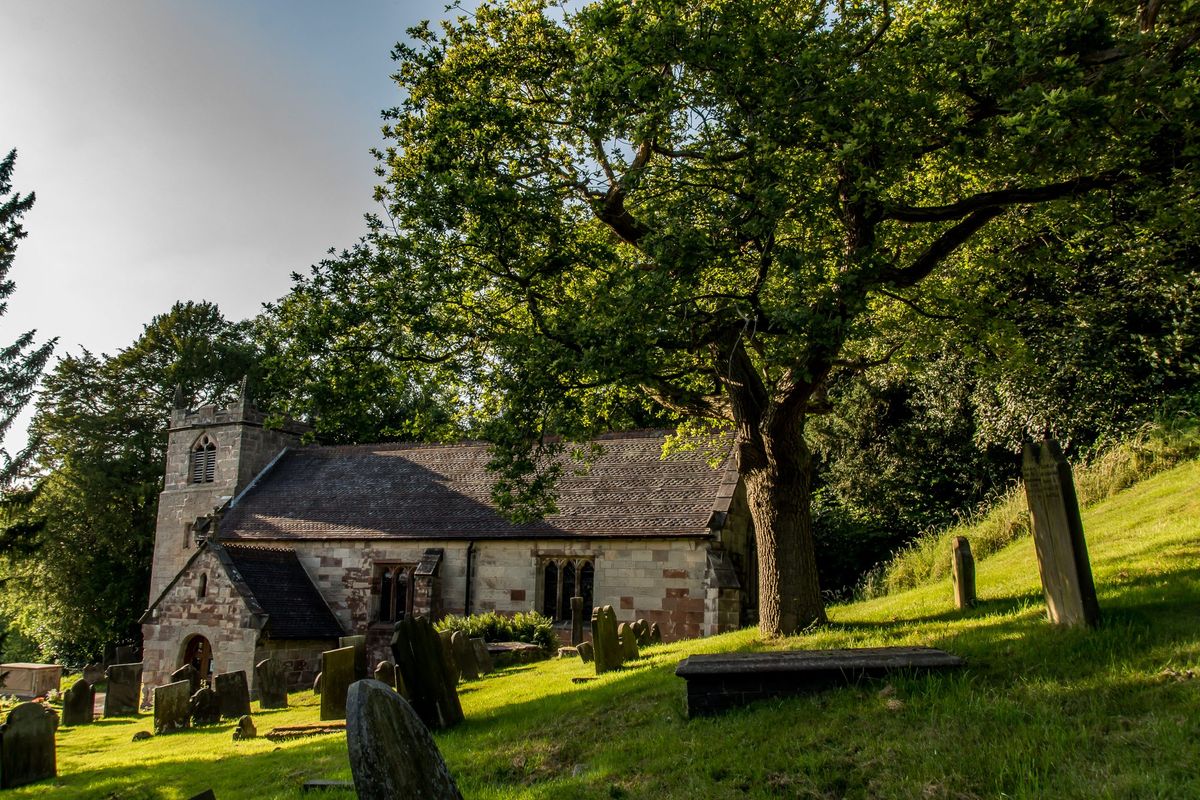
Darwin's wife, Emma Wedgwood, was his first cousin: her father, Josiah Wedgwood II, was the brother of Darwin's mother, Susannah, according to the Darwin Correspondence Project. They married at St Peter's Church in Maer, Staffordshire, on 29 January 1839, according to the Linda Hall Library. Darwin's mother's own parents were third cousins.
The record I would point you to is a letter. On 17 July 1870 Darwin asked John Lubbock to speak up when the census came before the House, hoping it would ask about marriages of cousins. The letter says plainly that the belief such marriages do harm rested on no direct evidence. The Darwin Correspondence Project notes he failed to get the question into the 1871 census.
In 2010 a team at Ohio State University and a Spanish university traced 25 Darwin and Wedgwood families. Darwin's own ten children had an inbreeding coefficient of 0.0630, almost exactly the 6.25 percent for a child of first cousins. Three of the ten died before age ten, and three of the six who had long marriages had no children.
What it does not prove is cause. The letter shows what Darwin suspected, and the study shows a pattern, not the reason for any one child; its lead author said the childless marriages can't be pinned on cousin marriage. Your next step: if the same surname reaches you from two sides, trace both lines and see whether they meet.
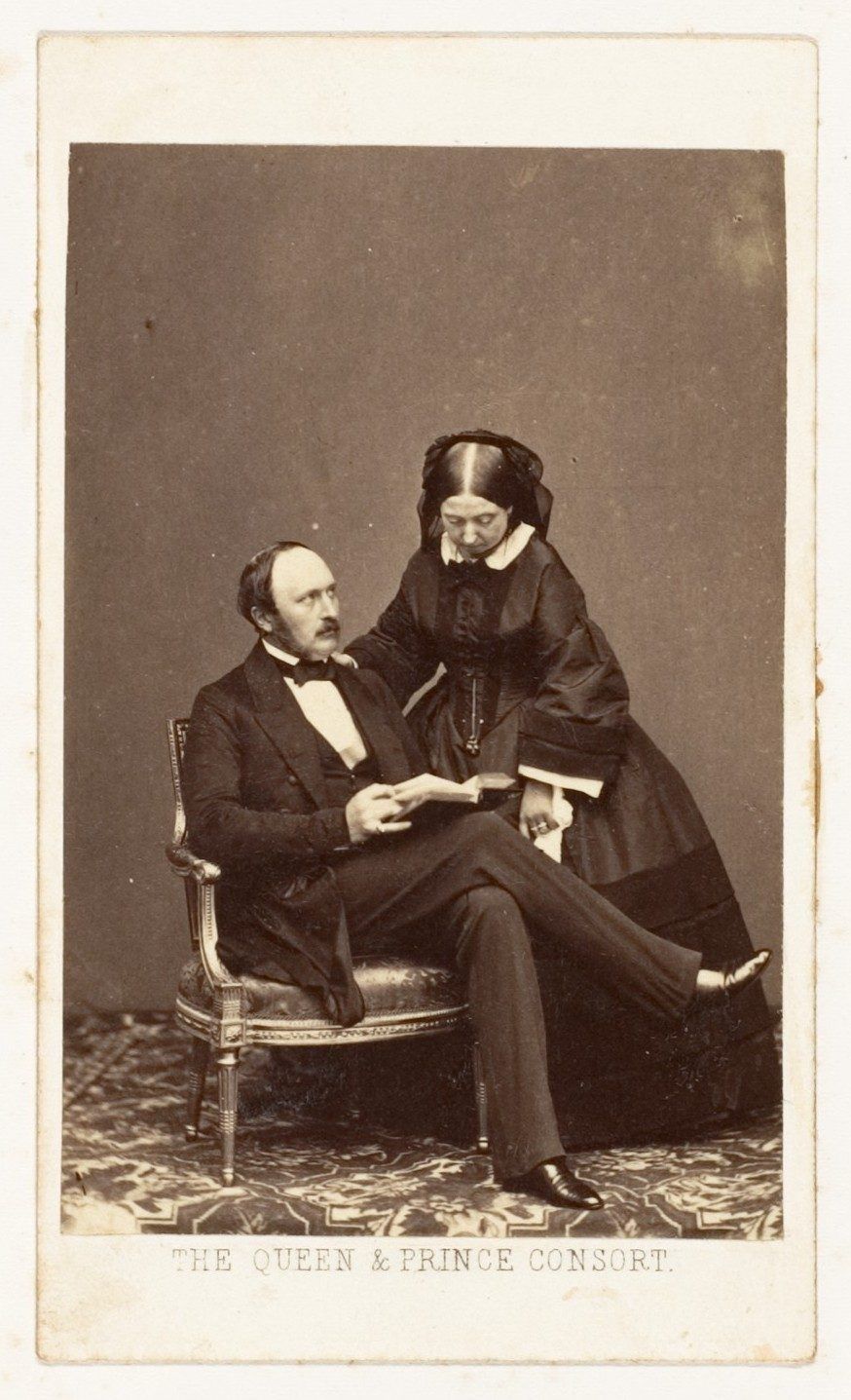
Queen Victoria and Prince Albert, who married in 1840, were first cousins, according to the Royal Collection Trust and English Heritage. A child of first cousins has at most six great-grandparents, not eight, so each of their children does too. Here they are twenty years after the wedding, in a card photograph from 1860.
How is pedigree collapse different from endogamy?
Pedigree collapse is the event. Endogamy is the habit. One marriage between relatives produces one fold; endogamy is marrying only within one's own community for generations, as the Who Are You Made Of blog defines it, so the whole chart is laced with repeats.
Royal houses are the textbook case, because their pedigrees survive. The Habsburg study notes that most European dynasties of the period were closely interconnected through political alliances, and this engraving of 1708 draws it.
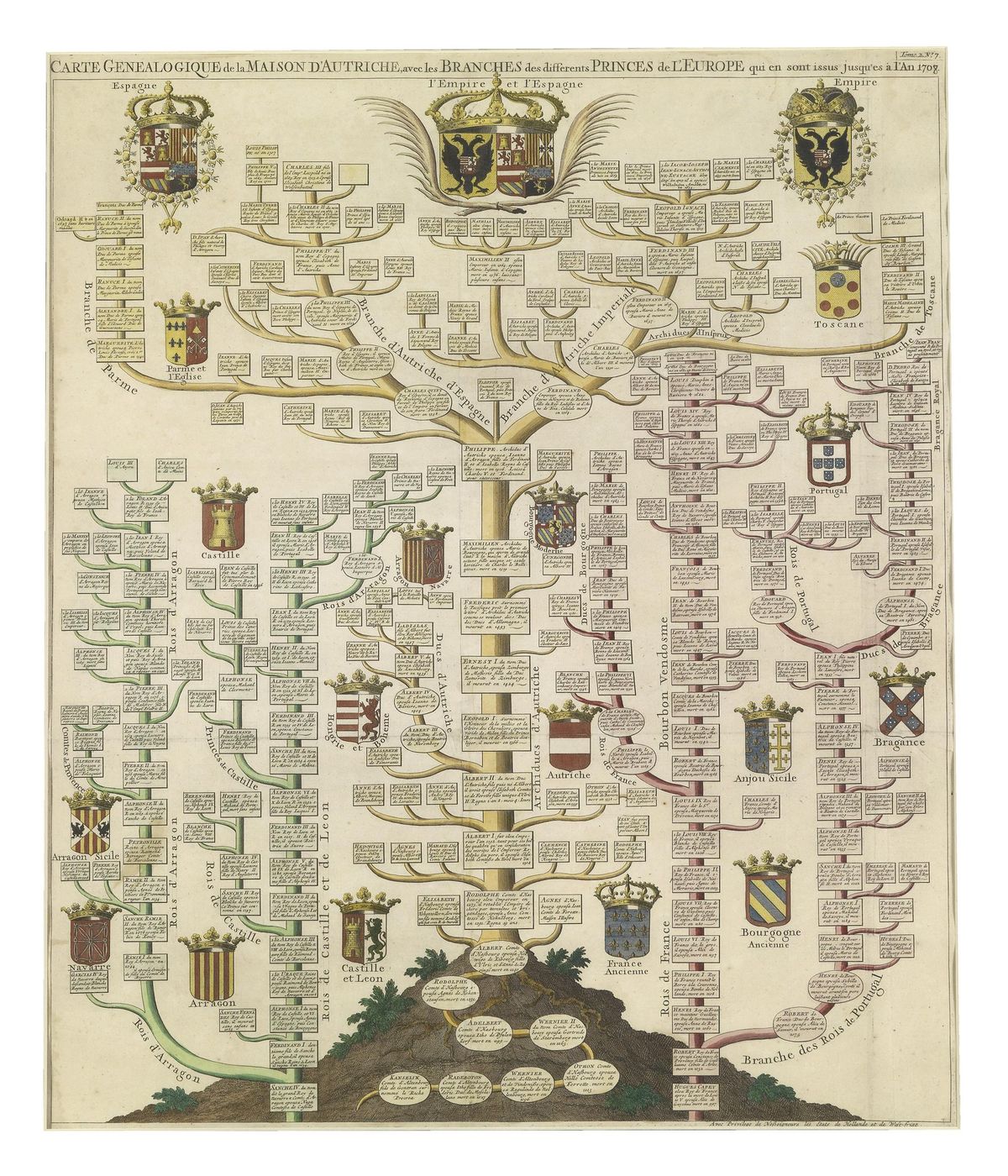
Geography can do it too. Iceland is an island, and a 2008 study in Science of all known Icelandic couples born between 1800 and 1965 found the greatest reproductive success among third and fourth cousins, a reminder that how close the cousins are matters.
For the Ptolemies of Egypt it was policy. The dynasty's first sibling marriage was Ptolemy II and his sister Arsinoe II, according to the World History Encyclopedia. When Cleopatra VII's father died in 51 BCE, she took the throne beside her brother Ptolemy XIII, then about twelve and ceremonially married to her. The encyclopedia says it is not known whether the family suffered health problems from inbreeding, and I don't know either.
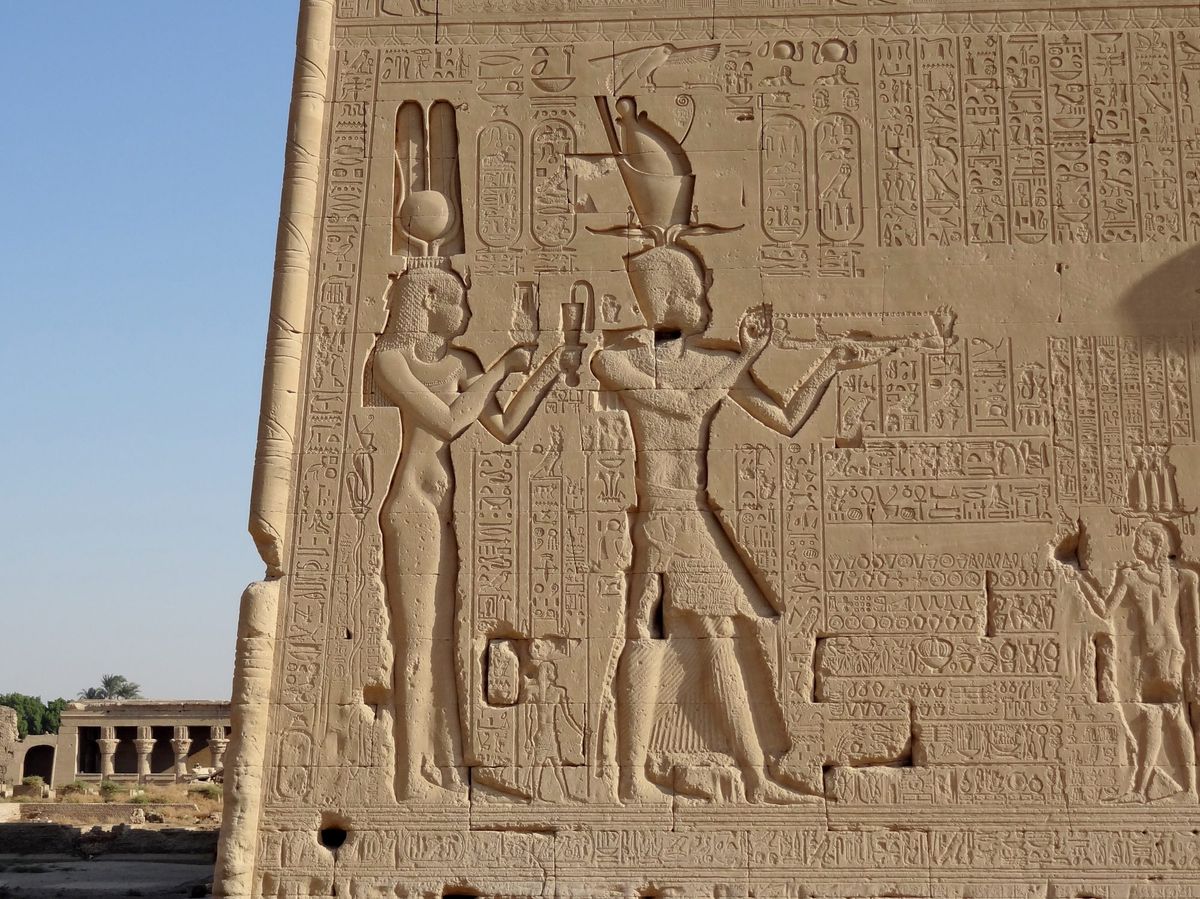
The difference matters for one practical reason. A single collapse is a curiosity you can map. Endogamy changes what your DNA results mean.
Does pedigree collapse change my DNA matches?
Yes, and the more recent the collapse, the more it changes them.
A consumer DNA test matches you with relatives by the amount of DNA you share, measured in centimorgans (cM), and predicts a relationship from it. When the same ancestors fill two slots, descendants can inherit their DNA along both lines and share more than the paper relationship predicts, as the Who Are You Made Of blog notes, so a match can look closer than it is.
With one cousin marriage the distortion sits on one line, and once you have found the marriage you can account for it. With endogamy it sits everywhere. A 2014 study in Nature Communications sequenced 128 Ashkenazi Jewish genomes and found a recent bottleneck, a sharp narrowing of the population, of about 350 individuals. A population that narrowed to a few hundred people is related many times over, so its match lists fill with people who look like close cousins.
That is why I treat a DNA match as a question for the records, never as proof. Whether a test is worth taking is in do you need a DNA test for genealogy.
What does pedigree collapse look like on paper?
Example: the arithmetic of a child of first cousins
Take one couple, the grandparents. Their son and daughter each marry and have a child; those two children are first cousins. Suppose the cousins marry and have a child, and count that child's ancestors:
- Parents: 2, as usual.
- Grandparents: 4, as usual.
- Great-grandparents: 6, not 8. Each parent brought four, but two of the four are the same couple on both sides.
The fold carries upward: 12 great-great-grandparents instead of 16, then 24 instead of 32. On a fan chart, the circular pedigree where each ring is one generation, two wedges of the outer rings are the same people printed twice.
Example: a Catholic marriage dispensation
In Catholic parishes everywhere, the Rio Grande included, the fold was sometimes written down before the wedding. The Church counted kinship in degrees, and after the Fourth Lateran Council of 1215, a general council of the Church, the prohibition ran out to the fourth degree, counted by generations back to the common ancestor, as the Catholic Encyclopedia explains. By that count first cousins are related in the second degree, second cousins in the third, third cousins in the fourth. Anyone inside that range needed a dispensation, a formal exemption; fourth cousins did not, so a fold between distant cousins left no file.
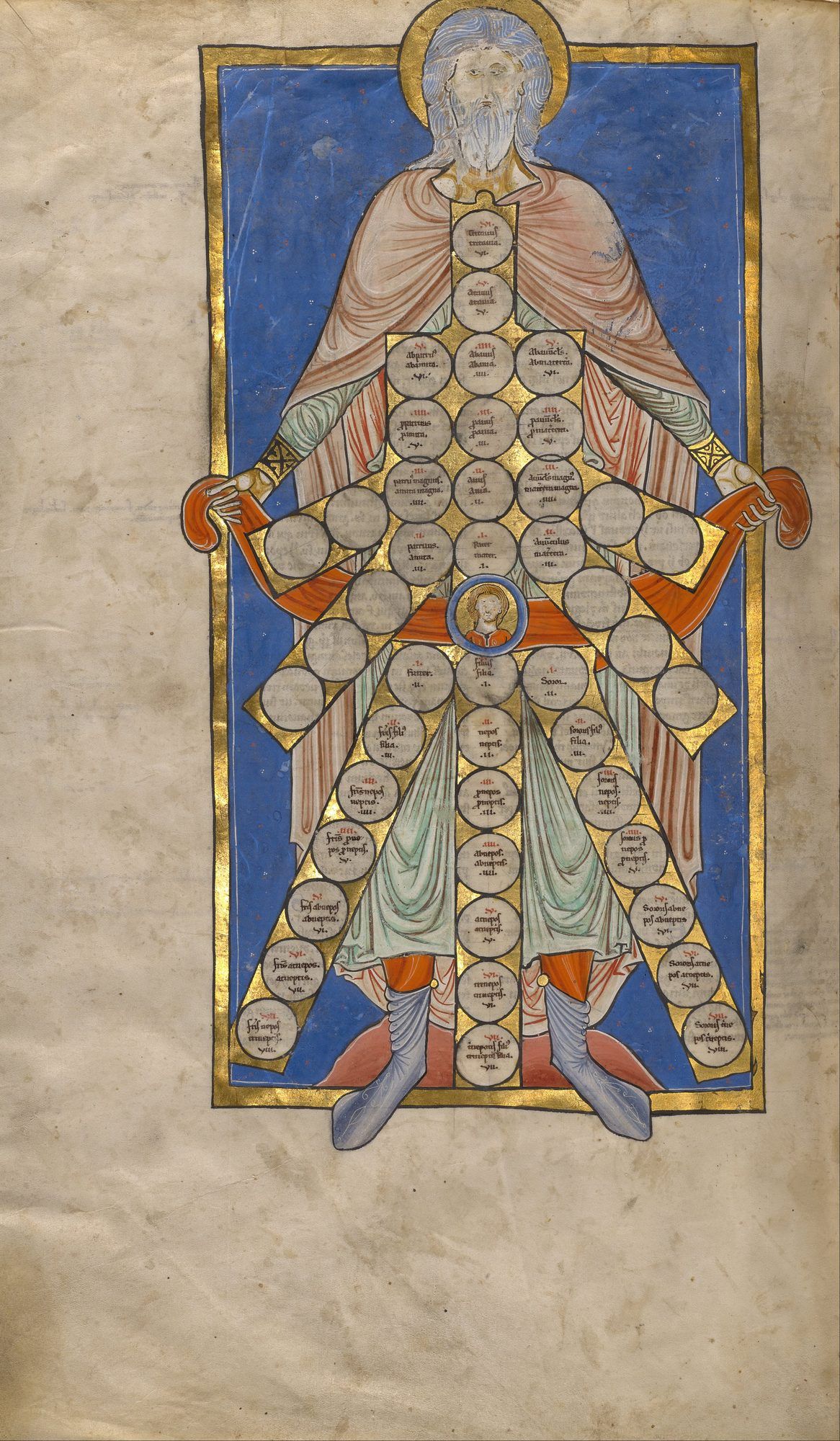
The FamilySearch wiki's page on Mexican church records describes the file. Before a Catholic wedding the couple went through a pre-marriage investigation, the información matrimonial, recording names, ages, residence and parents. When the couple were related, it may include the dispensation and genealogical charts, sometimes giving "a line of ascent up to the common progenitors."
The wiki says only limited work has been done to index or inventory diocesan archives, mostly their marriage dispensations, and it lists a Guadalajara Marriage Dispensation Index for 1600 to 1899. Reynosa belonged to the Diocese of Guadalajara until the Diocese of Linares was created in December 1777. I haven't searched the index for this post.
It matters on a borderlands line because a dispensation is sometimes the only record that names a generation. The baptism entry that would state the birth of Padre Ballí, the subject of my File 001 case, was likely lost when a flood destroyed Reynosa in 1800. I have no dispensation to show from that case and won't invent one; File 001 lists the archdiocesan archive in Monterrey and the Guadalajara diocese's archive as leads for his ordination file.
The honest limit: a file was made only when the Church required one, and not all survive. The record proves a fold where it survives. It does not prove the absence of one.
Example: a sixteen-ancestor proof from Prague, 1844
A different kind of document asked for proof of descent. In parts of Europe, noble families had to show it: an Ahnenprobe, German for an ancestor proof, could decide whether a knight entered a tournament or a candidate joined a cathedral chapter, according to a lecture notice from a Swiss family-history society.
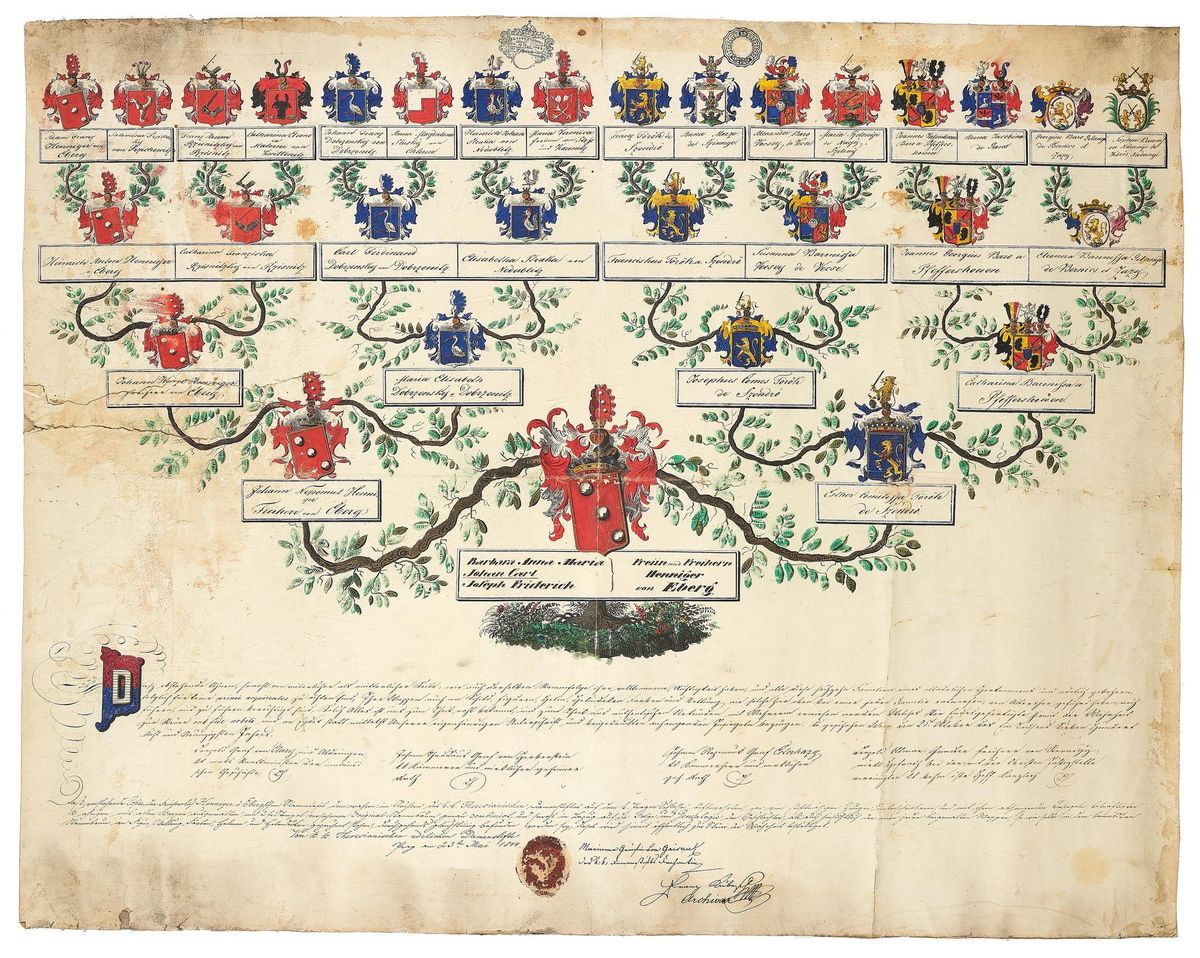
The record is a paper chart with a wax seal and an archivist's signature. At the bottom are a baroness and two barons of the Henniger von Eberg family (Wikimedia Commons spells it Henninger), and above them rows of 2, 4, 8 and 16 coats of arms. The sixteen families at the top are all different: Henniger von Eberg, Dobrzensky, Török de Szendrő, Pfeffershoven and twelve more.
What it does not prove is anything beyond the sixteenth slot; a fold one generation higher would be invisible. Your next step would be to take each family into its own parish records and count again.
How do I find pedigree collapse in my own tree?
Mostly by building the tree properly and then counting. Try this in 10 minutes:
- Go back far enough. Most people can go six to eight generations without seeing a repeat, according to the Who Are You Made Of blog. At about thirty years a generation (GenealogyBank cites studies near 32; MyHeritage gives 29 to 33), that means before about 1800 for someone born around 2000.
- Count each generation. Compare the distinct people against 2, 4, 8, 16, 32, 64. The first shortfall is where the fold is, provided every slot is filled by a record and not a guess.
- Watch the surnames and the parishes. The same surname arriving from two directions in one parish is a flag. Darwin's mother and his wife were both Wedgwoods.
- Read the marriage records, not the index. An index gives names and a date, not the kinship.
- Let the software help. Some programs can flag a person who occupies two positions.
- Make sure it is the same person. Two men of the same name in one town are not pedigree collapse. A copied tree that merges them is the opposite error, and far more common than a real fold.
Does it make a tree harder to research? Both ways. A couple proven once covers both slots, but DNA gets harder, and on Mexican and Tejano lines the depth you can reach depends on which parish and diocese kept its books, the subject of how far back Mexican and Tejano family trees can go.
What you can do free is the counting, and the indexes the wiki lists. A professional adds reading: the Spanish of a dispensation file, the archive that holds it, and the patience to count generation by generation. What no professional can buy is a file the Church never made, and anyone who promises to sort out an endogamous match list from DNA alone is promising what the records haven't agreed to.
If you'd rather have this done, start with the $300 Discovery assessment; it's credited in full toward any package. At checkout your card is authorized, not charged, and it is captured only when you accept the written quote and I accept the case. Start with the assessment.
Questions people also ask
How many ancestors should I have in 10 generations?
Counting your parents as the first generation back, the tenth generation holds 1,024 slots, and all ten generations together hold 2,046. At roughly thirty years a generation, that reaches back about three hundred years. Those are slots, not people; if any two of your ancestors were related, the same person fills more than one slot. Most people see no repeat within six to eight generations, but further back the repeats are always there.
Why do the same couple appear twice in my tree?
Because two of their descendants had a child together, so the couple are ancestors of that child along two separate lines. A chart draws each line in full, so the couple is printed twice; some software can show the repeated section once. Check first that it is really the same couple and not two couples with the same names, which is a common error in copied trees. If the records agree, you have found pedigree collapse, and it is normal.
What is endogamy and how is it different?
Endogamy is marrying within one group, by custom or geography, for many generations, such as an island, a valley, or a religious community. Pedigree collapse is a single event, one pair of relatives having a child; endogamy is that event repeated so often that the whole tree is laced with it. One cousin marriage changes the ancestor count in one spot. Endogamy changes how much DNA everyone in the community shares and makes DNA matching much harder to read.
Does pedigree collapse change my DNA matches?
It can. When the same ancestors sit in two slots, their descendants can inherit DNA from them along both lines and share more than the paper relationship predicts, measured in centimorgans, the unit the testing sites use. The site estimates a relationship from that amount, so a match may look closer than it is. The more recent the cousin marriage, the larger the effect, and with heavy endogamy many matches look closer than they are.
How do I find it in my own tree?
Build every line back as far as the records allow, at least six to eight generations, and count the distinct people in each generation against the expected 2, 4, 8, 16. Watch for the same surname arriving from two directions in one parish, and read the marriage records closely, because a Catholic marriage between close relatives needed a dispensation, and the file behind it can state how the couple were related. Some genealogy software can flag a person who occupies two positions. I don't count it as found until both lines are proven by records rather than copied from other trees.
Sources
- Family Tree Magazine, "What Is Pedigree Collapse?" (January 4, 2011)
- Who Are You Made Of, "Pedigree Collapse Explained" (June 12, 2020)
- PLoS ONE (2009), "The Role of Inbreeding in the Extinction of a European Royal Dynasty"
- Ohio State University news release (May 2010) on the BioScience study of the Darwin and Wedgwood families
- Darwin Correspondence Project, letter from Charles Darwin to John Lubbock, 17 July 1870
- Darwin Correspondence Project, letter from Charles Darwin to James Crichton-Browne, 5 January 1874
- Darwin Correspondence Project, "Emma Darwin"
- Linda Hall Library, Scientist of the Day, "Emma Darwin"
- Royal Collection Trust, "Prince Albert (1819-61)"
- The Metropolitan Museum of Art, John Jabez Edwin Mayall, "The Queen and Prince Consort" (1860, accession 2005.100.382 (76)), Open Access record
- English Heritage, "Queen Victoria"
- National Trust Collections, Las Meninas (copy after Velázquez), catalog entry
- World History Encyclopedia, "Ptolemaic Dynasty"
- World History Encyclopedia, "Cleopatra VII"
- National Geographic, Photo of the Day, "Cleopatra Relief, Egypt"
- Science (2008), "An association between the kinship and fertility of human couples" (PubMed record)
- Nature Communications (2014), "Sequencing an Ashkenazi reference panel supports population-targeted personal genomics and illuminates Jewish and European origins" (PubMed record)
- Nature (2004), "Modelling the recent common ancestry of all living humans"
- U.S. Census Bureau, Historical Estimates of World Population
- U.S. Census Bureau, Historical Statistics of the United States, Colonial Times to 1970, series Z 1-19
- Population Reference Bureau, "How Many People Have Ever Lived on Earth?"
- Catholic Encyclopedia, "Consanguinity (in Canon Law)"
- J. Paul Getty Museum, Table of Consanguinity (Ms. Ludwig XIV 2, fol. 227v), collection record
- Central Swiss Society for Family Research, invitation to a lecture on Ahnenproben at the University of Lucerne (April 22, 2023)
- GenealogyBank Blog, "How Long Does a Generation Last? A Comprehensive Guide" (September 6, 2022)
- MyHeritage Blog, "Counting Generations for Genealogists" (February 20, 2025)
- FamilySearch Research Wiki, "Mexico Church Records"
- Skeleton Files, File 001, The Padre Ballí Birthdate
- Skeleton Files, Packages and Pricing