The federal census first, 1950 and 1940, because both are free and each puts a whole household on one page with ages, birthplaces and relationships. Then your grandparents' death certificates, because a death certificate names the parents. Then marriages, births, draft cards, newspapers and church books, in that order, nearly all of it free.
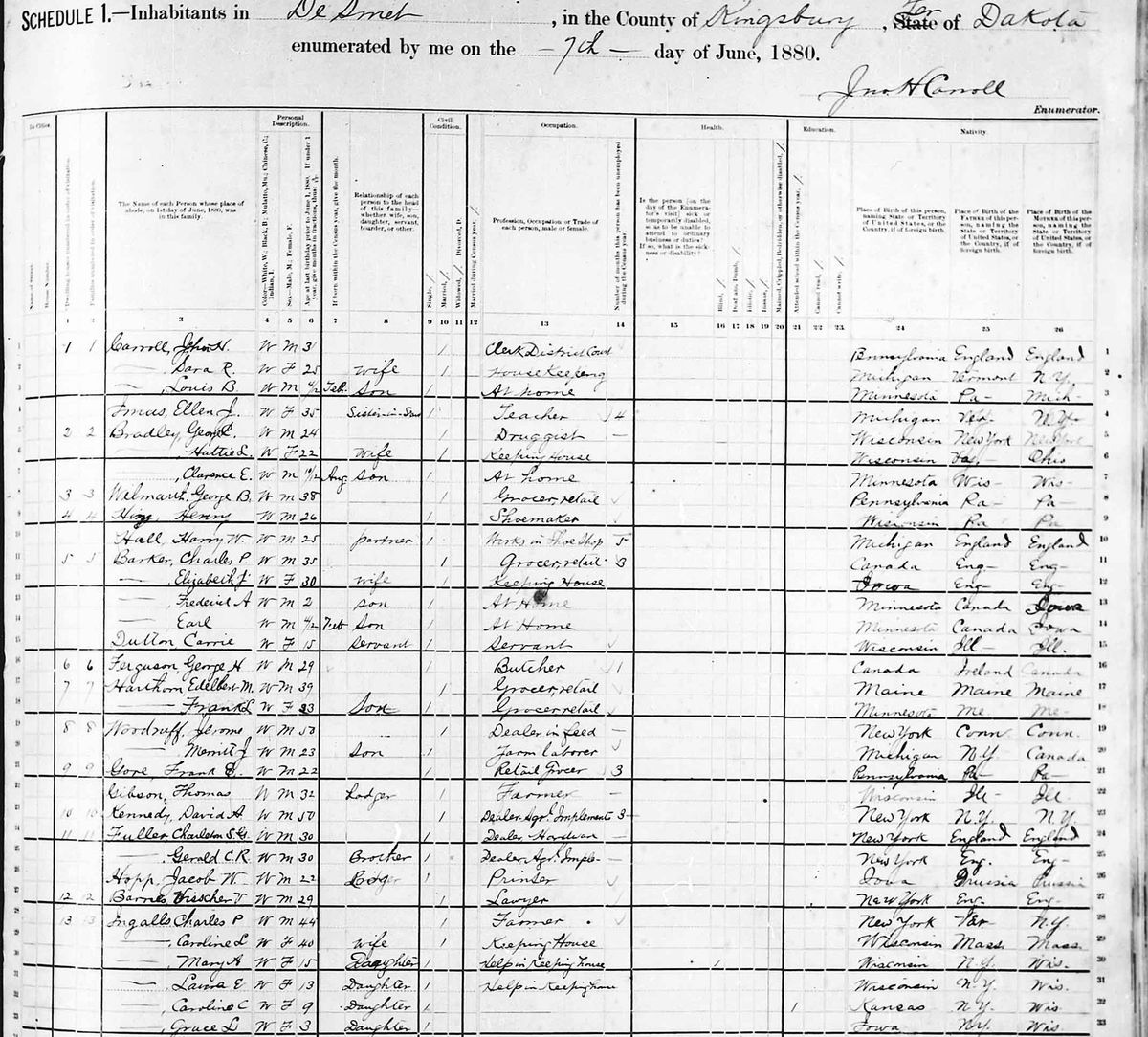
On June 7, 1880, a census taker in De Smet, Dakota Territory, wrote down a household of six on lines 28 to 33 of one sheet. The head was Charles P. Ingalls, 44, a farmer. Beside his oldest daughter, Mary, 15, there is a mark in the column for blind, and in the occupation column the census taker wrote "Help in keeping house." The family is the one behind Laura Ingalls Wilder's Little House books, and the National Archives holds the page.
The order matters: each record is easier to find once the one above it has handed you a date and a place, and how to start family history research for free covers the week before any of this.
Why does the census come first?
Because it is the one record made for everyone, on a schedule. FamilySearch's guide to beginning genealogy says the federal census has been taken every 10 years since 1790, so once a family is on one page the next is a decade away. The Nibble beginners' FAQ ranks census and vital records, the government's birth, marriage and death records, first for the same reason.
Example: reading the Ingalls page, column by column
Read the sheet above left to right. Column 3 is the name, column 6 the age at the last birthday before June 1, 1880, column 8 the relationship to the head of the family, column 13 the occupation, column 16 the blind mark, and columns 24 to 26 the birthplaces of the person, the father and the mother. The daughters' birthplaces in column 24 run Wisconsin, Wisconsin, Kansas and Iowa, oldest to youngest, so the page alone shows a family that moved.
What the page proves is where the household was counted and who was in it. It does not prove a birth date, because it gives only ages, and the parents' birthplaces in columns 25 and 26 are only as good as the person who answered the census taker. So I treat each column as a lead and look next for the same family ten years earlier and later.
Censuses change by decade: 1850 was the first to name everyone in the household, enslaved people excepted, 1880 asked the relationship to the head of the household and both parents' birthplaces, per the FamilySearch research wiki, and 1950 was the first to ask whether a household owned a television.
The National Archives put the 1950 census online on April 1, 2022: 6.4 million scanned pages that record each person's name, age, sex, race, marital status, relationship to the head of household, birthplace, naturalization status and job details, by the Census Bureau's account. Handwriting recognition built its name index, and that account says it "will not be 100% accurate."
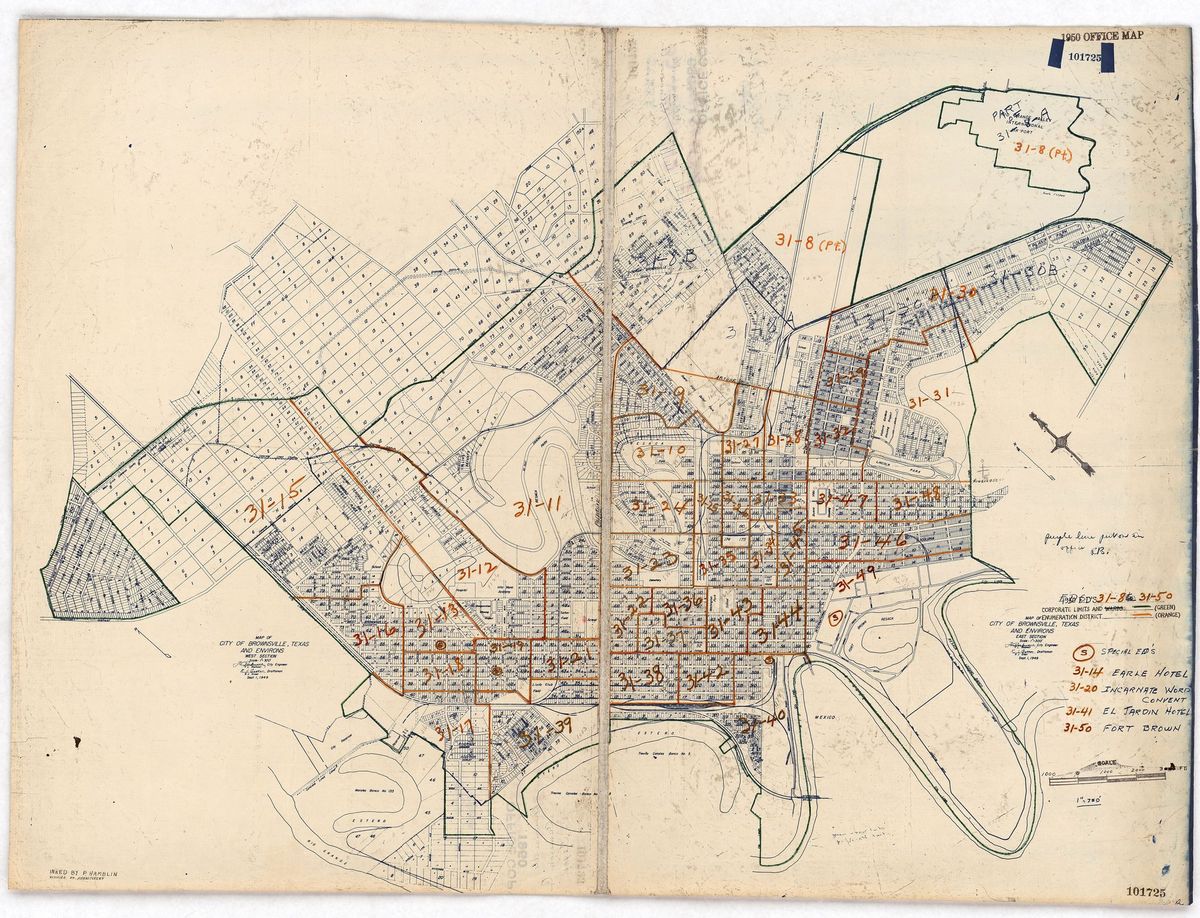
So when a search misses, use the district map. Census takers worked by enumeration district, the area one census taker covered, and the Archives offers its maps free. On this one for Brownsville, Texas, each district is outlined in orange and numbered; find the family's street and read the number.
Which record comes after the census, and why death before birth?
Death certificates, because they are the record most likely to name the generation above. A Texas certificate typically gives age, cause, residence, birthplace, the parents' names and the burial, by FamilySearch's description of its collection. The catch, from FamilySearch's Texas wiki: an informant, the person who gave the answers to the clerk, supplied those facts, and how close that person was to the family bears on how far to trust them.
Example: a 1920 death certificate that names both parents
The Missouri Historical Society holds the 1920 death certificate of Powhatan H. Clarke, a 27-year-old lawyer who died at Saranac Lake, New York. Box 6 gives his birth date, April 5, 1893, box 9 his birthplace, Fort Custer, Montana, and boxes 10 to 13 name his father, Powhatan Clarke, and his mother, Elsie Clements, with a birthplace for each.
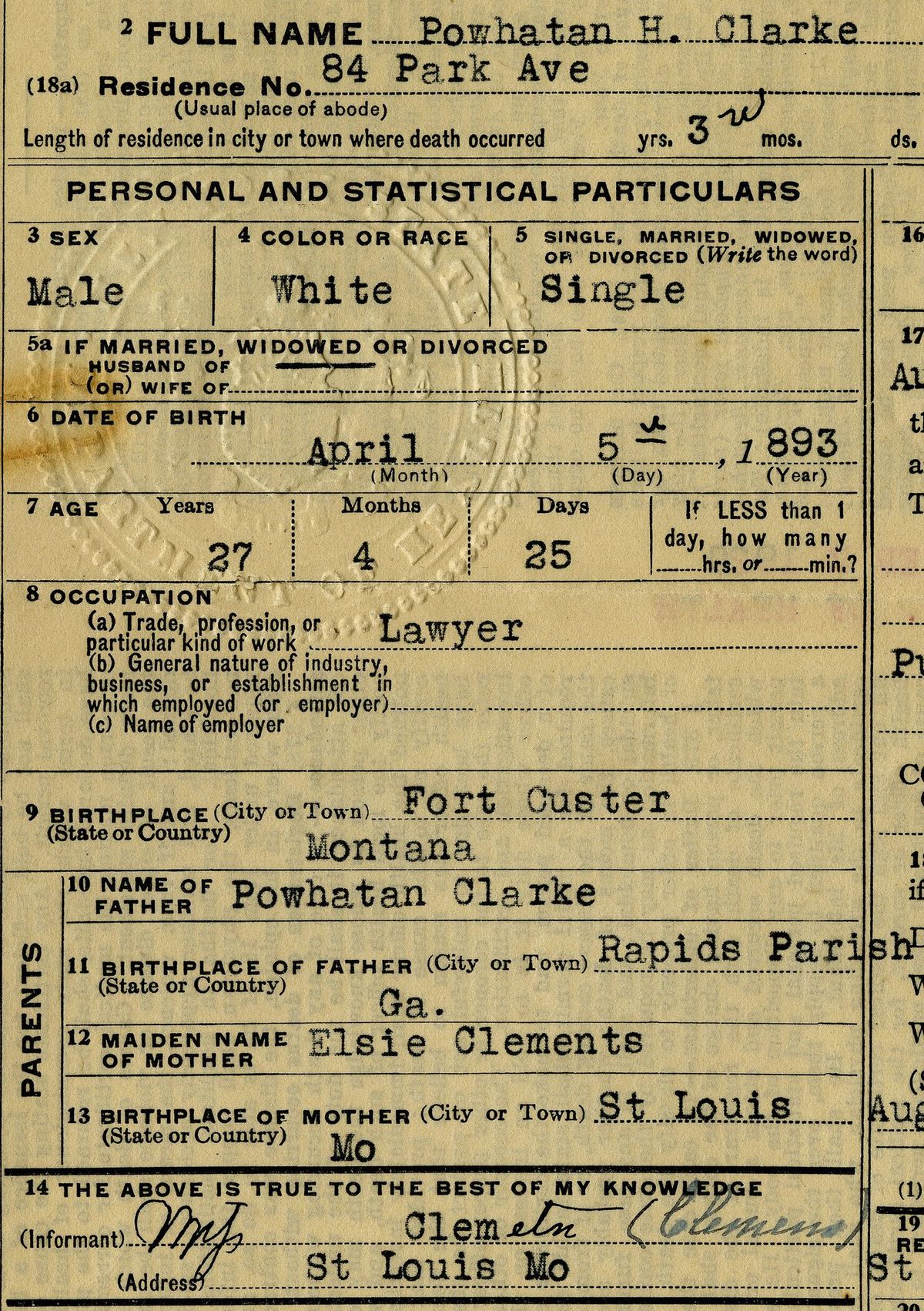
Box 14 names the informant, a Clemens of St. Louis; the typed "Clemetn" has "Clemens" written beside it, and I don't know how that person was related. The certificate opens a new generation: the Society's finding aid, its guide to the family papers, says the father was Lt. Powhatan H. Clarke, a West Point graduate awarded the Medal of Honor, who drowned at Fort Custer on July 21, 1893, when his son was less than four months old.
It disagrees with the finding aid in two places. Box 11 reads "Rapids Parish, Ga.", but the finding aid puts the father's birth at Alexandria, Rapides Parish, Louisiana, and it spells the mother's maiden name Clemens, not Clements. Next I would take the father's name and dates to the Army, West Point and the family papers.
Birth records come last, for two reasons. States started late: Texas began statewide registration in 1903, and the Texas State Library says births were not consistently recorded until the 1930s, so a Texan born in 1910 may have no certificate. And a birth certificate names the parents and little else; a death certificate adds a date to search. A delayed birth certificate, one filed long after the birth, which Texas began registering in 1939, is proved with documents such as census, selective service (draft), school and religious records and a relative's sworn affidavit, per the state health department, so it can lead back to this very list.
Marriages sit between. Texas did not register marriages at the state level until 1966, so anything earlier is a county clerk record: the FamilySearch wiki says county recorders issued the licenses and kept the registers from 1837 to 1966.
A marriage record is where a bride's maiden name was written by someone who knew her, and some licenses say far more: this one, from Richmond, Virginia, lists both people's ages, birthplaces and residences, the husband's occupation and both sets of parents.
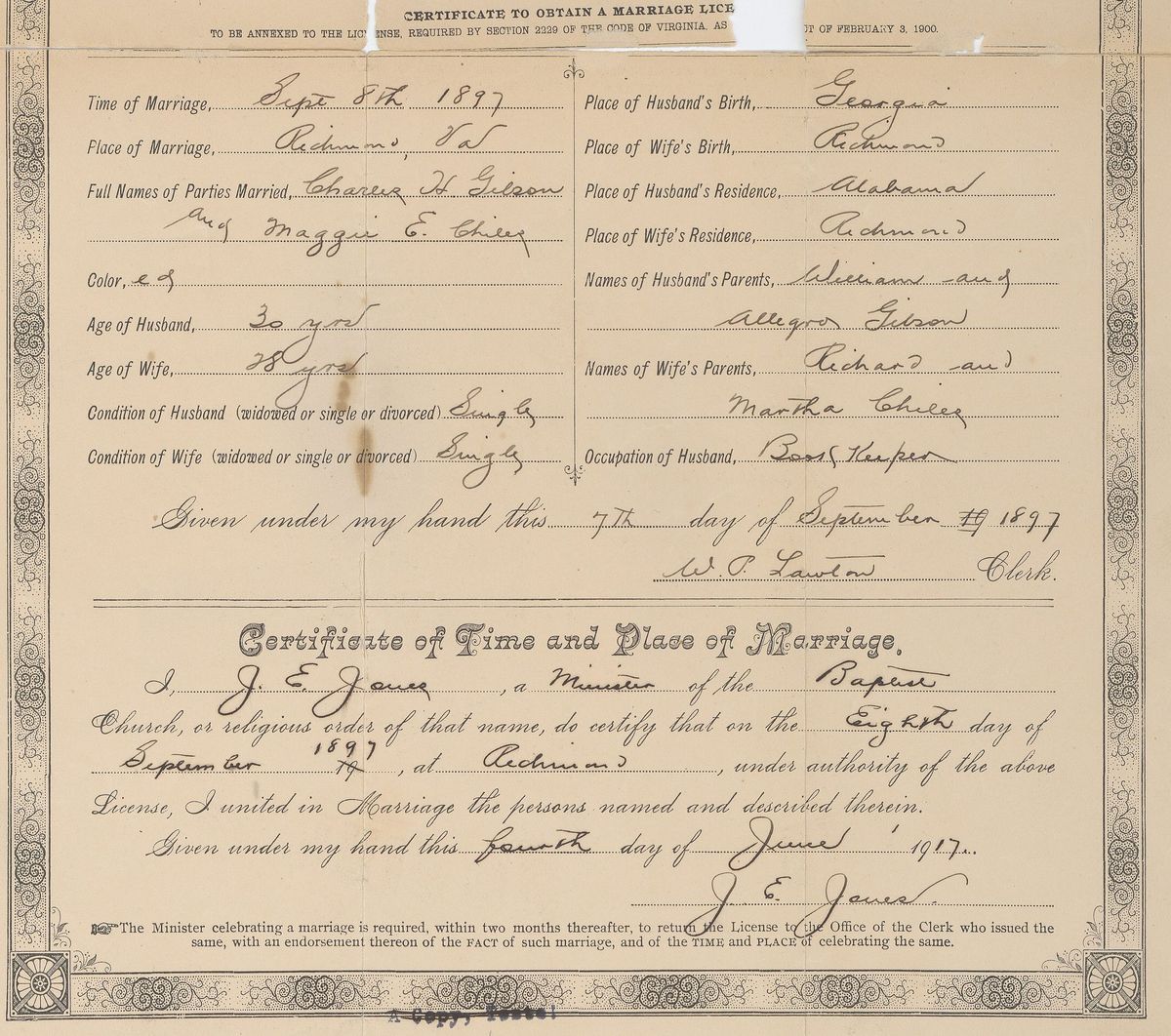
The minister signed his certificate nearly twenty years after the wedding, so the date on a record is when it was written, not always the date it describes.
What does the ranked list look like, and where is each record free?
I worked this list for Texas, where I work.
- The 1950 and 1940 censuses. 1950 is free on the National Archives' own site, with a name search. 1940 is free through the National Archives Catalog, open since April 2, 2012, with no Archives name index; FamilySearch has indexed it by name, with images, free with a free account.
- The censuses before that. Free on FamilySearch, per Genealogy Explained, one page per decade until the names stop. Family Tree Magazine's ten steps say the same about order: search the free record collections before you spring for a subscription.
- Death certificates. FamilySearch's Texas, Deaths, 1890-1977 has about 4.5 million images as of October 2026, free with a free account, from 1903; Ancestry's Texas, U.S., Death Certificates, 1903-1982 is not free. For another state, the FamilySearch wiki page for that state's vital records says which years are online.
- Marriage records. The county clerks' books before 1966, many on FamilySearch.
- Birth records. Only from 1903 in Texas and spotty until the 1930s; substitutes are the census age, the death certificate and a baptism.
- Draft cards. World War I and the 1942 registration, free on FamilySearch with images.
- Newspapers and graves. Chronicling America and Find a Grave.
- Church books. Last for most US families, first for a family from Mexico.
Example: Alvin York's 1917 draft card
Draft cards are the surprise on the list, and often the only document with a man's exact birthplace written in his own lifetime. About 24 million men registered for the World War I draft, the National Archives says; that is nearly every man born between about 1872 and 1900. The 1942 registration is the one people miss: it covered men born on or after April 28, 1877, and on or before February 16, 1897, as the National Archives' copy of the form says. FamilySearch calls it an inventory of manpower, not a call-up, and its cards name a person who will always know the man's address.
A famous World War I card is Alvin C. York's, registered in Fentress County, Tennessee, on June 5, 1917. Line 3 gives his birth date, December 13, 1887, line 5 his birthplace, Pall Mall, Tenn., and line 7 his work, "Labor on farm." Line 12 asks whether he claims exemption from the draft, and he wrote, "Yes, Don't want to fight."
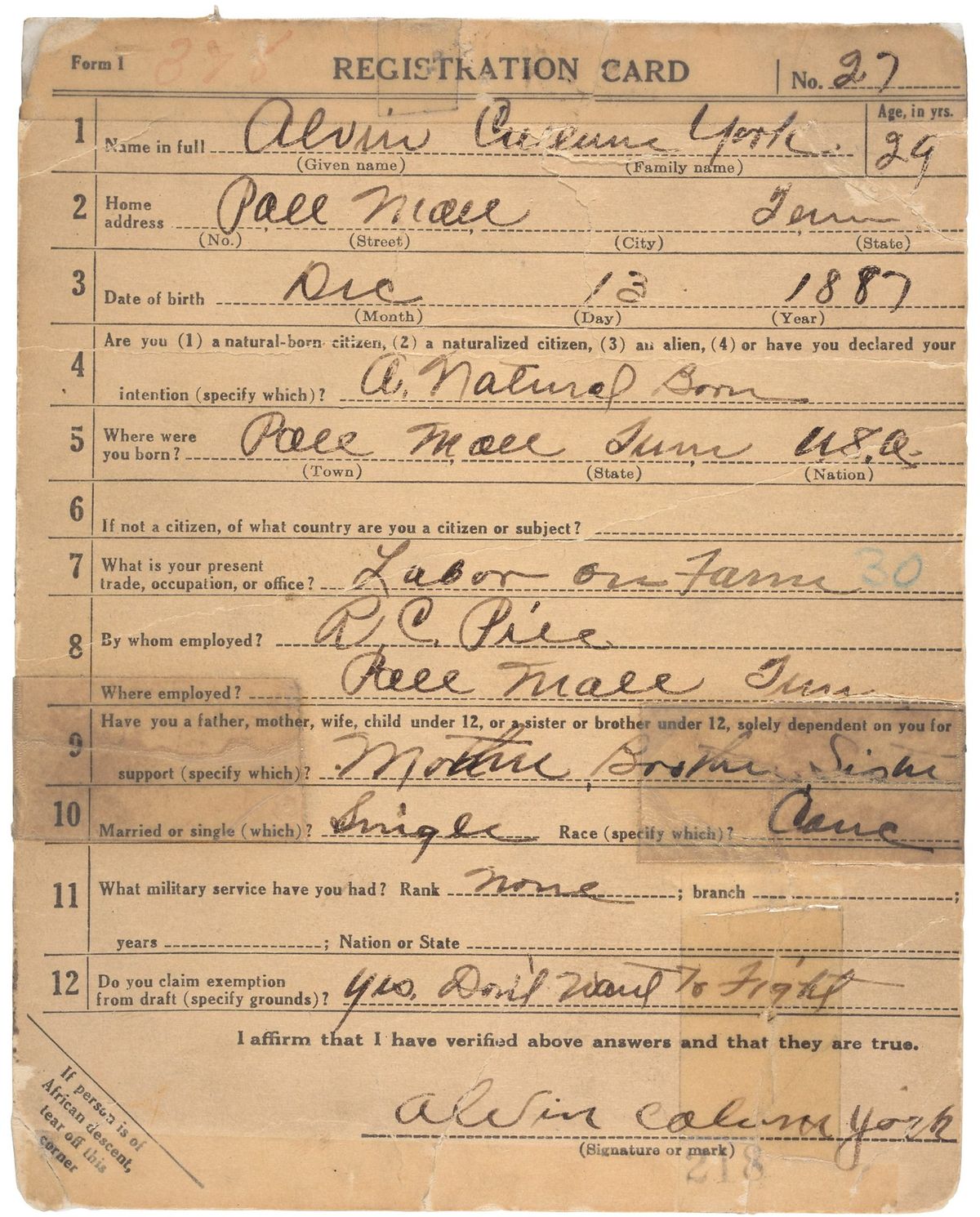
The card proves a birth date and place in his own hand, and what he said on registration day. It does not prove military service, because the National Archives says these cards are not service records. The Tennessee Encyclopedia says the local and state boards denied his claim, and that he became a Medal of Honor winner for a fight in the Meuse-Argonne in France on October 8, 1918. So the card is a lead, and a man like York turns up next in the newspapers.
Example: a 1925 obituary that points back a generation
Chronicling America, the Library of Congress's newspaper site, has free searchable images of US newspapers from 1792 to 1963, per Genealogy Explained, and a death date tells you which issue to open. On April 1, 1925, the Brownsville Evening Herald ran an Associated Press obituary for Henrietta King, headed "Mrs. King Succumbs," that names her husband, Captain Richard King, and gives her age as 93 and her birthplace as "Booneville, Mo., in 1832."
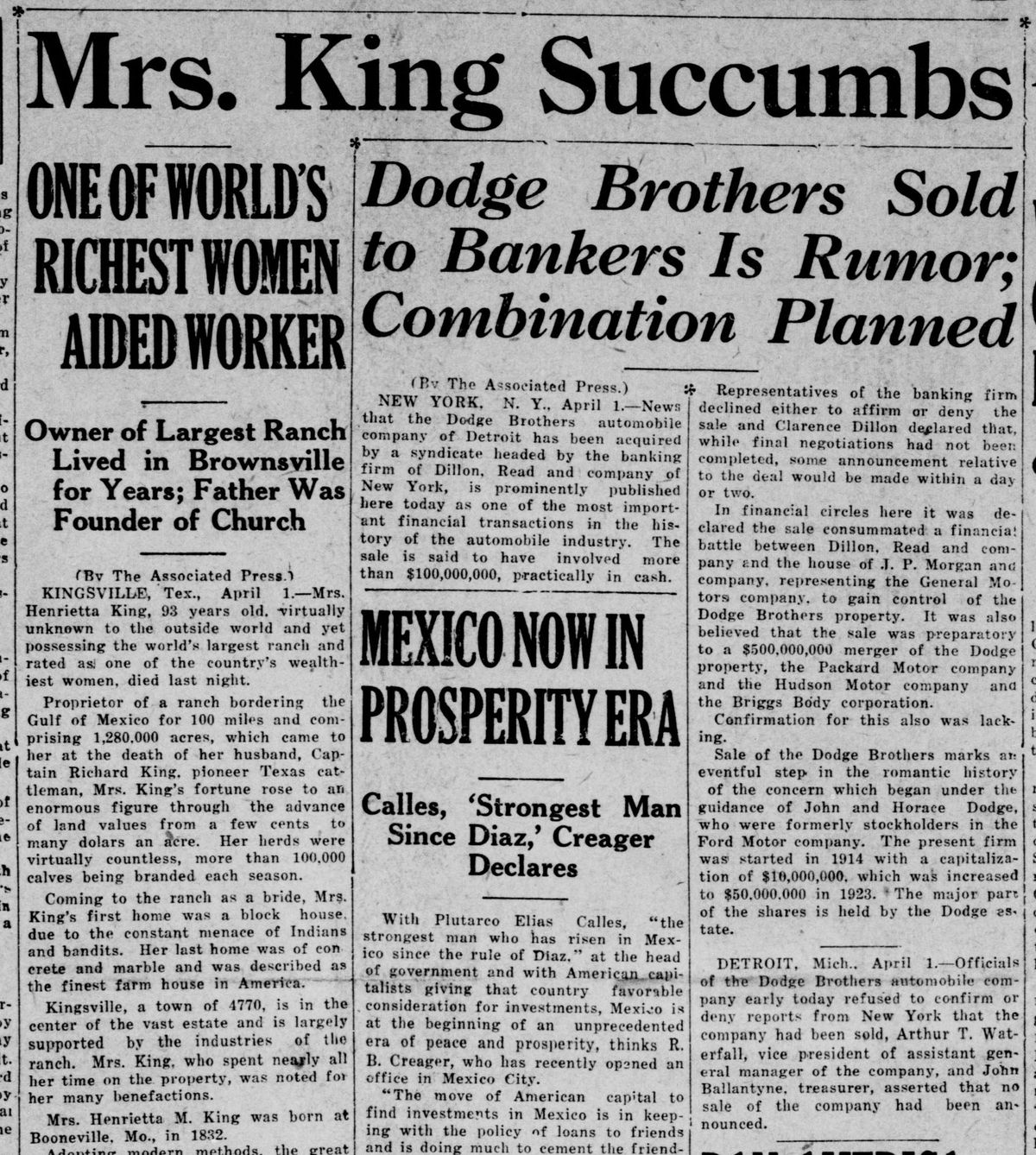
The Handbook of Texas gives Boonville, Missouri, and July 21, 1832, which makes her 92 when she died on March 31, 1925, and says her father, Hiram Chamberlain, organized the first Presbyterian mission in South Texas, at Brownsville, in 1850. So the obituary is a map of leads with a spelling and an age off by one. Find a Grave is free and volunteer-built; a headstone gives dates to check, not to copy.
Example: a burial entry that gives a date but no age
Church books come last for most US families, because the government records above usually exist. They come first for a family from Mexico, where civil registration, the government's own record of births, marriages and deaths, began in 1859 and the earliest vital records were the Catholic Church's, per the FamilySearch wiki. A baptism there usually names the parents and godparents, and sometimes the grandparents. Where those books are free is in how to find Mexican ancestors for free.
Padre José Nicolás Ballí, for whom Padre Island is named, was buried on April 16, 1829, in Matamoros. The parish burial book records the full funeral rite, the highest in the book, at a church fee of twenty-five pesos, and says he died of apoplexy, a stroke. File 001 transcribes the entry but shows no picture of it, because the record holders restrict republishing their images.
The entry gives a date, a cause and a rite, and no age, so nobody can work his birth year back from it. That is part of why the published years run from about 1768 to 1772, with "177?" on both state markers. So I went around the gap: his own signature in a January 1807 marriage entry shows he was already a priest, and church law set 24 as the minimum age, which points to a birth by about 1783 unless he had an exception.
What about the records that don't exist: the 1890 census and the 72-year rule?
The 1890 census is mostly gone, and the story is stranger than "it burned." On January 10, 1921, a fire broke out in the basement of the Commerce Department building in Washington, where the 1890 schedules were stacked outside the vault. The Census Director estimated that a quarter were destroyed and half of the rest damaged by fire, smoke and water, and one account quoted in the National Archives' own history put them "first in the path of the firemen."
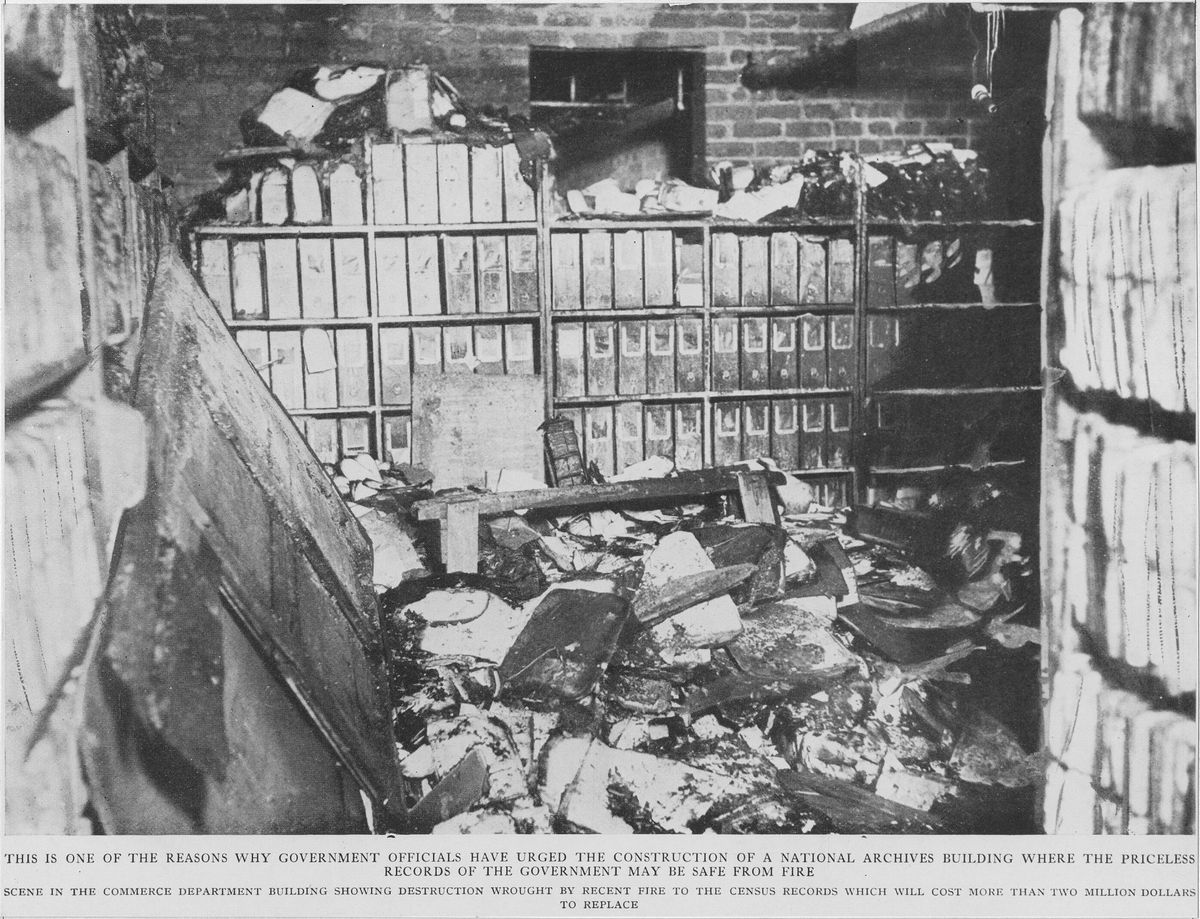
Congress authorized the destruction of the remaining originals on February 21, 1933. What survives is a fragment for parts of ten states and the District of Columbia, a little over 6,000 people, plus the 1890 schedule of Union veterans and widows; in Texas, a few precincts in Ellis, Hood, Kaufman, Rusk and Trinity counties. For everyone else there is a twenty-year hole between 1880 and 1900, which steps 3, 4, 6 and 8 bridge: a marriage, a death, a baptism, and the draft card of any son born in the gap.
The newest censuses are sealed. The Census Bureau says the government will not release personally identifiable information from a decennial census until 72 years after it was collected, a rule that began with letters between the Bureau's director and the Archivist in 1952 and became law in 1978. So the 1940 census opened on April 2, 2012, the 1950 census on April 1, 2022, and the 1960 census is due in 2032; no public census page names anyone born after April 1, 1950, which is why this list starts with your grandparents.
How do I know the record I found is the right person?
When it agrees with what you already have on more than the name. A census page, a death certificate and a draft card for the same man should agree on birth year within a year or two, on birthplace and on relatives. I want three of the four checks, name, date, place and relationships, to agree before a record goes under a person, and I open the image, not just the index line. The whole method is in how to tell if a record is really your ancestor.
Three of the examples above carry a small mismatch: the Clarke certificate says Georgia where the finding aid says Louisiana, Henrietta King's obituary gives her age a year high, and the Richmond minister signed late. None was the wrong person, so a mismatch is a note in your file, not a reason to throw the record out.
Try this in 10 minutes:
- Write down one grandparent's name, birth year and where they lived in 1950.
- Search the National Archives' 1950 census page; if the name misses, find the address's enumeration district on the Archives' maps.
- Copy each person's age, birthplace and relationship from the page, repeat for 1940, and write down every mismatch.
When should I stop looking on my own?
Honest both ways. Everything on this list is free and indexed well enough that a patient person can take a Texas family from 1950 back to about 1900 in a few weekends. What a professional adds at this depth is time, a method and proof you can check, not access, and no one can bring back the 1890 census.
Three reasons to hand it over anyway: you keep starting and quitting; the line crosses into Mexico, Spanish or unindexed books; or you want the first four generations proven before you build on them. File 001 is my example of the second: Padre Ballí's baptism would be in Reynosa's earliest parish books, which are not known to survive.
That is the 1900 package on my pricing page: both sides of your family back to about 1900, from $900, with $225 to start and the balance on delivery. Your card is authorized at checkout, not charged; it is captured only when you accept the written scope and I accept the case.
If you'd rather have this done, start with the $300 Discovery assessment; it's credited in full toward any package. You get a brick-wall check and a written research plan before committing to anything larger. Start with the assessment.
Questions people also ask
Where do I see the 1950 and 1940 census free?
The 1950 census is on the National Archives' own site at no charge, with a name search, since April 1, 2022. Handwriting recognition built that name index and it is not 100 percent accurate, so the Archives' free enumeration district maps help when a search misses. The 1940 census has been open since April 2, 2012, free through the National Archives Catalog, where you browse by enumeration district because the Archives has no name index of its own; FamilySearch has indexed it by name, with images, free with a free account. Earlier censuses are free on FamilySearch too.
What is the 72-year rule?
The federal government does not release personally identifiable information from a decennial census until 72 years after it was collected. It began as a 1952 agreement between the director of the Census Bureau and the Archivist of the United States, and Congress wrote it into law in 1978 as Public Law 95-416. That is why the 1940 census opened on April 2, 2012, the 1950 census on April 1, 2022, and the 1960 census is due in 2032.
What happened to the 1890 census?
A fire in the Commerce Department building in Washington on January 10, 1921, destroyed a quarter of it and damaged about half of the rest, by the Census Director's estimate. Congress then authorized the destruction of the remaining originals on February 21, 1933. Fragments survive for parts of ten states and the District of Columbia, a little over 6,000 people, along with the 1890 schedule of Union veterans and widows for many states. For most families there is a twenty-year hole between 1880 and 1900, bridged by marriages, deaths, church books and, for men born in the 1870s through 1900, the World War I draft cards.
Where are free death records for Texas?
On FamilySearch, in the collection Texas, Deaths, 1890-1977, which held about 4.5 million images of the certificates themselves in October 2026, free with a free account. Statewide registration began in 1903, so that is where real coverage starts, and the state library says deaths were not consistently recorded until the 1930s. The Texas State Library holds indexes, not certificates; the certificates come from the state health department or a county clerk.
What are draft cards good for?
An exact birth date and birthplace, written down in the man's own lifetime and usually signed by him. About 24 million men registered for the World War I draft in 1917 and 1918, nearly every man born between about 1872 and 1900, and the 1942 registration of men aged 45 to 64 covers those born from April 28, 1877, to February 16, 1897. Both sets are free on FamilySearch with images. A draft card is not a service record, because not every man who registered served.
Sources
- Beginning Genealogy, How to Get Started the Right Way, FamilySearch blog
- National Archives Releases 1950 Census Records, U.S. Census Bureau (April 2022)
- 1950 Census Fact Sheet, National Archives
- 1950 Census, National Archives
- 10 steps to start your genealogy research, Family Tree Magazine
- Free Genealogy Websites, Genealogy Explained
- Genealogy for Beginners FAQ, Nibble
- The 72-Year Rule, U.S. Census Bureau
- 1890 Census, National Archives
- "First in the Path of the Firemen": The Fate of the 1890 Population Census, Kellee Blake, Prologue, National Archives (Spring 1996)
- 1940 Census FAQs, National Archives
- United States, Census, 1940, FamilySearch collection
- United States Census 1850, FamilySearch Research Wiki
- United States Census 1880, FamilySearch Research Wiki
- Little House in the Census: Almanzo and Laura Ingalls Wilder, National Archives
- 1880 census page for De Smet, Kingsbury County, Dakota Territory (PDF), National Archives, Records of the Bureau of the Census, Record Group 29
- 1950 Census Enumeration District Maps, Texas, Cameron County, Brownsville, ED 31-8 to 50, National Archives Catalog (NAID 44271161)
- Texas Vital Records, FamilySearch Research Wiki
- Texas Vital Statistics Indexes, Texas State Library and Archives Commission
- Delayed Birth Registration, Texas Department of State Health Services
- Texas, Deaths, 1890-1977, FamilySearch collection
- Texas, U.S., Death Certificates, 1903-1982, Ancestry collection
- Powhatan H. Clarke Papers, 1842-1921, Missouri Historical Society
- Death certificate of Powhatan H. Clarke, August 30, 1920, Missouri Historical Society
- Cameron County Courthouse, 1150 East Madison Street, Brownsville, HABS TX-3272, Library of Congress
- Marriage license of Charles Hansford Gibson and Maggie Eleanor Chiles Gibson, September 7, 1897, Toledo Lucas County Public Library, via Digital Public Library of America
- World War I Draft Registration Cards, National Archives
- United States, World War I Draft Registration Cards, 1917-1918, FamilySearch collection
- United States, World War II Draft Registration Cards, 1942, FamilySearch collection
- World War I Draft Registration Card for Alvin C. York, June 5, 1917, National Archives Catalog (NAID 596217)
- York, Alvin Cullom, Tennessee Encyclopedia
- WWII: Draft Card (4th Registration), National Archives (NA Form 14133d)
- Brownsville Herald, April 1, 1925, Chronicling America, Library of Congress
- King, Henrietta Chamberlain, Handbook of Texas Online, Texas State Historical Association
- Mexico Civil Registration, FamilySearch Research Wiki
- Mexico Church Records, FamilySearch Research Wiki
- File 001, Padre Ballí, Skeleton Files
- Photograph of Commerce Department Building (64-NAD-264), National Archives Catalog (NAID 18519812)
- Skeleton Files, Packages and Pricing