One thesis, tested across the whole Bible: the Gospel of John is built as a mirror of Genesis, and the resurrection in John 20 reverses the fall in Genesis 3. I spent an estimated 24 hours working through the Hebrew and Greek texts with lexicons, rating 19 Old Testament “types” against the New Testament, and cross-referencing them. It is the same discipline a genealogist uses on a family line: read the original, compare the copies, label what is proved and what is only believed.
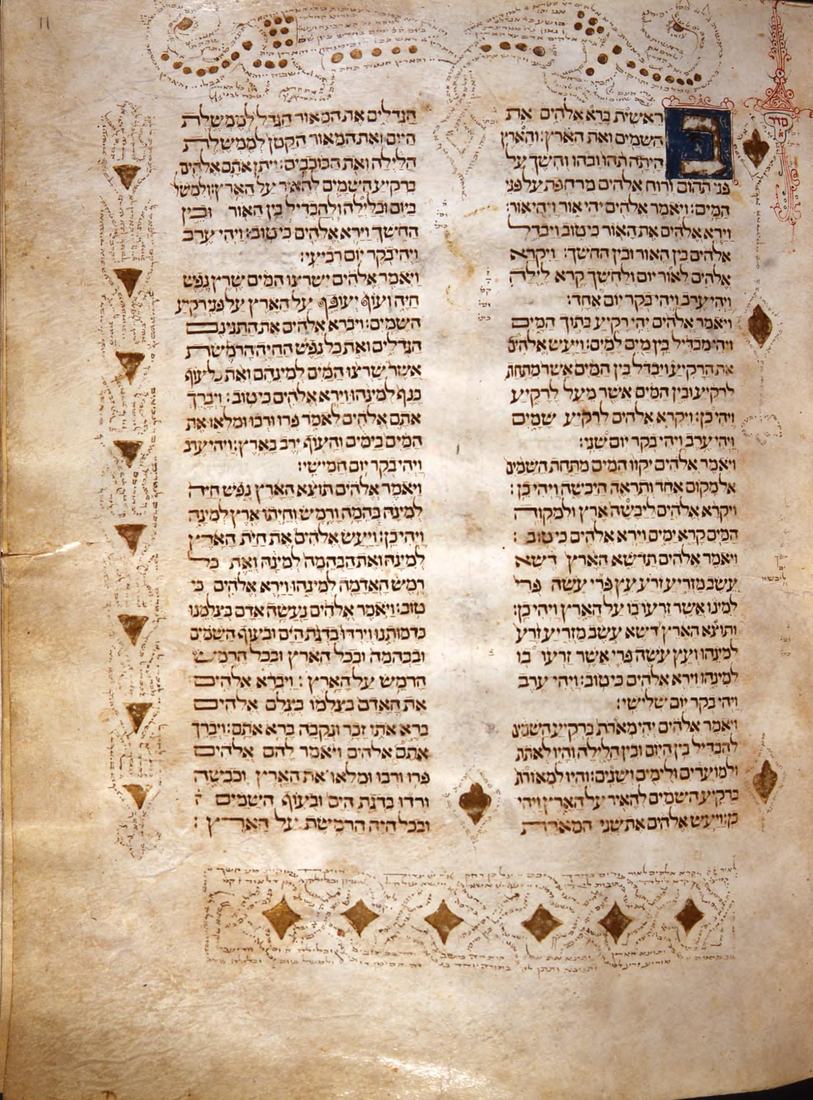
Genesis 1:1 · Hebrew
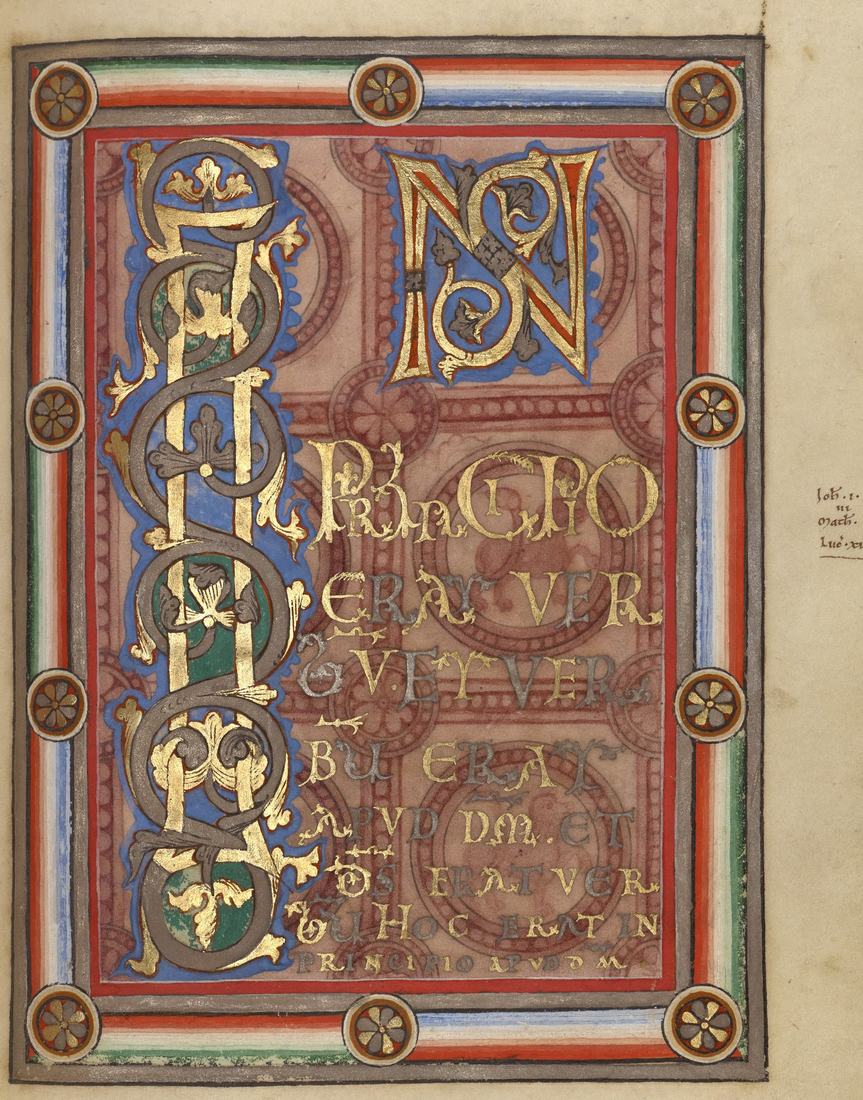
John 1:1 · Greek
19type studies
493references cited
5language studies
16texts in Hebrew and Greek
218cross-links
≈24hours of research (my estimate)
Researched by James Duncan; the research notes are from April and June 2026. This page was assembled with AI tools. AI research assistants checked its quotations, Hebrew and Greek words, counts and dates against sources, and what they could not check is listed under Limits. The ratings come from my notes, with one change that the page marks, and none of it is presented as proof of a faith.
The question
Did John write Genesis again, on purpose?
Typology is a way of reading the Bible as one pattern instead of a shelf of separate books. An Old Testament person, event or object, called a “type”, is said to prefigure a later one, called its “antitype”. The New Testament does this itself: Paul calls Adam a “type” of the one to come (Romans 5:14), says that what happened to Israel at the Red Sea and in the wilderness happened “by way of example” (1 Corinthians 10:11), and Jesus compares his own death to the bronze serpent Moses lifted up.
My question was narrower and easier to check: is the Gospel of John arranged to echo Genesis, line by line, and does the garden-tomb morning of John 20 undo the garden scene of Genesis 3? I started from the original-language texts, not from commentaries, and I rated every link by how directly the text itself makes it.
Each claim is marked as the text (what the words say), the pattern (how passages connect) or the reading (what it means). Only the first can be settled by looking at a document.
Every link has a rating
MAXIMUM, VERY STRONG or STRONG, by a plain rule: how directly Jesus or a New Testament author makes the connection themselves.
Every link has limits
Each study states what a thoughtful skeptic, or a scholar who rejects the link, would say.
Every quotation is checked
English quotations come from public-domain translations: the World English Bible (WEB) and the King James Version (KJV). New Testament Greek comes from the SBL Greek New Testament (SBLGNT, a scholarly edition), the Greek Old Testament from Brenton’s Septuagint, and Hebrew from the Westminster Leningrad Codex (the standard scholarly text of the Hebrew Bible). Word meanings come from lexicons, which are dictionaries of the original languages: Brown-Driver-Briggs (BDB) for Hebrew, Thayer’s for Greek, and the numbered word list called Strong’s. Nothing is quoted from memory.
How I tested
Three labels, three ratings, one rule: show the work
Every link in the type studies, the language studies and the John and Genesis table carries one of three labels, and every type study carries one of three ratings. The ratings come from my notes; the rule behind them is stated below, and Limits lists where the rule and a rating disagree.
The text
What the words say in the original language or a standard edition. Anyone with the same edition can check it.
The pattern
A literary or structural link between passages: a shared word, a repeated scene, the same order of events. It is arguable, so the evidence is shown.
The reading
A theological interpretation of what the pattern means. It is held by faith or tradition and cannot be proved by a document.
MAXIMUM
Jesus or a New Testament author explicitly makes or confirms the link: a direct quotation, a named comparison, or the technical word “type”.
VERY STRONG
An explicit identification, or a dense structural link with no single explicit verse.
STRONG
A structural link that no New Testament author states, resting on shared words, setting or order. It is the lowest tier I use, and the studies at this level say how loose the match is.
The six steps
Read the originalsHebrew from the Westminster Leningrad Codex (the standard scholarly text of the Hebrew Bible), the Greek Old Testament (the Septuagint), and the Greek New Testament (the SBL edition, a modern scholarly text). Sixteen passages are read in the original, some whole and some as selected verses, as the Texts tab shows.
Label every claimText, pattern or reading, so a reader can see which kind of claim they are being asked to accept.
Rate every linkBy how directly the New Testament itself makes it. The rule above restates the reasons given in my notes, and the check found places where the rule and a rating do not match (see Limits).
Cross-reference everythingThe 48 research notes link to each other 218 times and cite hundreds of passages. The graph below shows all of it.
State the limitsEvery study says what would make the link weaker, and the convergence test is marked exploratory.
Check the quotationsAI research assistants did a second pass: they compared every quotation, Hebrew and Greek word, count and date against a source, found errors in my notes, and wrote down what changed. They also drafted the label (text, pattern or reading) and the limits for each study. They did not set the ratings, which come from my notes; the one change, to the binding of Isaac, is marked on its study. Where a study says “I checked”, “I searched” or “I counted”, or describes other checking, adding, recomputing or calculating in the first person, that was this second pass, not work I did by hand.
What this file does not claim
That typology can be proved the way a land deed can.
That a reader who rejects the reading has to accept it.
That the convergence statistics show cause and effect; they do not, and I say so there.
That the ratings are a scholar's consensus; they come from my notes and are applied by a stated rule.
The result is not a proof of faith. It is a map. For the thesis itself: John’s opening words and the verb “breathed on” in John 20:22 are word matches with the Greek Genesis that anyone can check; the garden setting and the gardener are patterns; and the claim that John 20 reverses Genesis 3 is a reading that no verse states. The five Eden studies rate VERY STRONG or STRONG, never MAXIMUM. Most MAXIMUM ratings go to types that Jesus or a New Testament writer names outright, such as the bronze serpent, the Passover lamb and the manna; two exceptions are listed under Limits.
The hours behind this file, about 24 by my own estimate, are in the research ledger, marked as my own log because they come from my own count, not from a session record.
Updated October 2026. Research done in April and June 2026.
John and Genesis
Eleven places to compare the two stories
The core of the thesis. Each row sets a Genesis scene beside its echo in John, with the label for how the link is made.
In the beginning, God created the heavens and the earth.
John
John 1:1
In the beginning was the Word, and the Word was with God, and the Word was God.
The first two words of Genesis in the Septuagint, the Greek translation of the Hebrew Scriptures made before Jesus' time (Ἐν ἀρχῇ in Brenton's edition), are the first two words of John's Gospel. That match is checkable, but it holds in Greek only, because the Hebrew word is bereshit. That John means a "new creation" is an argument, not a fact. Matthew and Mark also open with words that echo Genesis, but only John uses these two.
בְּרֵאשִׁיתbereshitin the beginning (first word of Genesis in the Hebrew)Genesis
Ἐν ἀρχῇEn archēin (the) beginningGenesis (Greek OT) and JohnSame two words open Gen 1:1 in the Greek Old Testament and John 1:1 in the SBL Greek New Testament.
2 / 11The pattern
Genesis
Gen 1:3
God said, “Let there be light,” and there was light.
John
John 1:3
All things were made through him.
Genesis shows God making by speaking; John says all things came to be through "the Word" (ho logos). Psalm 33:6 already joins word and creation: "By Yahweh’s word, the heavens were made". So the idea is older than John, and John may draw on both. I rate it a pattern: the themes match, but the wording differs apart from common words such as egeneto, "came to be".
ὁ λόγοςho logosthe WordJohnJohn 1:1.
וַיֹּאמֶרvayyomerand he saidGenesisGen 1:3 (Hebrew).
3 / 11The pattern
Genesis
Gen 1:4
God saw the light, and saw that it was good. God divided the light from the darkness.
John
John 1:5
The light shines in the darkness, and the darkness hasn’t overcome it.
Both passages set light against darkness. Light is the same Greek word in both (φῶς). Darkness is related but not identical: the Greek Old Testament says skotos (Gen 1:2, 4, 5) and John says skotia. I rate it a pattern.
φῶςphōslightGenesis (Greek OT) and John
σκότοςskotosdarknessGenesis (Greek OT)Gen 1:2, 1:4, 1:5 in Brenton's text.
σκοτίαskotiadarknessJohnJohn 1:5. Related word, different form from skotos.
4 / 11The text
Genesis
Gen 2:7
Yahweh God formed man from the dust of the ground, and breathed into his nostrils the breath of life
John
John 20:22
When he had said this, he breathed on them
The Greek Old Testament says God "breathed" life into the first man (ἐνεφύσησεν, Gen 2:7). John 20:22 uses the same verb, and it is the only place the New Testament uses it. The word match is checkable; reading it as a "new creation" of the disciples is an interpretation. Thayer's lexicon ties the act to giving the Spirit and compares Ezek 37:5.
ἐνεφύσησενenephysēsenhe breathed on / intoGenesis (Greek OT) and JohnGen 2:7 in Brenton's text; John 20:22 in the SBL Greek New Testament. Thayer lists only John 20:22 for ἐμφυσάω, and a search of the SBL Greek New Testament finds no other use.
וַיִּפַּחvayyippachand he breathedGenesisGen 2:7 (Hebrew).
5 / 11The pattern
Genesis
Gen 2:8
Yahweh God planted a garden eastward, in Eden, and there he put the man whom he had formed.
John
John 19:41
Now in the place where he was crucified there was a garden.
John sets the arrest (18:1), the burial and the empty tomb in a garden, and says the tomb in it was new (19:41). Genesis puts the first man in a garden in Eden. John's Greek word is kēpos; the Greek Old Testament calls Eden a paradeisos in Gen 2-3, so no Greek word joins the two (Ezek 36:35 does call an Eden-like land a kēpos, and Thayer notes that the Septuagint uses kēpos for the Hebrew gan elsewhere). I rate it a pattern: same kind of setting, different words.
גַּןgangardenGenesis
παράδεισοςparadeisospark, gardenGenesis (Greek OT)Gen 2:8 and 2:15 in Brenton's text.
κῆποςkēposgardenJohnJohn 18:1, 18:26, 19:41. In Ezek 36:35 the Greek Old Testament has κῆπος τρυφῆς, "garden of delight", for the Hebrew "garden of Eden".
6 / 11The pattern
Genesis
Gen 2:15
Yahweh God took the man, and put him into the garden of Eden to cultivate and keep it.
John
John 20:15
She, supposing him to be the gardener, said to him
Genesis says the man was put in the garden “to cultivate and keep it” (Hebrew leovdah uleshomrah, literally to work it and to keep it). Mary supposes Jesus is the gardener (kēpouros, a word found nowhere else in the New Testament). The Hebrew never calls Adam a gardener, and Mary's guess is only her guess. Paul, not John, calls Christ “the last Adam” (1 Cor 15:45) and calls Adam a type (typos, Greek for a pattern or model) of the one to come (Rom 5:14).
לְעָבְדָהּ וּלְשָׁמְרָהּleovdah uleshomrahto work it and to keep itGenesisGen 2:15. Shamar (שָׁמַר), "keep, guard", is also the verb in Gen 3:24.
κηπουρόςkēpourosgardenerJohnJohn 20:15 only. Thayer's lexicon lists no other New Testament use.
7 / 11The pattern
Genesis
Gen 2:23
She will be called ‘woman,’ because she was taken out of Man.
John
John 20:1
Now on the first day of the week, Mary Magdalene went early, while it was still dark, to the tomb
Genesis 2:23 is where the first woman is named; John gives Mary Magdalene the first place at the empty tomb. In John, she is the first to reach the tomb (20:1) and the first to see the risen Jesus (20:14-16). She does not go in at first; Peter and the other disciple enter before her (20:5-8). Other accounts differ on who saw him first: Matthew 28:9 has the women meet him, Luke 24:34 names Simon, and Paul's list starts with Cephas (1 Cor 15:5). I rate the Eve parallel a pattern: a woman at a decisive moment in a garden.
אִשָּׁהishahwomanGenesisGen 2:23; the verse explains the word by its sound-play with ish, "man".
8 / 11The reading
Genesis
Gen 3:13
The serpent deceived me, and I ate.
John
John 20:14
she turned around and saw Jesus standing, and didn’t know that it was Jesus.
In Genesis the woman is deceived by the serpent. In John 20 Mary does not recognize Jesus, but nobody deceives her. Not recognizing the risen Jesus also happens on the road to Emmaus (Luke 24:16) and at the lake (John 21:4), so it is not special to Mary. I rate this the weakest link: it is a reading, not a match in the text.
Yahweh God said to the woman, “What have you done?”
John
John 20:15
Jesus said to her, “Woman, why are you weeping? Who are you looking for?”
Both are questions put to a woman in a garden. The Hebrew of Gen 3:13 is mah zot asit, which the KJV renders “What is this that thou hast done?” [KJV]. The questions in John 20:13-15 ask about her tears and who she is seeking, and the angels ask the first one. That John's question answers God's question in Genesis (blame, then comfort) is a reading; the shared setting is the pattern.
מַה־זֹּאת עָשִׂיתmah zot asitwhat is this you have doneGenesisGen 3:13. Greek OT: τί τοῦτο ἐποίησας; (Brenton's text; his page prints the accent on the verb as ἐποιήσας, here set to the standard form).
ΓύναιGynaiWoman (said when speaking to her)JohnJohn 20:13 and 20:15.
10 / 11The pattern
Genesis
Gen 3:24
he placed cherubim at the east of the garden of Eden ... to guard the way to the tree of life.
John
John 20:12
And seeth two angels in white sitting, the one at the head, and the other at the feet, where the body of Jesus had lain. [KJV]
Genesis names cherubim posted to guard the way to the tree of life; the Hebrew gives no number. John names two angels sitting where Jesus' body had lain. The Hebrew does not call the cherubim "angels," and John's angels only speak to Mary, so the idea that the guardians no longer block the way and access is restored is a reading. I rate the guardian echo a pattern.
כְּרֻבִיםkeruvimcherubim (plural; no number given)GenesisGen 3:24.
ἀγγέλουςangelousangelsJohnJohn 20:12.
καθεζομένουςkathezomenoussittingJohnJohn 20:12: one at the head, one at the feet.
11 / 11The reading
Genesis
Gen 3:19
for dust thou art, and unto dust shalt thou return. [KJV]
John
John 20:18
Mary Magdalene came and told the disciples that she had seen the Lord
Genesis 3:19 gives the sentence of death. John 20:18 reports that Mary "had seen the Lord" (Greek Ἑώρακα τὸν κύριον in her own words); it does not mention death or Adam. Paul sets Adam and Christ side by side on death and life: "as in Adam all die, so also in Christ all will be made alive" (1 Cor 15:22). That John 20 reverses Genesis 3 is the thesis I am testing, not a finding.
Ἑώρακα τὸν κύριονHeōraka ton kyrionI have seen the LordJohnJohn 20:18, Mary's words as the Greek gives them (direct speech).
What only John has
Only John uses the word "garden" (κῆπος) for the place of the crucifixion and burial.John 19:41True for the word. SBL Greek New Testament, John 19:41: ἦν δὲ ἐν τῷ τόπῳ ὅπου ἐσταυρώθη κῆπος, καὶ ἐν τῷ κήπῳ μνημεῖον καινόν (World English Bible: “Now in the place where he was crucified there was a garden. In the garden was a new tomb”). John also uses κῆπος for the arrest site (18:1, 18:26). Thayer lists only Luke 13:19 and John 18:1, 18:26 and 19:41 for the noun, and a search of the SBL Greek New Testament agrees.
Matthew 27:60, Mark 15:46 and Luke 23:53 say the tomb was cut in rock and use no word for garden. Matthew 26:36 and Mark 14:32 call Gethsemane a place (χωρίον); Luke 22:39 names the Mount of Olives. In the other Gospels the word κῆπος appears once, in a parable (Luke 13:19). They do not deny a garden; they just do not use the word. What the text supports saying is that there was a garden in the place where he was crucified, with a new tomb in it.
Only John has Mary taking Jesus for "the gardener" (κηπουρός).John 20:15True. κηπουρός occurs nowhere else in the New Testament (Thayer's Greek Lexicon lists John 20:15 only, and a search of the SBL Greek New Testament agrees), and no other Gospel has this scene. Two cautions: Mary only supposes it (δοκοῦσα), and not recognizing the risen Jesus is not unique to her (Luke 24:16, John 21:4).
John is the only Gospel with two angels sitting inside the tomb, one at the head and one at the feet. (Luke has two men, later called angels.)John 20:12My first notes said John is the only Gospel with two angels at the tomb. That is not true as written. Luke 24:4 has two men in dazzling clothing who “stood by” (ἐπέστησαν) the women, and Luke 24:23 calls the scene “a vision of angels” (ὀπτασίαν ἀγγέλων).
Matthew 28:2-5 has one angel of the Lord, who rolled the stone away and sat on it outside. Mark 16:5 has one young man (νεανίσκον) sitting on the right inside the tomb. What is unique to John: the figures are called angels in the scene itself, they sit inside the tomb, one at the head and one at the feet where the body lay (ἕνα πρὸς τῇ κεφαλῇ καὶ ἕνα πρὸς τοῖς ποσίν), and Mary sees them. The claim above is the corrected wording.
John alone opens with "In the beginning" (Ἐν ἀρχῇ).John 1:1True for the four Gospels, with one fix. Matthew 1:1 opens Βίβλος γενέσεως (literally book of origin; Thayer: “a book of one's lineage”), the phrase that heads Gen 2:4 and Gen 5:1 in the Greek Old Testament; Mark 1:1 opens Ἀρχὴ τοῦ εὐαγγελίου (“The beginning of the Good News”); Luke opens with a preface (1:1-4).
So all of them open with Genesis-flavored words, but only John uses the exact two words of Gen 1:1 in the Greek Old Testament (Brenton's text). My first notes called John 1:1 an “exact quotation”; it is the same two opening words, not a quotation, and it matches the Greek translation, not the Hebrew.
The verb "breathed on" (ἐμφυσάω) appears in the New Testament only in John 20:22, and it is the verb of Gen 2:7 in the Greek Old Testament.John 20:22True. SBL Greek New Testament John 20:22 has ἐνεφύσησεν; Brenton's Greek text of Gen 2:7 has ἐνεφύσησεν; Thayer lists John 20:22 as the New Testament's only use, and a search of the whole SBL Greek New Testament finds no other form of the verb. My research notes call this the strongest single-word connection; that is a judgment, so I only call it a word match.
The “woman” thread
In John, Jesus says "Woman" (Greek gynai) at Cana, to the Samaritan woman, from the cross and at the tomb, and the angels say it once too. I tested whether this echoes "the woman" of Genesis 3:15. But gynai was an ordinary polite address, so I rate that echo a reading. The firmer link is Revelation 12, where the woman, the ancient serpent and her offspring appear together.
Genesis: the word "woman" is givenGen 2:23 “She will be called ‘woman,’ because she was taken out of Man.” Hebrew ishah. (The text.)
Genesis: God speaks to the womanGen 3:13 “Yahweh God said to the woman, ‘What have you done?’” Hebrew la-ishah, "to the woman". This is a description, not an address by title. (The text.)
Genesis: hostility between the serpent and the womanGen 3:15 “I will put hostility between you and the woman, and between your offspring and her offspring.” Hebrew ha-ishah; the Greek Old Testament has τῆς γυναικός. (The text.) Whether this foretells one person is interpretation: the verse names no one. (The reading.)
John: CanaJohn 2:4 “Woman, what does that have to do with you and me?” Jesus to his mother; Greek Τί ἐμοὶ καὶ σοί, γύναι; (The text.)
John: the Samaritan womanJohn 4:21 “Woman, believe me”. Jesus to the woman at the well. Greek Πίστευέ μοι, γύναι. (The text.)
John: sorrow and birthJohn 16:21 “A woman, when she gives birth, has sorrow”. Greek ἡ γυνὴ ὅταν τίκτῃ λύπην ἔχει. The Greek Old Testament of Gen 3:16 has ἐν λύπαις τέξῃ τέκνα (Brenton: “in pain thou shalt bring forth children”): same noun (lypē, pain or sorrow) and same verb for bearing (tiktō). (The pattern: a shared-word link.)
John: the crossJohn 19:26 Jesus “said to his mother, ‘Woman, behold, your son!’” Greek Γύναι, ἴδε ὁ υἱός σου. (The text.)
John: the angels at the tombJohn 20:13 “Woman, why are you weeping?” The angels speak, not Jesus; Greek Γύναι, τί κλαίεις; (The text.)
John: Jesus at the tombJohn 20:15 “Woman, why are you weeping? Who are you looking for?” Greek Γύναι, τί κλαίεις; τίνα ζητεῖς; (The text.)
Same address elsewhereMatt 15:28; Luke 13:12; Luke 22:57 Jesus says "Woman" to the Canaanite woman (Matt 15:28) and to a woman he heals (Luke 13:12); Peter says it to the servant girl (Luke 22:57). Thayer's lexicon says gynai as an address can carry indignation, admiration, kindness or respect, and lists John 2:4 and 19:26 under "respect". So it is not a special title. (The text.)
Not counted: John 8:10John 8:10 The King James and World English Bibles have “Woman” here, but the Greek of this verse in the SBL Greek New Testament has no gynai. The passage (7:53-8:11) sits there in double brackets, the mark for text that Westcott and Hort did not think belonged to the genuine Gospel; the 2010 print edition gave it only in the notes, and the 2023 online update prints it in the text. I leave it out. (The text.)
Paul: born of a womanGal 4:4 “God sent out his Son, born to a woman, born under the law”. Greek γενόμενον ἐκ γυναικός. (The text.) Paul does not cite Gen 3:15 here; the link is a reading.
Revelation: the woman, the serpent, her offspringRev 12:9; Rev 12:17 “the old serpent” (ὁ ὄφις ὁ ἀρχαῖος) is thrown down; then “The dragon grew angry with the woman, and went away to make war with the rest of her offspring”. Greek τοῦ σπέρματος αὐτῆς. The nearest New Testament echo of Gen 3:15, with all three actors present. (The pattern.)
The Genesis 5 name chain
The ten names from Adam to Noah (Gen 5) can be strung into a sentence that sounds like the gospel: “Man (is) appointed mortal sorrow; (but) the Blessed God shall come down teaching; his death shall bring the despairing rest/comfort.” Below, “the chain” means that sentence. I checked each name in BDB, the standard Hebrew lexicon of 1906, and in Strong's short glosses. Four meanings are standard, one is probable, two are loose or paraphrased (Enoch and Mahalalel), and three are non-standard or unknown: Kenan, Methuselah and Lamech. The sentence works only if those three are chosen to fit, so I treat it as a reading, not evidence.
AdamאָדָםBDB: "man, mankind." The chain uses "Man." Gen 2:7…Standard…
BDB: "man, mankind." The chain uses "Man." Gen 2:7 plays on adamah (ground), but BDB does not derive the name from it; Strong's links it to a verb meaning "be red."
SethשֵׁתBDB: Gen 4:25 explains the name from the verb shith,…Standard (the text explains it)…
BDB: Gen 4:25 explains the name from the verb shith, "put, set." The KJV renders it "appointed", the WEB "given". The chain uses "appointed."
EnoshאֱנוֹשׁBDB: "man, mankind," mostly poetic and often set…Standard for "man"; "mortal" is a nuance…
BDB: "man, mankind," mostly poetic and often set against God. The chain uses "mortal." BDB keeps the verb "be weak, sick" as a separate word, so "mortal" is a nuance, not the dictionary meaning.
KenanקֵינָןBDB gives no meaning (it only notes a Sabaean divine…Contested (weakest link)…
BDB gives no meaning (it only notes a Sabaean divine name spelled the same). The Strong's list gives "possession"; Strong's own entry says "fixed." The name sounds like Cain (Qayin), but neither BDB nor Strong's derives Kenan from Cain. The chain uses "sorrow," which no lexicon I checked supports; it would need the name to come from qinah, "dirge."
MahalalelמַהֲלַלְאֵלBDB: "praise of God," and it notes a proposed reading…Standard compound; the chain's wording is a paraphrase…
BDB: "praise of God," and it notes a proposed reading with different vowels (Mehallel-el). The chain uses "the Blessed God," a paraphrase that turns the name into a statement about God.
JaredיֶרֶדBDB gives no meaning for the nameProbable (BDB gives no meaning)…
BDB gives no meaning for the name. Strong's: "descent," from yarad, "go down." The chain uses "shall come down," a verb form.
EnochחֲנוֹךְBDB gives no meaning for the nameDefensible but loose…
BDB gives no meaning for the name. The verb chanak means "train up, dedicate" (Prov 22:6; dedicating a house), and the word Hanukkah ("dedication") comes from the same verb; the Strong's list gives "dedicated" (Strong's own entry: "initiated"). The chain uses "teaching," a stretch from "train up."
MethuselahמְתוּשֶׁלַחBDB: "? man of the dart: more probNon-standard reading (assembled)…
BDB: "? man of the dart: more prob. Bab." (that is, Babylonian), so uncertain and probably a Babylonian-style name (cf. Methushael, "man of God"). The chain uses "his death shall bring," which reads the name as "death" plus "send"; BDB lists "send" and "weapon" as separate words. The "died in the Flood year" arithmetic works only on the Hebrew numbers (187 + 182 + 600 = 969, Gen 5:25, 5:28, 7:6, 5:27); the Greek Old Testament's numbers (167 + 188 + 600) give 955, fourteen years short.
LamechלֶמֶךְBDB gives no meaning (it cites only a scholar's…Contested (meaning unknown)…
BDB gives no meaning (it cites only a scholar's conjecture). The Strong's list gives "powerful"; Strong's own entry says the root is of uncertain meaning. The chain uses "the despairing," which no lexicon I checked supports.
NoahנֹחַBDB gives the name without a meaning and marks Gen 5:29…Standard (the text glosses it)…
BDB gives the name without a meaning and marks Gen 5:29 as the "trad. etym." (traditional etymology); Strong's: "rest," the same as nuach. The verse itself says "This one will comfort us" (Hebrew yenachamenu, from nacham), a sound-play. The chain uses "rest / comfort."
The assembled sentence, "Man (is) appointed mortal sorrow; (but) the Blessed God shall come down teaching; his death shall bring the despairing rest/comfort," is a devotional reading, not what Genesis says: the chapter is a genealogy with ages, and no verse presents the names as a message. It needs three glosses that are non-standard or unknown (Kenan, Methuselah, Lamech) and two that are loose or paraphrased (Enoch, Mahalalel). Names also repeat: Enoch and Lamech appear in Cain's line too (Gen 4:17-19). I could not trace who first proposed the reading, and I found no lexicon that supports the whole sentence, so I label it the reading.
19 types
Nineteen types, each rated and each limited
Each study sets an Old Testament type beside its New Testament antitype, then gives my rating and the plain reason for it, the key passages, the words that matter, and what a skeptic would say. The reference line on each card runs from the Old Testament passage to the New Testament passage and, where there is one, to a closing passage that ends the thread, usually in Revelation.
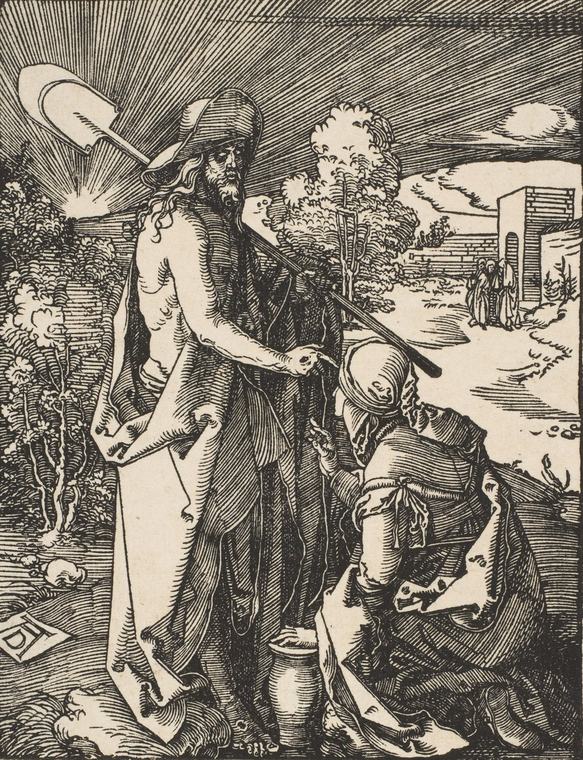
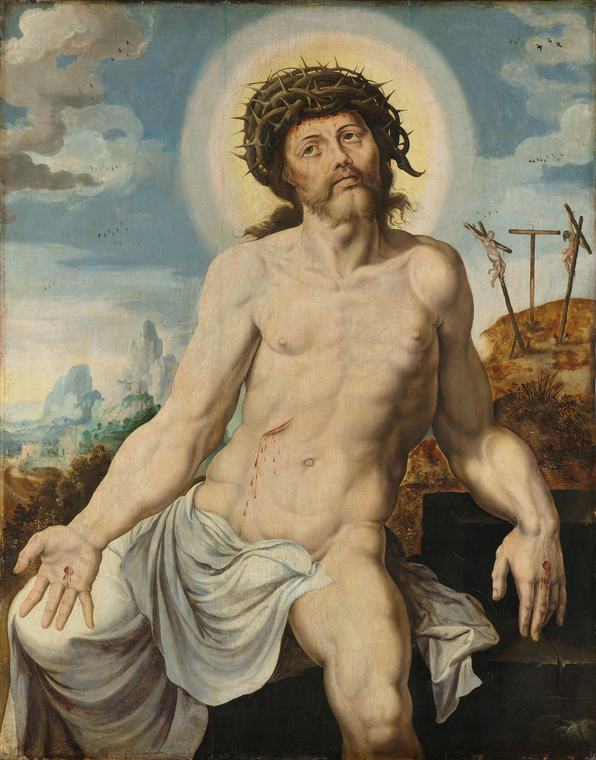
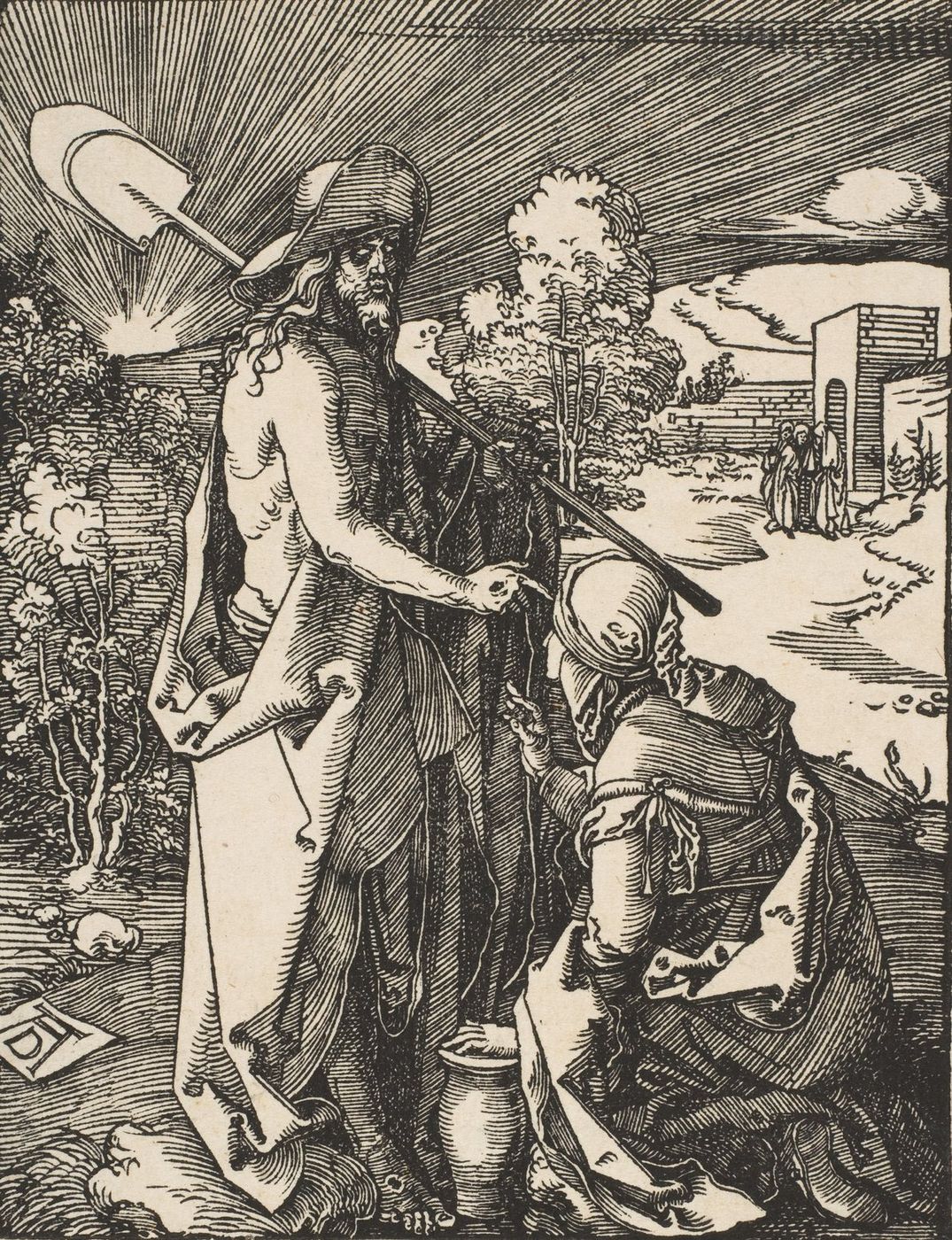
Albrecht Dürer's woodcut from the Small Passion (about 1510) shows the risen Jesus dressed as a gardener, with a spade on his shoulder and a broad-brimmed hat, while Mary Magdalene kneels beside a jar and reaches toward him (John 20:15). It is a representative image of Jesus as the new gardener.
Adam and the gardener at the tomb
VERY STRONG
Gen 2:15→John 20:15; Rom 5:14; 1 Cor 15:45
Genesis says God put the man in the garden to work it and keep it. Paul says Adam is a type, a pattern pointing ahead, of the one to come, and he calls Christ the last Adam. In John 20, Mary supposes the risen Jesus is the gardener, a word the New Testament uses only here. Paul makes the Adam link and John never does, so I treat the gardener scene as a fitting echo that John does not state.
My rating: My notes rate it very strong and point to Paul: Romans 5:14 and 1 Corinthians 15:45. I checked both. Paul says outright that Adam is a type of the one to come and calls Christ the last Adam, so the Adam and Christ pairing meets my top test. The gardener scene is different: John never says Jesus is Adam, so I hold the study at very strong and not at the top.
The arc
The first gardenerGen 2:15 God puts the man in the garden of Eden to work it and keep it. (The text)
Adam as a patternRom 5:14 Paul says Adam is a type (Greek typos, a pattern or figure that points ahead) of the one who was to come. (The text)
The last Adam1 Cor 15:45-47 Paul says the first Adam became a living soul and the last Adam became a life-giving spirit. The first man is of the earth, the second from heaven. (The text)
The gardenerJohn 20:15 Mary, supposing him to be the gardener, speaks to Jesus. (The text) That she is more right than she knows, because the last Adam stands in a new garden, is my reading. (The reading)
Key passages
Gen 2:15Type
Yahweh God took the man, and put him into the garden of Eden to cultivate and keep it.World English Bible (public domain), 2020 stable text, Gen 2:15
וַיִּקַּ֛ח יְהוָ֥ה אֱלֹהִ֖ים אֶת־הָֽאָדָ֑ם וַיַּנִּחֵ֣הוּ בְגַן־עֵ֔דֶן לְעָבְדָ֖הּ וּלְשָׁמְרָֽהּWestminster Leningrad Codex (public domain), text as in the OpenScriptures Hebrew Bible, Gen 2:15
Rom 5:14Support
who is the figure of him that was to comeKing James Version (1769 text, public domain), Rom 5:14 (the end of the verse; the WEB has “who is a foreshadowing of him who was to come”)
“The first man Adam became a living soul.” The last Adam became a life-giving spirit.World English Bible (public domain), 2020 stable text, 1 Cor 15:45
לְעָבְדָהּ וּלְשָׁמְרָהּle'ovdah uleshomrahto work it and to keep itGen 2:15Avad means to work or serve. Shamar means to keep or guard. The same two verbs appear together for the Levites’ duties at the tabernacle (Num 3:7-8), so the phrase is not only farming language.
κηπουρόςkēpourosgardener, garden keeperJohn 20:15Built from kēpos (garden) and ouros (warden or guard), according to Strong’s and Thayer. I checked the whole SBL Greek New Testament, and it occurs only here.
τύποςtyposmark, pattern, figure that points aheadRom 5:14Thayer lists a sense in which a person or thing prefigures a future Messianic person or thing, and gives Rom 5:14 as its example. Thomas uses the same word in John 20:25 for the “print” of the nails, which is the word’s first sense in Thayer and not a claim about typology. The word “typology” comes from it: typology is the study of how an Old Testament person or event (a type) is paired with a New Testament one (the antitype).
ὁ ἔσχατος Ἀδάμho eschatos Adamthe last Adam1 Cor 15:45Paul’s own phrase for Christ.
ψυχὴν ζῶσανpsychēn zōsanliving soul1 Cor 15:45; Gen 2:7 (Septuagint)Paul’s words quote Gen 2:7 in the Septuagint, which translates the Hebrew nefesh chayyah (WEB: “a living soul”). Paul adds “first” and “Adam” to the quotation, and then adds the line about the last Adam.
χοϊκόςchoïkosmade of dust, earthy1 Cor 15:47-49Paul calls the first man “of the earth, made of dust” (WEB). The word comes from the Greek for dust, and the Septuagint of Gen 2:7 has God form the man from dust of the earth (χοῦν ἀπὸ τῆς γῆς). The echo of Genesis is plain, and what Paul adds is the contrast with the second man from heaven.
ἐνεφύσησενenephysēsenhe breathed onJohn 20:22; Gen 2:7 (Septuagint)In John 20:22 Jesus breathes on the disciples and tells them to receive the Holy Spirit. The Septuagint uses the same verb when God breathes into the man in Gen 2:7, and it appears only here in the Greek New Testament. That John means an echo of Genesis is a pattern, and he does not say it.
Limits
John never says Jesus is the gardener or the new Adam. Mary only supposes it, and a man standing in a garden early in the morning is a natural guess. Paul’s Adam passages never mention a garden.
Paul’s comparison in Romans 5 and 1 Corinthians 15 is about death and life, not about gardening. So the explicit Adam link and the gardener scene support each other only if you already read John 20 in a Genesis frame.
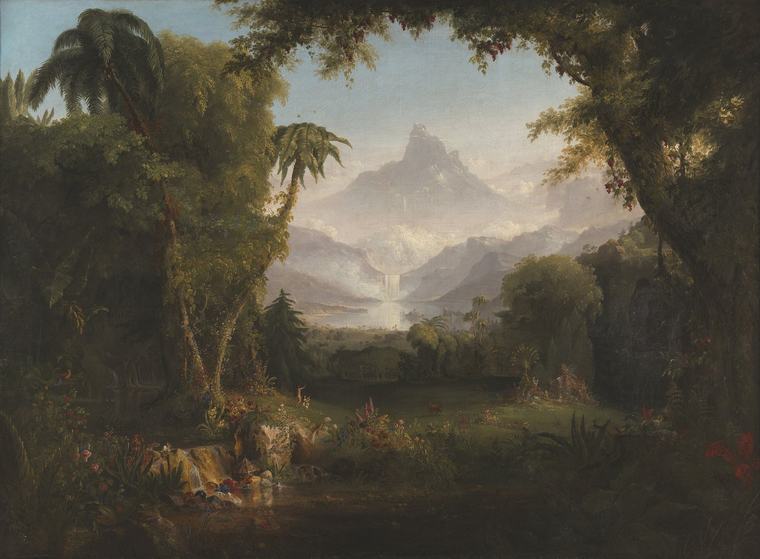
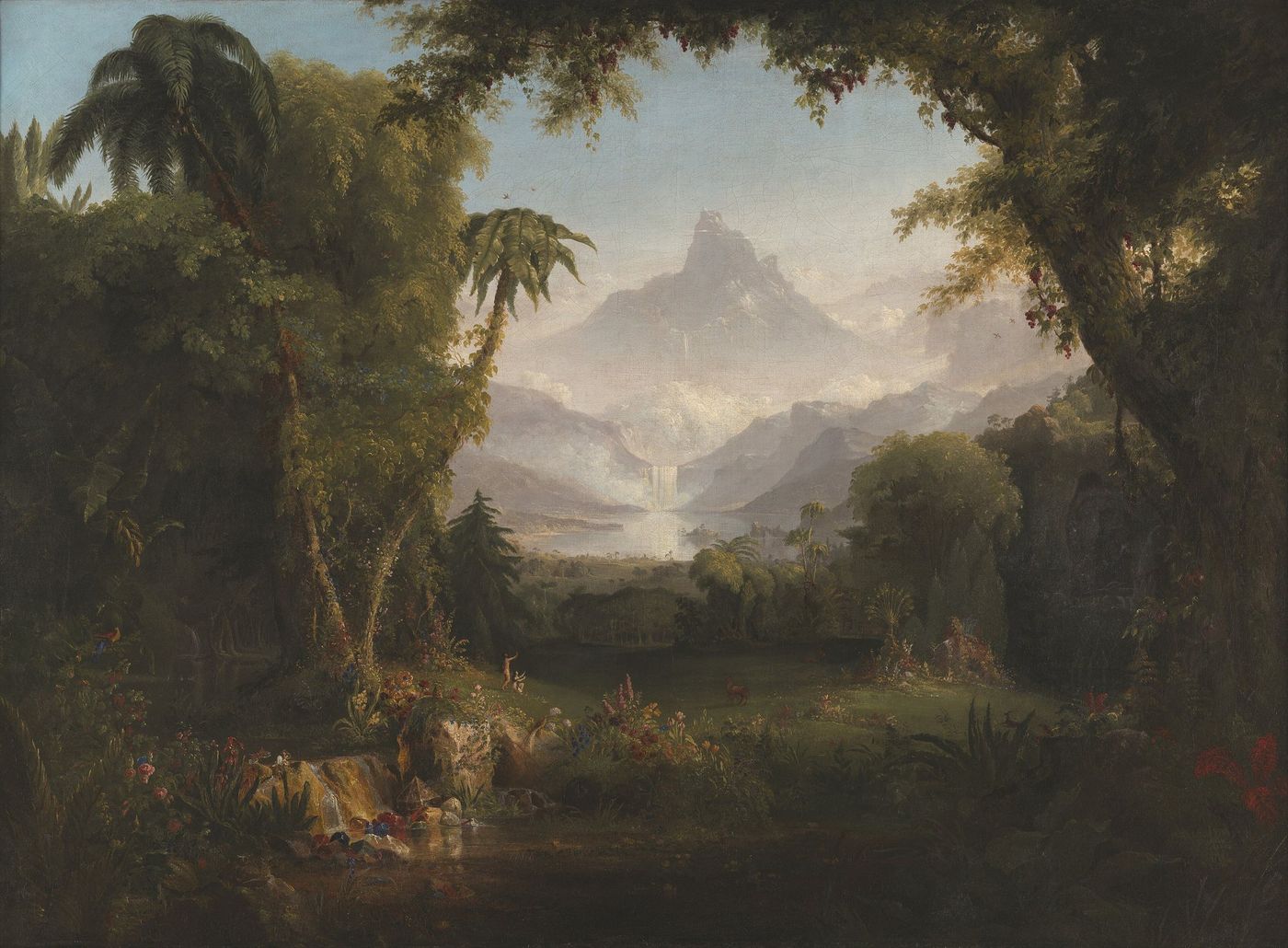
Thomas Cole's The Garden of Eden (1828) shows Eden as a luxuriant valley of palms, grapevines, flowers and waterfalls, with Adam and Eve as tiny figures in the meadow. It is a representative 19th-century picture of the garden that this study sets beside the garden of the tomb.
The garden of Eden and the garden tomb
VERY STRONG
Gen 2:8→John 19:41
In Genesis, God plants a garden in Eden. John, alone among the four Gospels, says Jesus was buried in a tomb in a garden, and he also puts the arrest in a garden and has Mary mistake the risen Jesus for the gardener. John’s first words, “In the beginning,” are the opening words of Genesis in the Greek Old Testament. I think the pattern is deliberate, but no verse in the Gospel says so.
My rating: My notes say John is “the ONLY Gospel that specifies the crucifixion/burial site was a garden” and call that “intentional literary architecture.” I checked the first claim against the Greek of all four Gospels, and it holds for the tomb. “Intentional” is my inference, since no author says it. I keep very strong because John uses the garden in three scenes, a dense structural link with no single explicit verse; this study shares its evidence with the gardener and cherubim studies, so they are not separate confirmations.
The arc
PlantedGen 2:8 God plants a garden in Eden and puts the man there. (The text)
The same first wordsJohn 1:1; Gen 1:1 John opens with “In the beginning” (Ἐν ἀρχῇ). Those are the first words of Genesis in the Septuagint, the ancient Greek translation of the Hebrew Scriptures. (The text) That this frames the whole Gospel as a new creation is the thesis I am testing. (The reading)
Three garden scenesJohn 18:1; 19:41; 20:15 John places the arrest, the burial and the first scene after the resurrection in a garden. Matthew and Mark never say the tomb was in a garden. Luke has a garden only in a parable (13:19). (The text)
One garden, then anotherJohn 19:41-20:1 In my reading, what went wrong in the first garden is answered in the second: death entered one and is overturned in the other. (The reading)
Key passages
Gen 2:8Type
Yahweh God planted a garden eastward, in Eden, and there he put the man whom he had formed.World English Bible (public domain), 2020 stable text, Gen 2:8
וַיִּטַּ֞ע יְהוָ֧ה אֱלֹהִ֛ים גַּן־בְעֵ֖דֶן מִקֶּ֑דֶם וַיָּ֣שֶׂם שָׁ֔ם אֶת־הָֽאָדָ֖ם אֲשֶׁ֥ר יָצָֽרWestminster Leningrad Codex (public domain), text as in the OpenScriptures Hebrew Bible, Gen 2:8
Gen 1:1 (Septuagint)Support
In the beginning God made the heaven and the earth.Brenton, The Septuagint Version of the Old Testament, with an English translation (London: Bagster, 1879; public domain), Gen 1:1, English column
Ἐν ἀρχῇ ἐποίησεν ὁ Θεὸς τὸν οὐρανὸν καὶ τὴν γῆν.Brenton, The Septuagint Version of the Old Testament, Greek column (London: Bagster, 1879; public domain), Gen 1:1
John 1:1Support
In the beginning was the Word, and the Word was with God, and the Word was God.World English Bible (public domain), 2020 stable text, John 1:1
he went out with his disciples over the brook Kidron, where there was a garden, into which he and his disciples entered.World English Bible (public domain), 2020 stable text, John 18:1
Now in the place where he was crucified there was a garden. In the garden was a new tombWorld English Bible (public domain), 2020 stable text, John 19:41
בְּרֵאשִׁיתbereshitin the beginningGen 1:1The Hebrew word that opens Genesis. The Septuagint translates it with the two Greek words Ἐν ἀρχῇ, and John 1:1 begins with the same two words. John does not say he is echoing Genesis.
גַּןgangardenGen 2:8The Hebrew word for the garden in Eden.
παράδεισοςparadeisospark, gardenGen 2:8 (Septuagint); Luke 23:43; Rev 2:7The Septuagint uses this word for Eden in Genesis 2. John does not use it. The same word appears in Luke 23:43 and Rev 2:7.
κῆποςkēposgardenJohn 18:1, 18:26, 19:41; Luke 13:19 (a parable)The Septuagint renders “the garden of Eden” in Ezek 36:35 as kēpos (“garden of delight” in Brenton’s English). So a Greek reader could hear kēpos as a word for Eden. It is still not the word the Septuagint uses in Genesis 2.
Ἐν ἀρχῇEn archēIn the beginningJohn 1:1; Gen 1:1 (Septuagint)Same two Greek words at the start of both books.
Limits
John never mentions Eden. The garden may simply be a real place near the crucifixion, and John uses the same word for the garden of the arrest (18:1) and in the question put to Peter (18:26), so it may be his ordinary word for that place. The Greek word is also not the Septuagint’s word for Eden in Genesis 2, although the Septuagint does use kēpos for Eden in Ezekiel 36:35. So the link is possible, not forced.
This study, the gardener study and the cherubim study all lean on the same two chapters, John 19 and 20. They are not three separate confirmations.
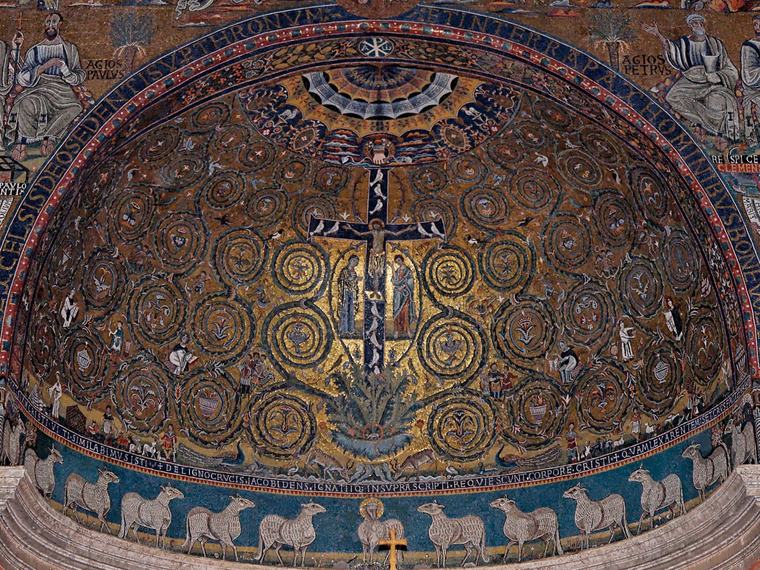
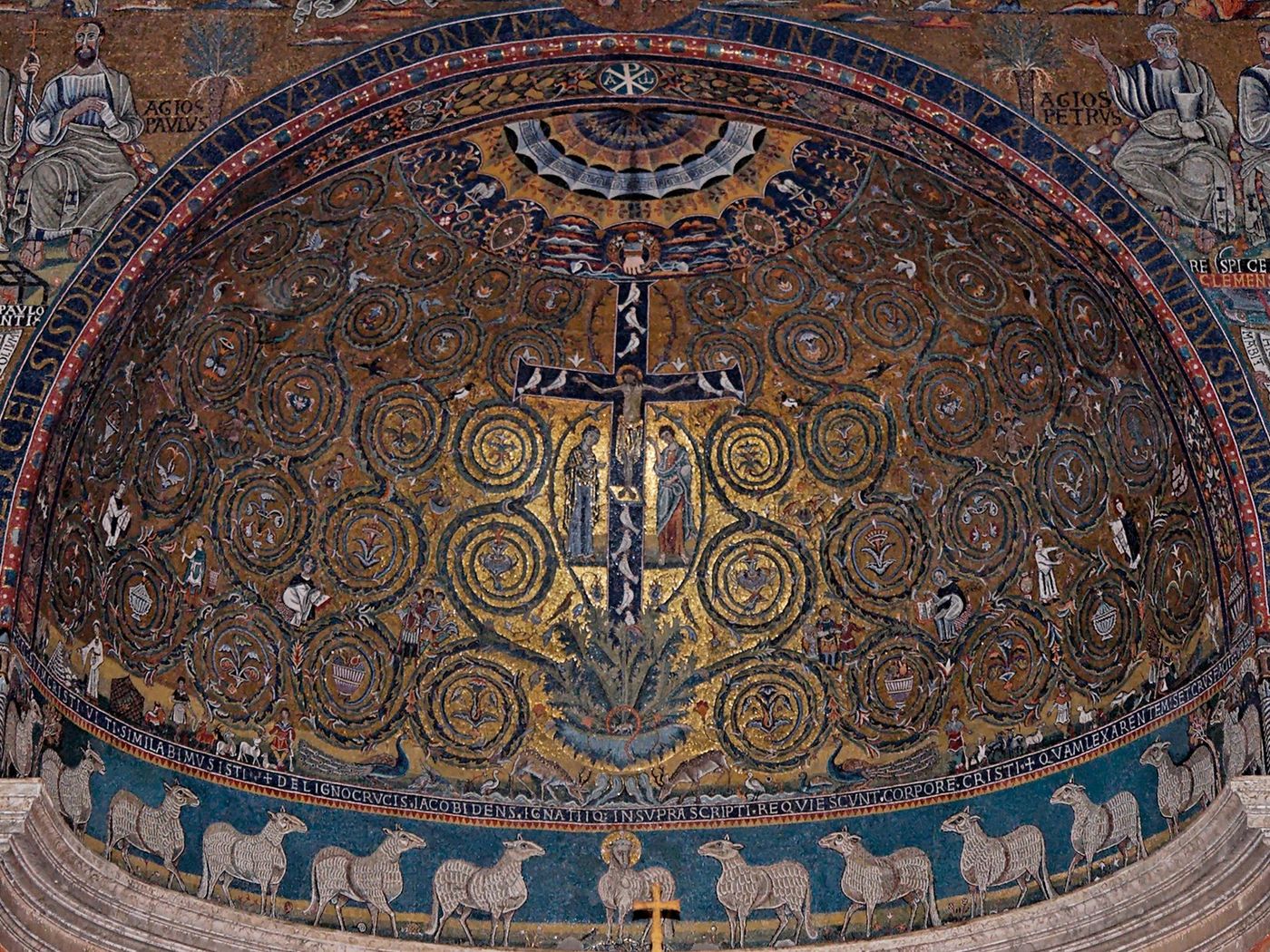
Apse mosaic of the Basilica of San Clemente in Rome (12th century): Christ crucified on a cross that rises from an acanthus plant like a tree, with vine scrolls spreading across the half-dome. It is a representative medieval image of the cross as the tree of life, the thread this study follows from Eden to the New Jerusalem.
The tree of life, from Eden to Revelation
VERY STRONG
Gen 2:9; 3:22-24→John 6:51-58; 14:6→Rev 2:7; 22:2
God plants the tree of life in the middle of Eden. After the fall he blocks the way to it, so the man cannot eat and live forever. In Revelation, Christ promises the one who overcomes the right to eat from it, and it stands by the river in the final city. In John, Jesus calls himself the life and the bread that gives life forever, language that echoes what the tree was for.
My rating: My notes call it “widely accepted across scholarship.” I could not check that against a source I opened, so I rest the rating on the texts. The same phrase, tree of life, runs from Genesis to Revelation 2:7 and 22:2, a dense structural link with no single verse that states it. That Christ is the tree himself is not stated anywhere, so that step is a reading.
The arc
PlantedGen 2:9 God makes the tree of life grow in the middle of the garden. (The text)
BarredGen 3:22-24 After the fall God sends the man out so that he cannot take from the tree and live forever. Cherubim and a flaming sword guard the way. (The text)
EmbodiedJohn 6:51-58; 14:6 Jesus says he is the living bread and that whoever eats of it will live forever. He also says he is the way, the truth and the life. Eating and living forever go together in Genesis 3:22 and in John 6:51. (The pattern) Saying that Jesus is the tree itself is my reading. (The reading)
RestoredRev 2:7; 22:2 Christ promises the one who overcomes the right to eat from the tree of life. In the final vision it stands by the river, and its leaves are for the healing of the nations. (The text)
Key passages
Gen 2:9Type
including the tree of life in the middle of the garden and the tree of the knowledge of good and evil.World English Bible (public domain), 2020 stable text, Gen 2:9
וְעֵ֤ץ הַֽחַיִּים֙ בְּת֣וֹךְ הַגָּ֔ן וְעֵ֕ץ הַדַּ֖עַת ט֥וֹב וָרָֽעWestminster Leningrad Codex (public domain), text as in the OpenScriptures Hebrew Bible, Gen 2:9
Gen 3:22Type
lest he reach out his hand, and also take of the tree of life, and eat, and live foreverWorld English Bible (public domain), 2020 stable text, Gen 3:22
פֶּן־יִשְׁלַ֣ח יָד֗וֹ וְלָקַח֙ גַּ֚ם מֵעֵ֣ץ הַֽחַיִּ֔ים וְאָכַ֖ל וָחַ֥י לְעֹלָֽםWestminster Leningrad Codex (public domain), text as in the OpenScriptures Hebrew Bible, Gen 3:22
John 6:51Antitype
I am the living bread which came down out of heaven. If anyone eats of this bread, he will live forever.World English Bible (public domain), 2020 stable text, John 6:51
the tree of life, bearing twelve kinds of fruits … The leaves of the tree were for the healing of the nations.World English Bible (public domain), 2020 stable text, Rev 22:2
עֵץ הַחַיִּיםetz ha-chayyimthe tree of lifeGen 2:9; 3:22, 24Chayyim (life) is plural in form. Brown-Driver-Briggs calls it a plural “abstract emphatic” noun meaning life, and it is the ordinary Hebrew word for life, as in “breath of life” (Gen 2:7). I do not build anything on the plural.
ξύλον τῆς ζωῆςxylon tēs zōēstree (or wood) of lifeGen 2:9 (Septuagint); Rev 2:7; 22:2The Septuagint, the ancient Greek translation of the Hebrew Scriptures, uses this phrase in Gen 2:9, and Revelation uses it at the end. Xylon means any tree or piece of wood, and it is also the word for the cross in Acts 5:30 and 1 Pet 2:24. Gal 3:13 quotes Deut 21:23, where the Greek also says xylon. Because it is the ordinary word for tree, I treat the cross link through this one word as a weak pattern.
ζήσει εἰς τὸν αἰῶναzēsei eis ton aiōnawill live foreverJohn 6:51, 58; compare Gen 3:22 (Septuagint: ζήσεται εἰς τὸν αἰῶνα)The SBL text of John 6:51 reads zēsei. Its footnotes record that another form, zēsetai (the same form as Gen 3:22 in the Septuagint), is the reading of an older printed edition (Tregelles) and of the Byzantine text (the Greek used in most later manuscripts). In 6:58 only the Byzantine text has it. “Forever” is a common Greek idiom, so I count the echo as a pointer, not proof.
Limits
No New Testament verse says Jesus is the tree of life. In Revelation the tree is a separate thing, and Christ is the one who gives access to it. John 6 and 14 never mention a tree. “Embodied” is the step where I move from a pattern to a reading.
“Tree of life” is not a phrase only for Eden. Proverbs 3:18 says of wisdom, “She is a tree of life to those who lay hold of her.” So each link here is a pointer, and the strength comes from the whole chain, not from any one word.
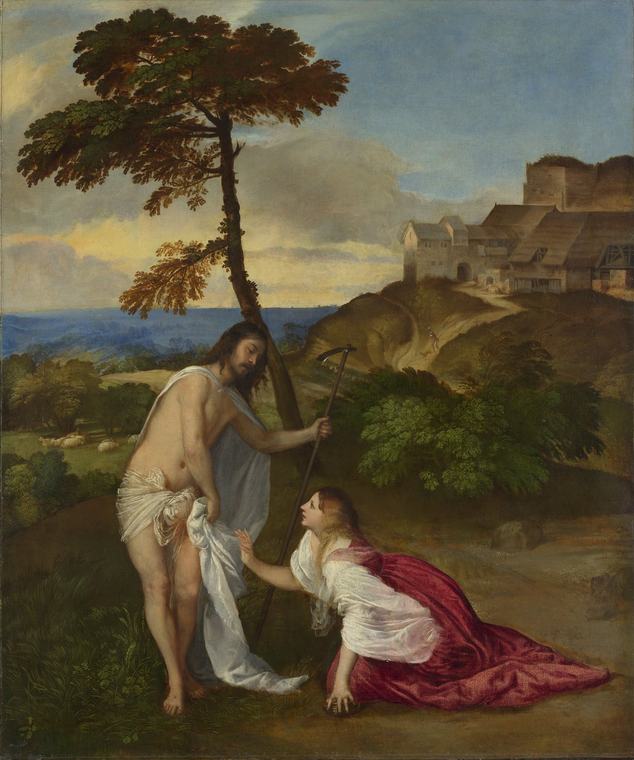
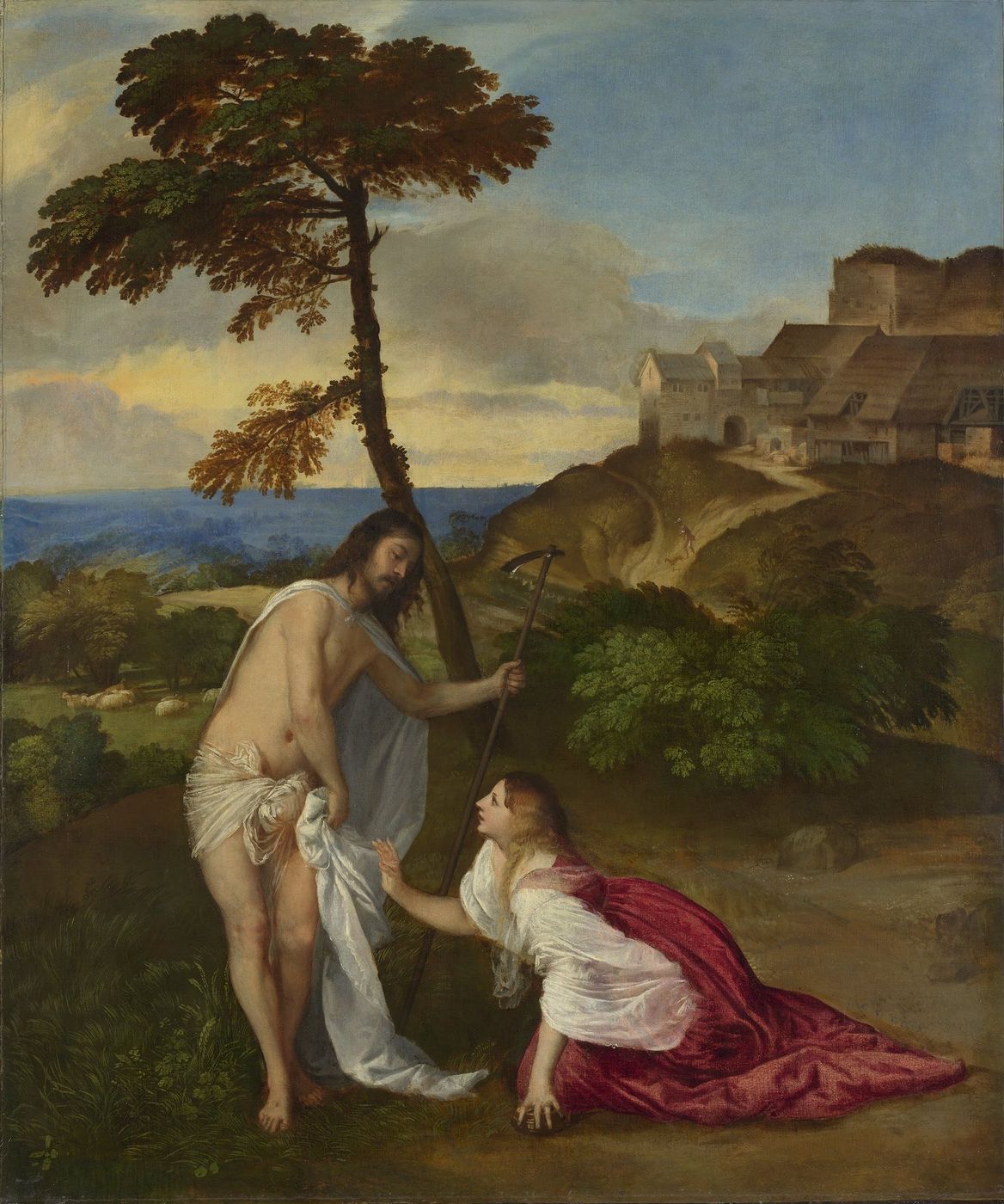
Titian's Noli me Tangere (about 1514): Mary Magdalene kneels in a green landscape and reaches toward the risen Jesus, who holds a hoe and draws back as he tells her not to touch him (John 20:14-17). It is a representative painting of the garden-tomb meeting that this study sets against Eve in Eden.
Eve and Mary Magdalene
STRONG
Gen 3:1-6, 13→John 20:1-18
In Genesis the woman listens to the serpent, eats, and is asked what she has done. In John, Mary Magdalene stands weeping in a garden, is asked why she is weeping, and recognizes Jesus only when he says her name. She then tells the disciples she has seen the Lord. I treat the two women as a pattern of loss and recovery, but no one in the text draws that comparison.
My rating: My notes give only the rating, strong. It is the lowest tier I use, and the link is loose. It rests on the garden setting, the address “woman,” and a pair of questions that are not the same question. No author compares Eve to Mary Magdalene.
The arc
A woman in a gardenGen 3:1-6 The serpent speaks to the woman, she eats the fruit, and she gives some to her husband. (The text)
The questionGen 3:13; John 20:13, 15 God asks Eve what she has done. At the tomb the angels and Jesus ask Mary why she is weeping. These are different questions: one asks about an act, the other about grief. (The pattern)
Called by nameJohn 20:16; 10:3 Jesus says “Mary” and she knows him. In John 10:3 the shepherd calls his own sheep by name. (The text) Set against Eve, who was misled by a voice, Mary knows the right one. (The pattern)
First to tellJohn 20:18; Luke 8:2 Mary Magdalene tells the disciples she has seen the Lord. Luke 8:2 says seven demons had gone out of her. (The text) Seeing her as the answer to Eve is an interpretation I add. (The reading)
Key passages
Gen 3:1Type
He said to the woman, “Has God really said, ‘You shall not eat of any tree of the garden’?”World English Bible (public domain), 2020 stable text, Gen 3:1
וַיֹּ֨אמֶר֙ אֶל־הָ֣אִשָּׁ֔ה אַ֚ף כִּֽי־אָמַ֣ר אֱלֹהִ֔ים לֹ֣א תֹֽאכְל֔וּ מִכֹּ֖ל עֵ֥ץ הַגָּֽןWestminster Leningrad Codex (public domain), text as in the OpenScriptures Hebrew Bible, Gen 3:1
Gen 3:13Type
What is this that thou hast done? And the woman said, The serpent beguiled me, and I did eat.King James Version (1769 text, public domain), Gen 3:13 (the WEB has “What have you done?”; the KJV is closer to the Hebrew words)
מַה־זֹּ֣את עָשִׂ֑ית וַתֹּ֨אמֶר֙ הָֽאִשָּׁ֔ה הַנָּחָ֥שׁ הִשִּׁיאַ֖נִי וָאֹכֵֽלWestminster Leningrad Codex (public domain), text as in the OpenScriptures Hebrew Bible, Gen 3:13
John 20:13Antitype
They asked her, “Woman, why are you weeping?”World English Bible (public domain), 2020 stable text, John 20:13
Jesus said to her, “Mary.” She turned and said to him, “Rabboni!” which is to say, “Teacher!”World English Bible (public domain), 2020 stable text, John 20:16
Mary Magdalene came and told the disciples that she had seen the Lord, and that he had said these things to her.World English Bible (public domain), 2020 stable text, John 20:18
γύναιgynaiwoman (as a form of address)John 2:4; 4:21; 19:26; 20:13, 15Jesus says it to his mother, to the Samaritan woman at the well, and to Mary Magdalene. It is his ordinary way to address a woman, so by itself it does not point to Eve.
ΜαριάμMariamMary (the Hebrew form of the name)John 20:16, 18The SBL text prints this form in 20:16 and, with a different accent mark, in 20:18. The Byzantine text reads Μαρία in both places. The argument does not depend on the spelling.
ΡαββουνιRhabbounimy teacherJohn 20:16John introduces it with “in Hebrew” (Ἑβραϊστί; the Byzantine text leaves that word out) and translates it “Teacher” (Διδάσκαλε). The SBL text prints Ραββουνι without accents.
נָחָשׁnachashserpentGen 3:1, 3:13The woman’s answer in Gen 3:13 uses it: “The serpent beguiled me” (KJV). It is also the word for the snakes in Numbers 21, so the bronze serpent study and this one share it. Brown-Driver-Briggs lists the Eden serpent and the Numbers snakes under the same entry.
Limits
Nobody in the text compares Mary Magdalene to Eve. The early “new Eve” comparisons that I could check, Justin Martyr’s Dialogue with Trypho 100 and Irenaeus’s Against Heresies 3.22.4, are about Mary the mother of Jesus. Linking Mary Magdalene is a different move, and I mark it as a reading.
The two scenes do not match closely. God asks Eve what she has done, while the angels and Jesus ask Mary why she is weeping. Eve’s story is about a choice, but Mary is grieving for a missing body, and John never says she is deceived, only that she supposes Jesus to be the gardener.
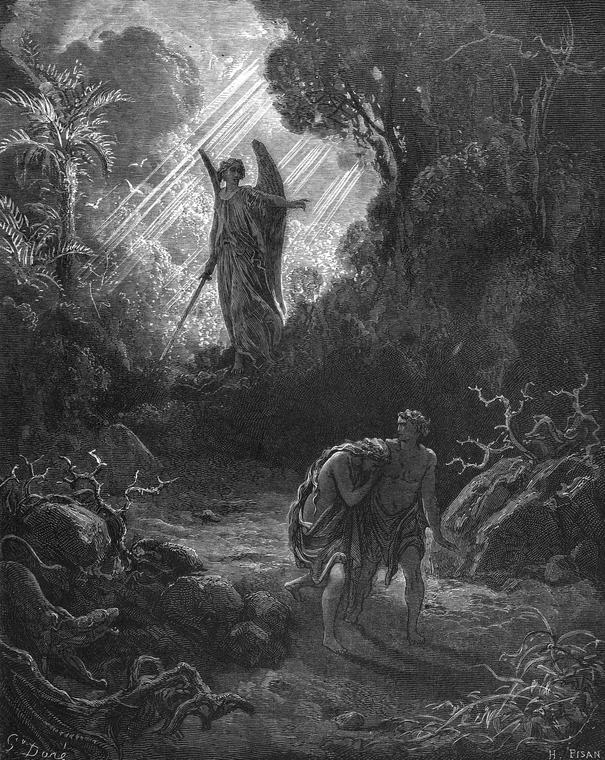
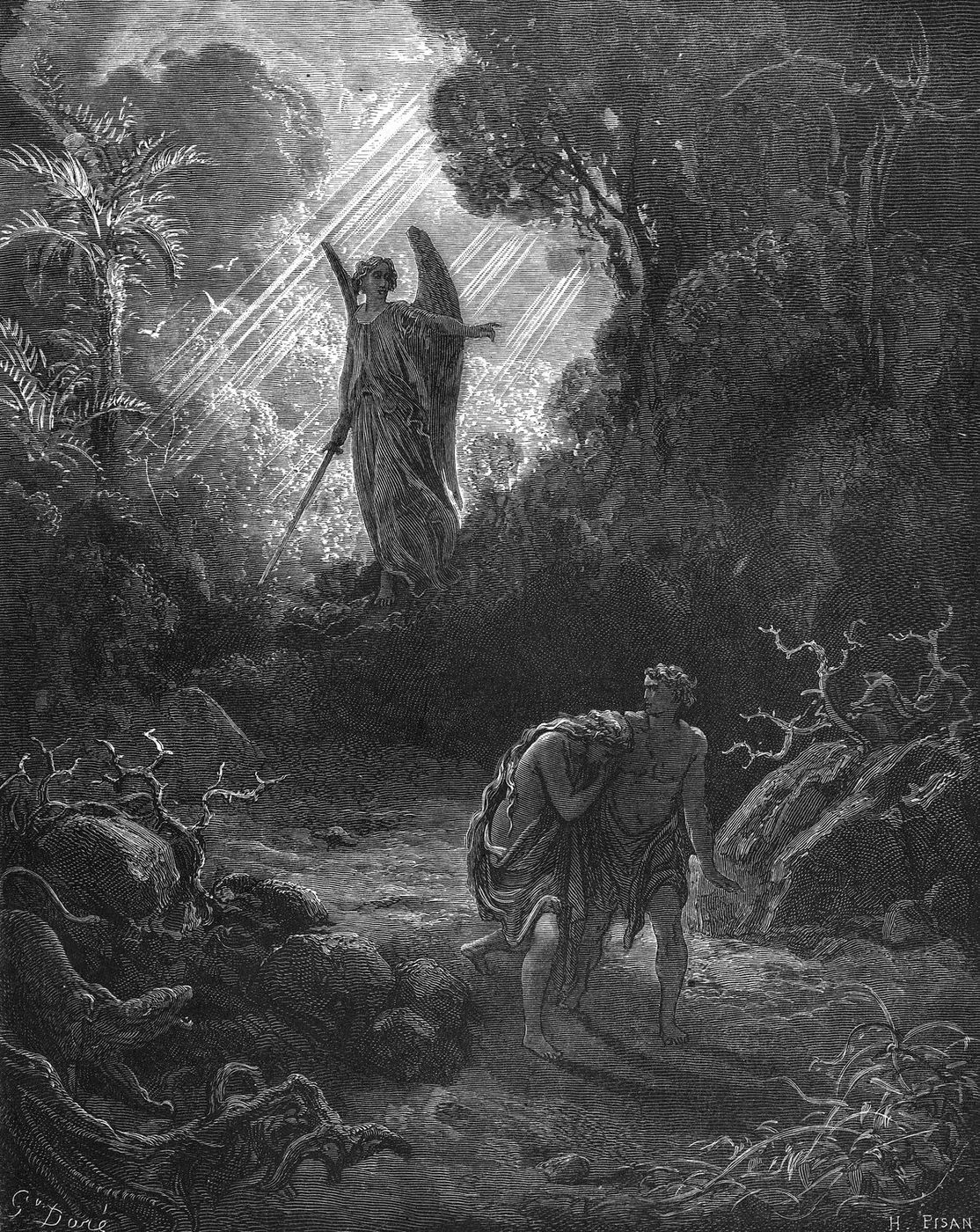
Gustave Doré's engraving (first published in 1866, shown here from an 1873 Polish Bible) of the guardian angel with a sword at the edge of Eden after Adam and Eve are driven out, the scene of Genesis 3:24, where cherubim and a flaming sword block the way to the tree of life. It is a representative 19th-century illustration, not an ancient source.
The guardians of Eden and the two angels at the tomb
STRONG
Gen 3:24→John 20:12
After the fall, God places cherubim at the east of Eden to guard the way to the tree of life. At the tomb, Mary sees two angels in white sitting where Jesus’ body had lain, one at the head and one at the feet. In the tabernacle, two golden cherubim sit at the two ends of the mercy seat, the gold cover of the ark. I read the angels as echoing both scenes, but the text does not say so.
My rating: My notes call it “logically airtight within the framework, less explicitly cited in mainstream scholarship.” I drop “airtight,” and I did not check how often scholars cite the link. The match is the number two, the word “angels,” and the place where the body lay; Genesis 3:24 gives no number, and the text never says the angels guard anything. Strong is the lowest tier I use, and it fits.
The arc
GuardiansGen 3:24 God places cherubim and a flaming sword at the east of Eden to guard the way to the tree of life. Cherubim (singular: cherub) are winged beings in the Hebrew Bible, and Exodus 25:20 describes their wings. (The text)
Two over the mercy seatExod 25:18-22 Two golden cherubim sit at the two ends of the mercy seat, covering it with their wings. God says he will meet Moses there. (The text)
Two angels at the tombJohn 20:12 Mary sees two angels in white sitting, one at the head and one at the feet, where the body of Jesus had lain. (The text)
The barrier goneJohn 20:11-12 In my reading, the angels at the tomb no longer block the way to life, and the place where the body lay is like a new mercy seat. (The reading)
Key passages
Gen 3:24Type
he placed cherubim at the east of the garden of Eden, and a flaming sword … to guard the way to the tree of lifeWorld English Bible (public domain), 2020 stable text, Gen 3:24
וַיַּשְׁכֵּן֩ מִקֶּ֨דֶם לְגַן־עֵ֜דֶן אֶת־הַכְּרֻבִ֗ים וְאֵ֨ת לַ֤הַט הַחֶ֨רֶב֙ … לִשְׁמֹ֕ר אֶת־דֶּ֖רֶךְ עֵ֥ץ הַֽחַיִּֽיםWestminster Leningrad Codex (public domain), text as in the OpenScriptures Hebrew Bible, Gen 3:24 (with the words “which turned every way” left out in both languages)
Exod 25:18Support
You shall make two cherubim of hammered gold. You shall make them at the two ends of the mercy seat.World English Bible (public domain), 2020 stable text, Exod 25:18
וְעָשִׂ֛יתָ שְׁנַ֥יִם כְּרֻבִ֖ים זָהָ֑ב מִקְשָׁה֙ תַּעֲשֶׂ֣ה אֹתָ֔ם מִשְּׁנֵ֖י קְצ֥וֹת הַכַּפֹּֽרֶתWestminster Leningrad Codex (public domain), text as in the OpenScriptures Hebrew Bible, Exod 25:18
John 20:12Antitype
and she saw two angels in white sitting, one at the head and one at the feet, where the body of Jesus had lain.World English Bible (public domain), 2020 stable text, John 20:12
כְּרֻבִיםkeruvimcherubimGen 3:24; Exod 25:18-20A plural form, so more than one. Genesis 3:24 gives no number. Exodus 25 has exactly two. Gen 3:24 itself does not call them angels.
לִשְׁמֹרlishmorto guard, to keepGen 3:24; compare Gen 2:15Same root (shamar) as “keep” in Gen 2:15, where the man is put in the garden to work it and keep it. The shared root is in the text. That the cherubim now guard what Adam failed to keep is an inference.
וַיַּשְׁכֵּןvayyashkenhe caused to dwell, he stationedGen 3:24From shakan, the root behind mishkan, “tabernacle” (Exod 25:9). Brown-Driver-Briggs glosses this verb as “place, set” in Gen 3:24, and WEB translates it “placed.” I mention it only as a word link to the tabernacle.
ἱλαστήριονhilastērionmercy seat; a means of atonementHeb 9:5; Rom 3:25; Exod 25:17 (Septuagint)It means the mercy seat in Heb 9:5, and the Septuagint uses it for the mercy seat in Exod 25:17. In Rom 3:25 it is said of Christ, and translators differ: WEB has “atoning sacrifice” and KJV “propitiation.” Whether Paul means the mercy seat there is debated, so the “new mercy seat” idea is a reading.
Limits
The text never says the angels guard anything. Mary looks in freely, the angels are sitting, and they ask why she is weeping. “The barrier is removed” is my reading. Genesis gives no number for the cherubim, so “two” matches the cherubim of the mercy seat better than Eden.
Angels or men also appear at the tomb in the other Gospels: one angel in Matthew 28:2, a young man in Mark 16:5, two men in dazzling clothes in Luke 24:4. So angels at the tomb are not special to John. The Eden link would have to rest on John’s wording alone.
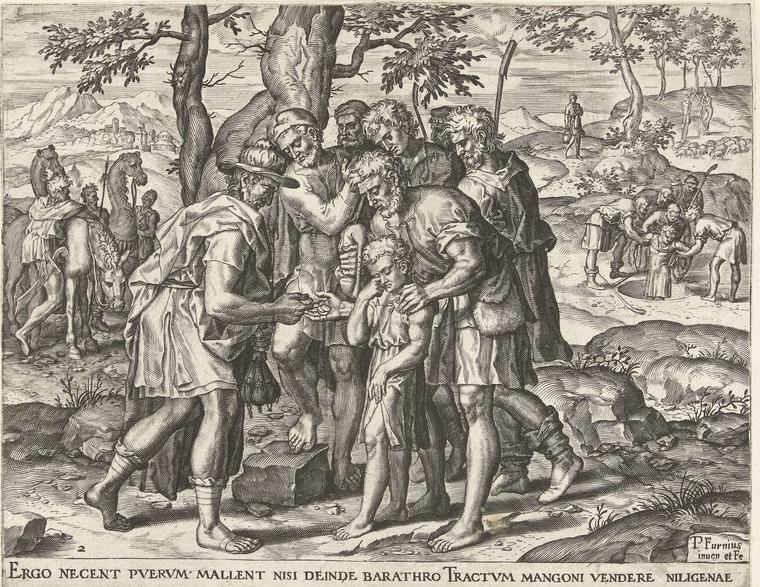
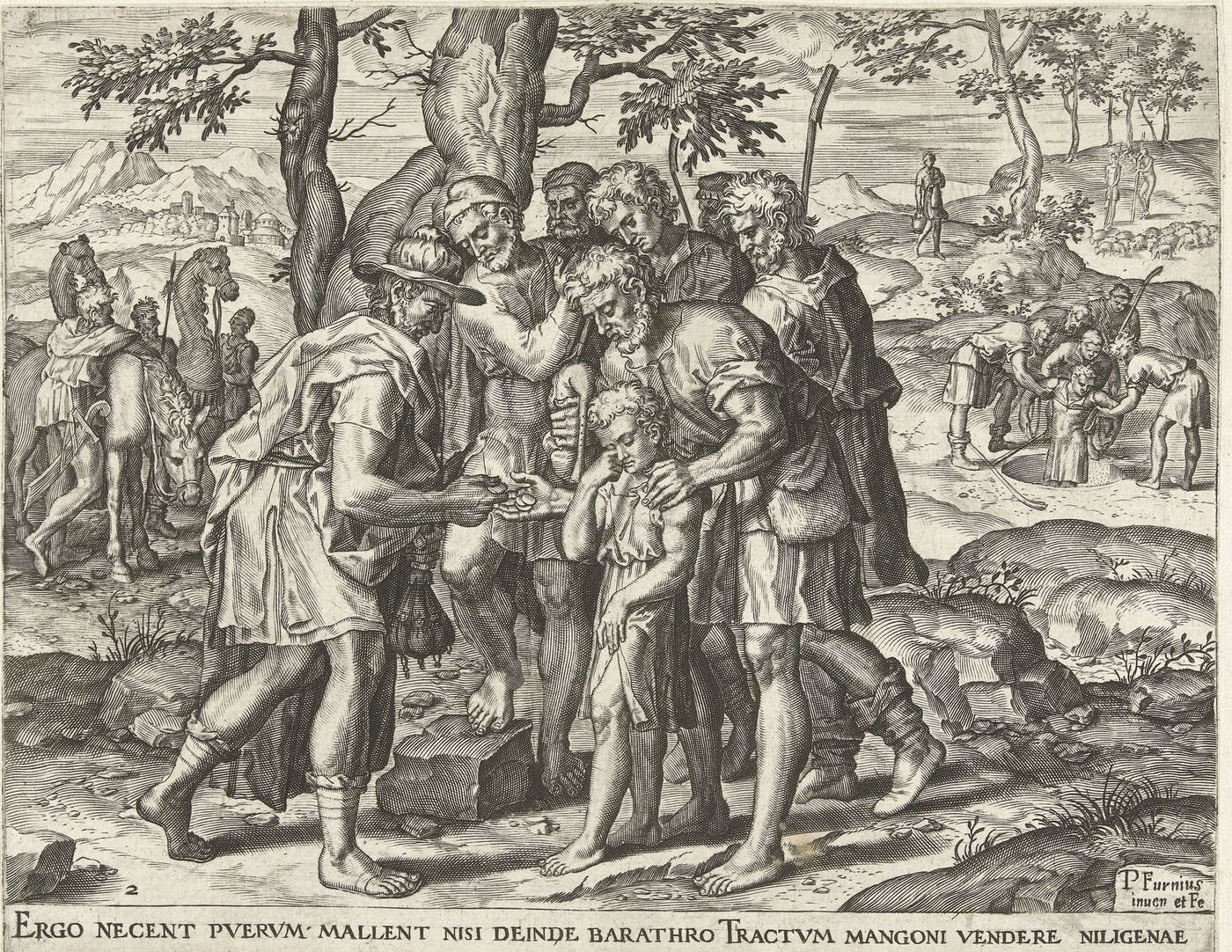
Pieter Furnius's 1572 engraving of Joseph being sold by his brothers (Genesis 37), with the well where they had thrown him shown behind. Betrayed by his own family and sold for silver, he is the figure this study sets beside Christ; this is a representative 16th-century image.
Joseph and Christ
VERY STRONG
Gen 37-50→Acts 7:9-14; Luke 24:36-39; Acts 2:23-24; Matt 26:15
Joseph is his father’s favorite, hated by his brothers, sold for silver, falsely accused and jailed, then raised up to rule and to save the family that betrayed him. My notes list 31 parallels with Jesus. I checked all 31 against the texts: 15 hold up plainly, 12 need softening or are loose, and I dropped 4. I rate it very strong because the shape is strong, but no New Testament writer names Joseph as a type.
My rating: I keep the rating of VERY STRONG from my notes. The link is structural, not explicit: no New Testament writer says Joseph is a type of Christ, and Stephen retells the story in Acts 7 without applying it. The strength comes from the shape of the story. A loved son is hated, sold, falsely accused and jailed, then raised up to save the family that betrayed him.
The arc
The patternGen 37-50 My notes list 31 parallels (the heading says ‘30+’). I checked each one against the Hebrew, the Greek and the English. Fifteen rest on a plain overlap in the texts, twelve I softened because a detail is wrong or the match is loose, and four I dropped. That count is my judgment, not a measurement.
The patternGen 37:26-28; Matt 26:15 Joseph is sold, after his brother Judah proposes it, for “twenty pieces of silver”. Judas hands Jesus over for “thirty pieces of silver”. The numbers differ, and the Septuagint (the ancient Greek translation) says twenty gold pieces. Judah and Judas are one name in two languages, but it was a common name: the New Testament itself has several men called Judas (Luke 6:16; Acts 5:37; Acts 15:22).
The patternGen 45:1-4; Luke 24:36-39 Joseph makes himself known in private and says “I am Joseph”. His brothers are “terrified at his presence”. The risen Jesus says “it is truly me”, and the disciples are “terrified and filled with fear”. The Septuagint has egō eimi Iōsēph (‘I am Joseph’) in Genesis 45:3 and Luke 24:39 has egō eimi autos (‘it is I myself’), but egō eimi is an ordinary phrase, so I call this a pattern.
The patternGen 50:20; Acts 2:23-24 Joseph tells his brothers “you meant evil against me, but God meant it for good, to save many people alive”. In Acts 2, Peter says Jesus was “being delivered up by the determined counsel and foreknowledge of God,” and that “you have taken by the hand of lawless men, crucified and killed”. Both passages put human evil and God’s purpose side by side. The Hebrew verb chashav (‘to plan, intend’) is used twice in Genesis 50:20, once for the brothers and once for God.
The textActs 7:9-14 Stephen retells the story: the patriarchs, “moved with jealousy against Joseph,” sold him into Egypt, and “God was with him”. On the second visit “Joseph was made known to his brothers”. Stephen never says Joseph points to Jesus. That is why I rate this very strong and not maximum.
Key passages
Gen 37:28Type
sold Joseph to the Ishmaelites for twenty pieces of silverWorld English Bible (public domain)
וַיִּמְכְּרוּ אֶת־יוֹסֵף לַיִּשְׁמְעֵאלִים בְּעֶשְׂרִים כָּסֶףWestminster Leningrad Codex (public domain), as given in the Open Scriptures Hebrew Bible (WLC 4.20); vowel points kept, cantillation marks and meteg omitted
Gen 45:3Type
His brothers couldn’t answer him; for they were terrified at his presence.World English Bible (public domain)
וְלֹא־יָכְלוּ אֶחָיו לַעֲנוֹת אֹתוֹ כִּי נִבְהֲלוּ מִפָּנָיוWestminster Leningrad Codex (public domain), as given in the Open Scriptures Hebrew Bible (WLC 4.20); vowel points kept, cantillation marks and meteg omitted
Gen 50:20Type
you meant evil against me, but God meant it for good, to save many people alive, as is happening todayWorld English Bible (public domain)
וְאַתֶּם חֲשַׁבְתֶּם עָלַי רָעָה אֱלֹהִים חֲשָׁבָהּ לְטֹבָה לְמַעַן עֲשֹׂה כַּיּוֹם הַזֶּה לְהַחֲיֹת עַם־רָבWestminster Leningrad Codex (public domain), as given in the Open Scriptures Hebrew Bible (WLC 4.20); vowel points kept, cantillation marks and meteg omitted
Matt 26:15Antitype
So they weighed out for him thirty pieces of silver.World English Bible (public domain)
כְּתֹנֶת פַּסִּיםketonet passima long tunic (traditionally ‘of many colors’)Gen 37:3, 23, 32The WEB reads “a tunic of many colors” in Genesis 37:3. The Brown-Driver-Briggs lexicon takes passim as ‘palms’ and ‘soles’, so a tunic reaching to the hands and feet. Joseph’s brothers strip it from him in 37:23.
חָשַׁבchashavto plan, intendGen 50:20Used twice in one verse: “you meant evil” and “God meant it for good”.
לְמִחְיָהlemichyahto preserve lifeGen 45:5Genesis 50:20 says the same with lehachyot (‘to keep alive’).
כֶּסֶףkesefsilverGen 37:28The Septuagint has chrysōn (‘of gold’) here, so the silver parallel rests on the Hebrew text.
ἐγώ εἰμιegō eimiI amSeptuagint Gen 45:3; Luke 24:39A common phrase in Greek, so the echo is a pattern, not proof.
יְהוּדָהYehudahJudahGen 37:26The Greek form of this name is Ioudas (Judas). It was a common name.
Limits
No New Testament writer calls Joseph a type. The more parallels I count, the more I match motifs that appear in other stories too. Shepherding, silver and weeping are everyday biblical motifs, and the age of thirty shows up elsewhere: David was “thirty years old when he began to reign” (2 Sam 5:4), and Numbers 4:3 counts Levite workers from age thirty.
A skeptical reader can say this is a common Bible storyline, not a prediction: a person suffers and is then raised up. Mordecai (Esther 6) and Daniel (Daniel 6) follow the same shape. My notes also have Joseph ‘at the right hand of Pharaoh’ and hated ‘without cause’. Neither phrase is in Genesis, so I corrected them.
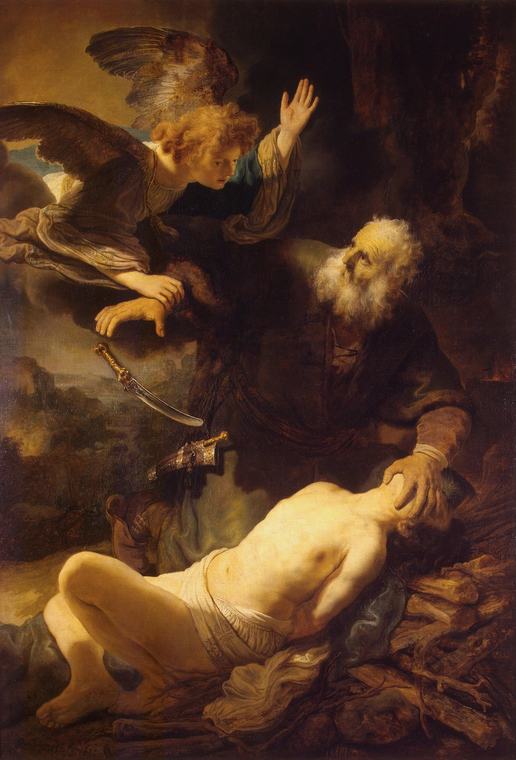
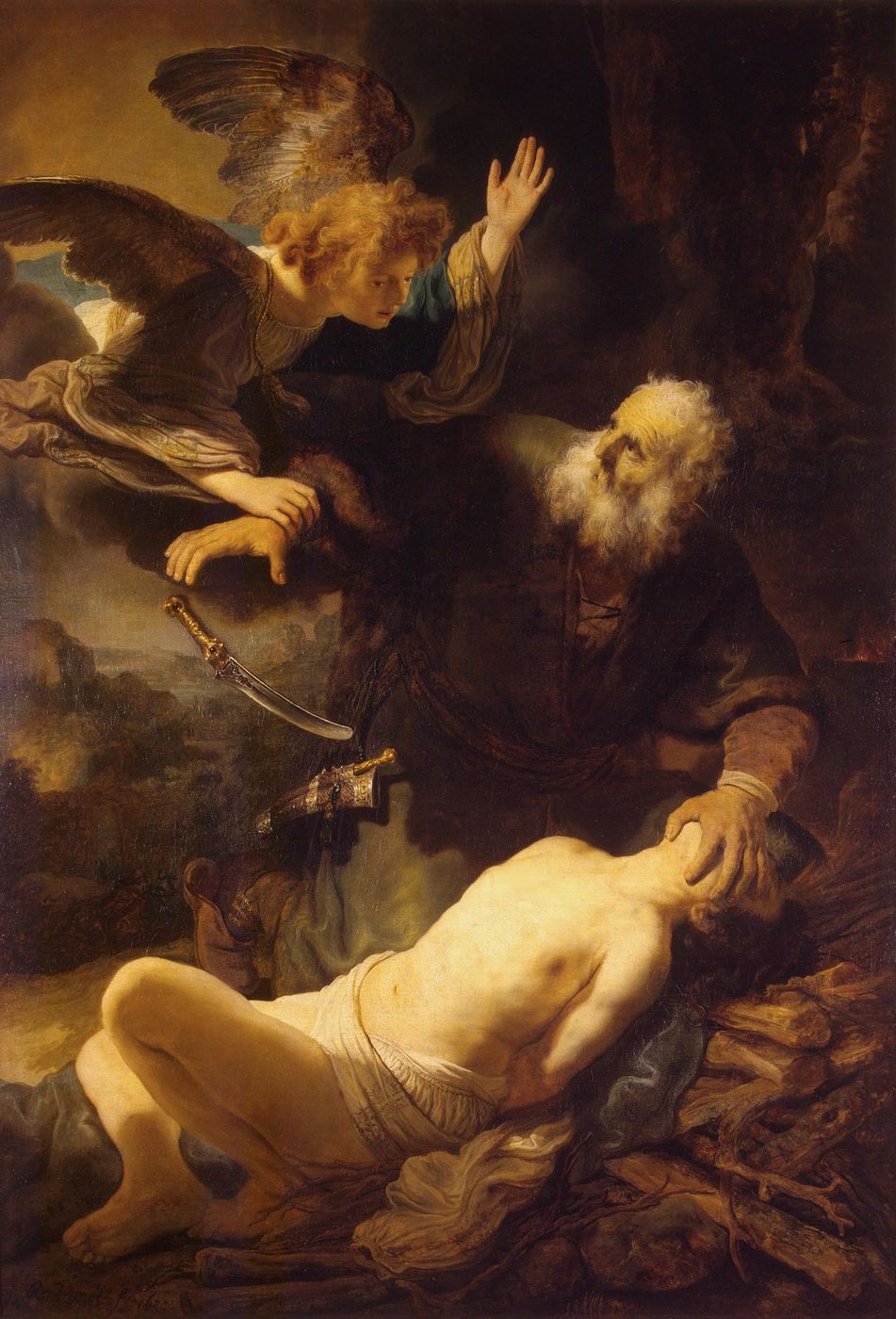
Rembrandt's 1635 painting of the binding of Isaac (Genesis 22): an angel catches Abraham's hand and the knife falls just as he is about to offer his son. It is a representative image of the scene that Christian readers have long taken as a pattern of the cross.
The binding of Isaac and the cross
VERY STRONG
Gen 22:1-19→Heb 11:17-19; Rom 8:32; John 3:16
God tells Abraham to offer “your son, your only son, Isaac, whom you love”. Hebrews 11 retells the story, calls Isaac his “only born” son, and says that “Figuratively speaking,” Abraham got him back from the dead. Paul’s “didn’t spare his own Son” uses the same verb as the ancient Greek translation of Genesis 22. I rate it very strong, not maximum, because no New Testament writer says outright that Isaac is a type of Christ.
My rating: My notes rated this MAXIMUM, resting on Hebrews 11:19: Abraham got Isaac back en parabolē (WEB: “Figuratively speaking”), which my notes read as Hebrews itself calling the binding a type of the resurrection. The second pass found that case thinner than my notes say. The Greek phrase can be read two ways (“in a figure” or, in Thayer’s lexicon, “in risking him”). Hebrews does not name Christ in that verse. Romans 8:32 echoes Genesis 22 without quoting it, and John 3:16 does not mention Isaac. I found no verse where Jesus confirms the link, which my notes say he does. Under my rating rule (see How I tested) that makes it VERY STRONG, and that is the rating shown here; my notes’ rating was MAXIMUM.
The arc
The textGen 22:2 God says to Abraham, “Now take your son, your only son, Isaac, whom you love”. The Hebrew word for “only” is yachid (‘only one’, used especially of an only son). The command piles up three descriptions of Isaac: your son, your only son, whom you love. Reading the Hebrew text from the start, this is the first time the verb ‘to love’ (ahav) appears in it.
The textHeb 11:17-19 Hebrews looks back at the story. It says Abraham “offered up Isaac” and calls him his “only born” son. The Greek word is monogenēs (‘only born’, ‘one of a kind’), the same word John 3:16 uses of Jesus. Abraham reasoned that God can raise the dead, and “Figuratively speaking, he also did receive him back from the dead.”
The patternRom 8:32 Paul writes that God “didn’t spare his own Son”. In the Septuagint (the ancient Greek translation of the Hebrew Bible), the angel tells Abraham ‘you did not spare your beloved son’ (Gen 22:12). The Greek verb, pheidomai (‘to spare’), is the same. Paul does not cite Genesis, so this is an echo, not a quotation.
The patternGen 22:4-6; John 19:17 Abraham put the wood for the offering on Isaac: he “laid it on Isaac his son.” John says Jesus went out “bearing his cross”. Matthew, Mark and Luke have Simon of Cyrene carry it, so only John makes the match. Genesis 22:4 also dates Abraham’s first sight of the place “On the third day”, but I count that link as looser.
The readingGen 22:8; John 1:29 Abraham says God will provide “the lamb for a burnt offering”, and a ram is provided instead (22:13). Christian readers hear “the Lamb of God” (John 1:29) here, but the Greek Genesis says probaton (‘sheep’), not amnos (‘lamb’), so the word link is not exact. An early Christian letter, the Epistle of Barnabas (usually dated between about AD 70 and 135), already calls the offering of Isaac a ‘type’. I hold all of this as a reading.
Key passages
Gen 22:2Type
Now take your son, your only son, Isaac, whom you loveWorld English Bible (public domain)
קַח־נָא אֶת־בִּנְךָ אֶת־יְחִידְךָ אֲשֶׁר־אָהַבְתָּ אֶת־יִצְחָקWestminster Leningrad Codex (public domain), as given in the Open Scriptures Hebrew Bible (WLC 4.20); vowel points kept, cantillation marks and meteg omitted
Gen 22:6Type
Abraham took the wood of the burnt offering and laid it on Isaac his son.World English Bible (public domain)
וַיִּקַּח אַבְרָהָם אֶת־עֲצֵי הָעֹלָה וַיָּשֶׂם עַל־יִצְחָק בְּנוֹWestminster Leningrad Codex (public domain), as given in the Open Scriptures Hebrew Bible (WLC 4.20); vowel points kept, cantillation marks and meteg omitted
Gen 22:12Support
you have not withheld your son, your only son, from meWorld English Bible (public domain)
וְלֹא חָשַׂכְתָּ אֶת־בִּנְךָ אֶת־יְחִידְךָ מִמֶּנִּיWestminster Leningrad Codex (public domain), as given in the Open Scriptures Hebrew Bible (WLC 4.20); vowel points kept, cantillation marks and meteg omitted
Heb 11:19Antitype
Figuratively speaking, he also did receive him back from the dead.World English Bible (public domain)
יָחִידyachidonly one; an only sonGen 22:2, 12, 16The Brown-Driver-Briggs Hebrew lexicon lists these three verses first. In these verses the Septuagint renders it agapētos (‘beloved’), not monogenēs, though it does use monogenēs for the feminine form in Judges 11:34.
ἀγαπητόςagapētosbelovedSeptuagint Gen 22:2, 12; Matt 3:17; Mark 1:11The voice at Jesus’s baptism uses this word. So does Matthew 12:18, where Matthew applies Isaiah 42:1 to Jesus, so the baptism voice may draw on Isaiah or Psalm 2 as well as on Genesis 22.
μονογενήςmonogenēsonly born; one of a kindHeb 11:17; John 3:16Hebrews uses it of Isaac, John of Jesus.
הַמֹּרִיָּהha-MoriyyahMoriah (a place name)Gen 22:2; 2 Chr 3:1Genesis 22:2 says “the land of Moriah”. Second Chronicles 3:1 puts Solomon’s temple “at Jerusalem on Mount Moriah”. Josephus (writing in the AD 90s) says Abraham offered Isaac at the same place where David later built his altar on Araunah’s threshing floor (Antiquities 7.13.4). Linking the two is a long tradition. My notes add that Golgotha is on the same mountain; neither text says so, so I dropped that.
בְּנִיbenimy sonGen 22:8The KJV and the WEB read it as Abraham speaking to Isaac. Rashi (died 1105) reads it as the answer: if no lamb is found, ‘my son’ is the offering.
יִרְאֶהyirehwill see; will provideGen 22:8, 14The verb means ‘to see’, and the Brown-Driver-Briggs lexicon also gives ‘provide’ for Genesis 22:8. The WEB reads “Yahweh Will Provide” in verse 14, with a footnote giving the Hebrew name as Yahweh-Jireh or Yahweh-Seeing.
סְבַךְsevakhthicketGen 22:13The ram is “caught in the thicket by his horns”. Some readers link this to Jesus’s crown of thorns (John 19:2), but sevakh means ‘thicket’, not ‘thorns’ (Brown-Driver-Briggs). That link is a reading.
זֶרַעzeraseed, offspringGen 22:17-18Genesis 22:18 says “All the nations of the earth will be blessed by your offspring”. Paul says the offspring in the promises to Abraham is Christ (Gal 3:16: “which is Christ”), but he does not cite Genesis 22:18 there, so I hold the link as a reading.
עָקַדaqadto bindGen 22:9This verb appears nowhere else in the Hebrew Bible (I searched the whole Westminster Leningrad Codex). The story is traditionally called the Aqedah, ‘the binding’.
παραβολήparabolēcomparison, figure; or ‘risk’Heb 11:19 (en parabolē)Older English versions read ‘in a figure’. Thayer’s Greek Lexicon prefers ‘in risking him’.
φείδομαιpheidomaito spareRom 8:32; Septuagint Gen 22:12Paul’s ouk epheisato (‘did not spare’) and the Greek Genesis’s ouk epheisō (‘you did not spare’) are the same verb.
Limits
Hebrews 11:19 says Abraham got Isaac back en parabolē. Older English versions read ‘in a figure’, but Thayer’s Greek Lexicon (a public-domain 19th-century reference) prefers ‘in risking him’ and calls the ‘in a figure’ readings less probable. Either way, Hebrews does not name Christ in this verse.
A Jewish text that has Isaac die and revive, Pirkei DeRabbi Eliezer 31, was edited around the eighth or ninth century AD. So it does not by itself show what first-century readers believed.
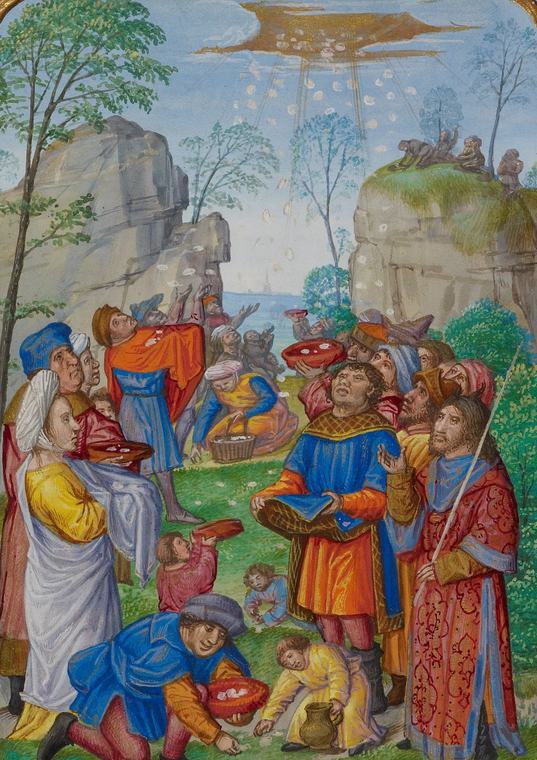
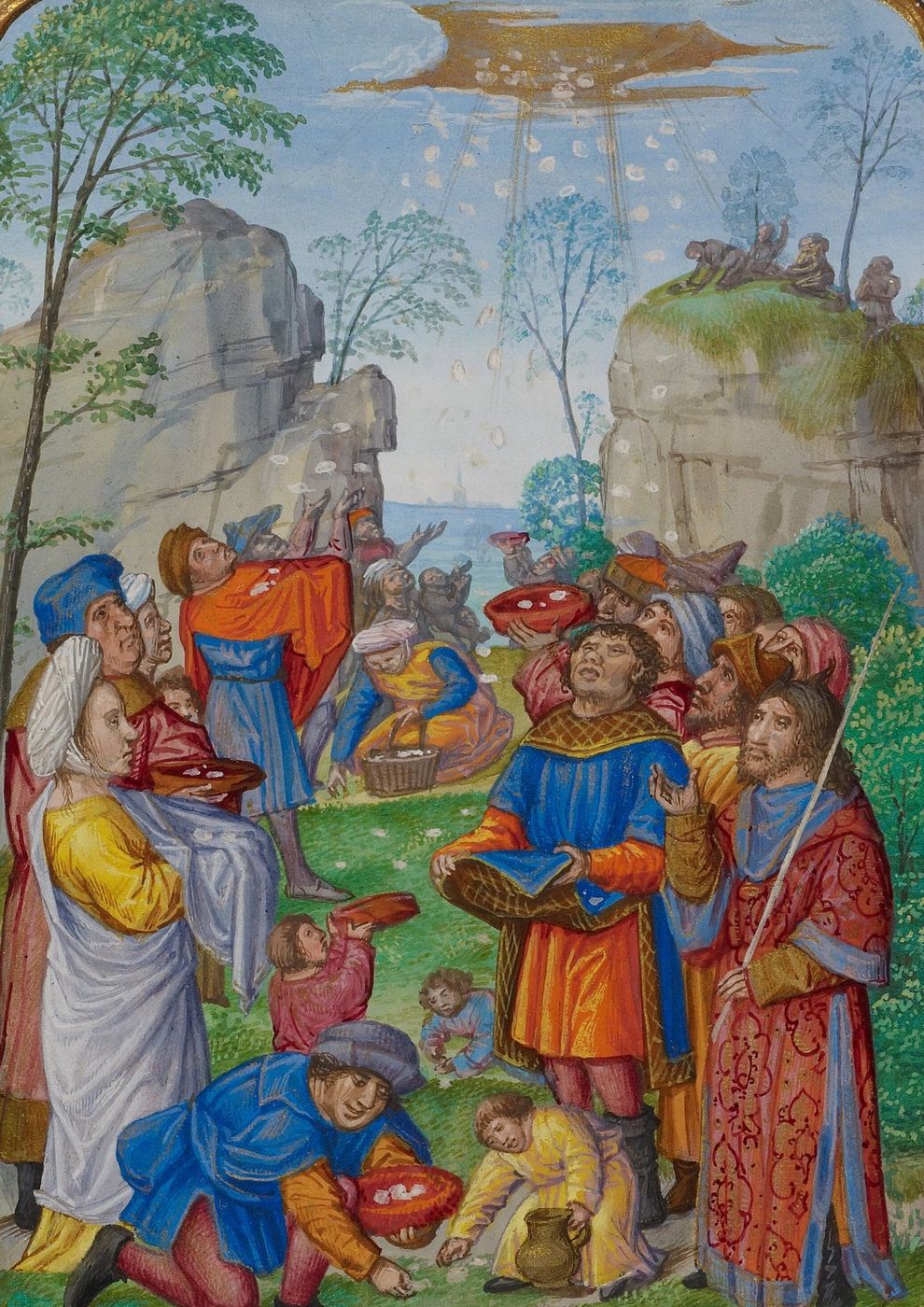
Men, women and children hold out bowls, baskets and cloaks to catch the white flakes of manna raining from a golden cloud (Exodus 16), the bread from heaven that John 6 sets beside Jesus as the bread of life. Representative image: a miniature from the Spinola Hours, a Flemish prayer book made about 1510-1520.
God fed Israel in the wilderness with bread from the sky. When a crowd in Galilee points to the manna and asks Jesus for a sign, he answers that he is the bread of life. He says their fathers ate the manna and died, while anyone who eats of this bread will live forever. Jesus draws the comparison himself, as a contrast, and I rate it at the top.
My rating: My notes say: “Jesus explicitly makes this connection.” I checked it. In John 6:32 and 6:49-58 Jesus himself sets the manna beside himself, and in 6:31 the crowd cites Scripture about the manna first. That meets my top test, that Jesus makes the connection.
The arc
Bread from heavenExod 16:4, 15 God says he will rain bread from the sky. The people ask “What is it?” and Moses says it is the bread Yahweh has given them to eat. (The text)
The crowd cites itJohn 6:30-31 The crowd asks for a sign and cites the manna: “As it is written, ‘He gave them bread out of heaven to eat.’” (The text)
I am the bread of lifeJohn 6:32-35 Jesus says it was not Moses who gave the bread. His Father gives the true bread, and Jesus says, “I am the bread of life.” (The text)
Died, or live foreverJohn 6:49-51, 58 Jesus says their fathers ate the manna and died, and that whoever eats this bread will live forever. (The text) Eating and living forever also go together in Genesis 3:22, the tree of life. (The pattern)
Key passages
Exod 16:4Type
Behold, I will rain bread from the sky for you, and the people shall go out and gather a day’s portion every dayWorld English Bible (public domain), 2020 stable text, Exod 16:4
הִנְנִ֨י מַמְטִ֥יר לָכֶ֛ם לֶ֖חֶם מִן־הַשָּׁמָ֑יִם וְיָצָ֨א הָעָ֤ם וְלָֽקְטוּ֙ דְּבַר־י֣וֹם בְּיוֹמ֔וֹWestminster Leningrad Codex (public domain), text as in the OpenScriptures Hebrew Bible, Exod 16:4 (first part)
Exod 16:15Type
“What is it?” For they didn’t know what it was. Moses said to them, “It is the bread which Yahweh has given you to eat.World English Bible (public domain), 2020 stable text, Exod 16:15 (the quotation continues into verse 16)
מָ֣ן ה֔וּא כִּ֛י לֹ֥א יָדְע֖וּ מַה־ה֑וּא וַיֹּ֤אמֶר מֹשֶׁה֙ אֲלֵהֶ֔ם ה֣וּא הַלֶּ֔חֶם אֲשֶׁ֨ר נָתַ֧ן יְהוָ֛ה לָכֶ֖ם לְאָכְלָֽהWestminster Leningrad Codex (public domain), text as in the OpenScriptures Hebrew Bible, Exod 16:15
John 6:31Support
Our fathers ate the manna in the wilderness. As it is written, ‘He gave them bread out of heaven to eat.’World English Bible (public domain), 2020 stable text, John 6:31
I am the bread of life. Whoever comes to me will not be hungry, and whoever believes in me will never be thirsty.World English Bible (public domain), 2020 stable text, John 6:35
מָןmanmanna; or “What is it?”Exod 16:15, 31Exodus 16:15 gives the people’s question and says they did not know what it was. Brown-Driver-Briggs takes the question as most probably a popular explanation of the name.
לֶחֶםlechembread; food in generalExod 16:4, 15In Exod 16:4 the bread is “from the sky” (min hashamayim).
ἄρτος τῆς ζωῆςartos tēs zōēsbread of lifeJohn 6:35, 48In John 6:31 the crowd says “bread out of heaven” (ἄρτον ἐκ τοῦ οὐρανοῦ). Jesus answers with “bread of life”, and in 6:51 and 6:58 he says “live forever” (ζήσει εἰς τὸν αἰῶνα).
Limits
Jesus draws the comparison as a contrast: the manna fed the body, and the people still died. A critic can say that makes the manna a foil, not a prediction. Exodus 16:4 presents it as a daily provision and a test (“that I may test them”), not as a sign of a later bread.
John 6:31 says “as it is written” but gives no reference. The words resemble Exodus 16:4, Exodus 16:15 and Psalm 78:24 (Psalm 77:24 in the Septuagint), and John does not say which one the crowd means.
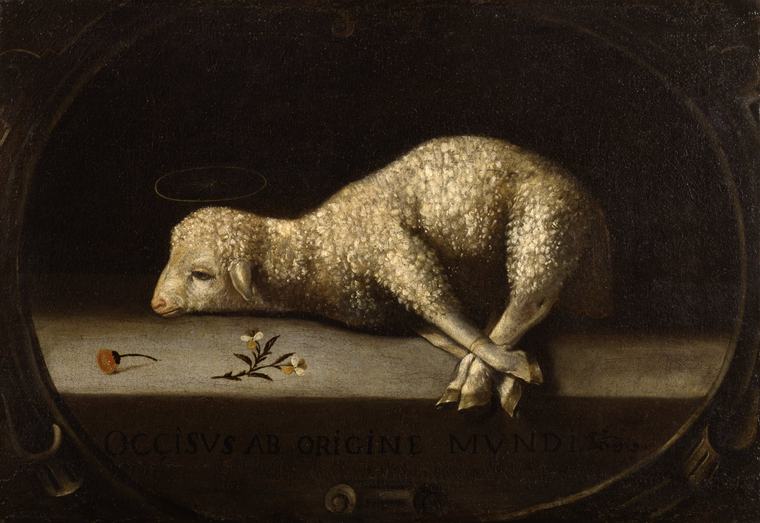
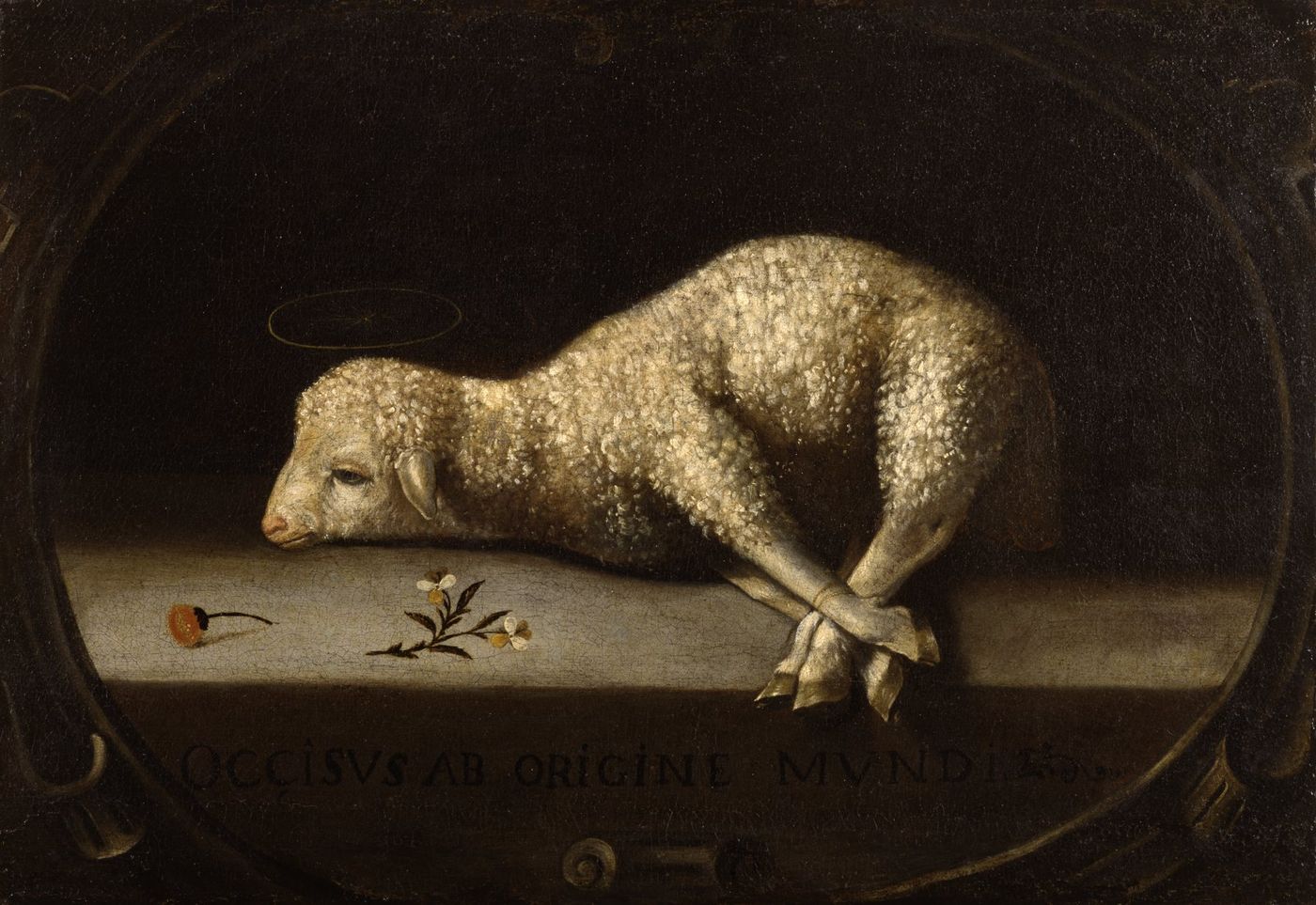
A lamb with a halo lies with its legs tied on a stone slab, and the Latin words beneath it read 'slain from the foundation of the world' (Revelation 13:8). Representative image: a Portuguese baroque painting from about 1670-1684, not a scene from Exodus. The Walters Art Museum notes that this picture of Christ as the sacrificial lamb draws on the Passover, and the study sets it beside John 1:29, 'Behold, the Lamb of God.'
At the exodus each household killed a lamb and put its blood on the doorposts, and God said he would pass over them. Paul states the link in one line: Christ, our Passover, has been sacrificed. John points the same way: the Baptist calls Jesus the Lamb of God, John dates the trial to the Preparation Day of the Passover, and John notes that none of Jesus’ bones were broken. The Lamb of God line alone is less certain.
My rating: My notes say “explicit NT identification.” I checked it. In 1 Corinthians 5:7 Paul writes that Christ, our Passover, has been sacrificed, which meets my top test. John 1:29 does not use the word Passover, so the weight rests on Paul and on John’s later details (19:14, 19:36).
The arc
The lambExod 12:3-7 Each household takes a lamb without defect, keeps it to the fourteenth day, kills it at evening, and puts some of the blood on the doorposts and the lintel. (The text)
Passed overExod 12:13 God says that when he sees the blood he will pass over the house and no plague will destroy it. (The text)
NamedJohn 1:29; 1 Cor 5:7; 1 Pet 1:19 John the Baptist calls Jesus “the Lamb of God”. Paul says Christ, our Passover, has been sacrificed. Peter says believers were redeemed with the blood of Christ, “as of a lamb without blemish or spot”. (The text)
Timed and testedJohn 19:14, 19:33-36 John dates the trial to the Preparation Day of the Passover and records that the soldiers did not break Jesus’ legs, citing Scripture. (The text) Linking these details to the Passover lamb is the pattern. (The pattern)
ClosureRev 5:6, 12 In Revelation a Lamb stands “as though it had been slain” and is called worthy. (The text)
Key passages
Exod 12:13Type
The blood shall be to you for a token on the houses where you are. When I see the blood, I will pass over youWorld English Bible (public domain), 2020 stable text, Exod 12:13
וְהָיָה֩ הַדָּ֨ם לָכֶ֜ם לְאֹ֗ת עַ֤ל הַבָּתִּים֙ אֲשֶׁ֣ר אַתֶּ֣ם שָׁ֔ם וְרָאִ֨יתִי֙ אֶת־הַדָּ֔ם וּפָסַחְתִּ֖י עֲלֵכֶ֑םWestminster Leningrad Codex (public domain), text as in the OpenScriptures Hebrew Bible, Exod 12:13 (first part)
John 1:29Antitype
Behold, the Lamb of God, who takes away the sin of the world!World English Bible (public domain), 2020 stable text, John 1:29
these things happened that the Scripture might be fulfilled, “A bone of him will not be broken.”World English Bible (public domain), 2020 stable text, John 19:36
Christ, our Passover, has been sacrificedWorld English Bible (public domain), 2020 stable text, 1 Cor 5:7 (the WEB adds “in our place,” which the SBL Greek text does not have)
פֶּסַחpesachPassoverExod 12:11, 21Brown-Driver-Briggs says the name is usually taken from the verb pasach, “pass or spring over,” used in Exod 12:13 of God passing over, or sparing, the houses. Other origins have been proposed.
πάσχαpaschaPassover (the festival, and the lamb)1 Cor 5:7; Luke 22:7The Greek form of pesach. Luke 22:7 says the Passover “must be sacrificed” (the same verb as 1 Cor 5:7), so the word can mean the lamb itself.
ἀμνόςamnoslambJohn 1:29, 36; Acts 8:32; 1 Pet 1:19In the Septuagint, the ancient Greek translation of the Hebrew Scriptures, the Passover animal in Exod 12:21 is a probaton, a sheep. Amnos is the word used for the lamb of Isa 53:7, which Acts 8:32 quotes. So the word in John 1:29 does not settle which lamb is meant.
ἀρνίονarnionlamb (a diminutive form)Rev 5:6, 12; 21:22Revelation’s usual word for the Lamb. It is a different word from the one in John 1:29.
Limits
Two of John’s links are less exact than they look. “Lamb of God” in 1:29 could point to the Passover, to the lamb of Isaiah 53:7, or to Genesis 22:8, “God will provide himself the lamb”, and the Greek does not decide it. The line John quotes in 19:36 has the noun of Exodus 12:46 and Numbers 9:12, which are about the Passover lamb, but its passive verb matches Psalm 34:20 (Psalm 33 in the Septuagint’s numbering), about a righteous person’s bones.
The timing depends on John’s calendar. John puts the trial on the Preparation Day of the Passover (19:14) and has Jesus’ accusers avoid defilement so they can eat the Passover (18:28), while Mark 14:12 and Luke 22:15 have Jesus eating the Passover meal the night before. The Gospels appear to give different days, scholars have proposed several ways to reconcile them, and I do not decide between them. A popular idea that Jesus died at the same hour the Passover lambs were killed also mixes John’s sixth hour, Pilate’s judgment, with Mark’s ninth hour for the death (Mark 15:34). Josephus says the priests killed the Passover lambs from the ninth hour to the eleventh (Jewish War 6.9.3).
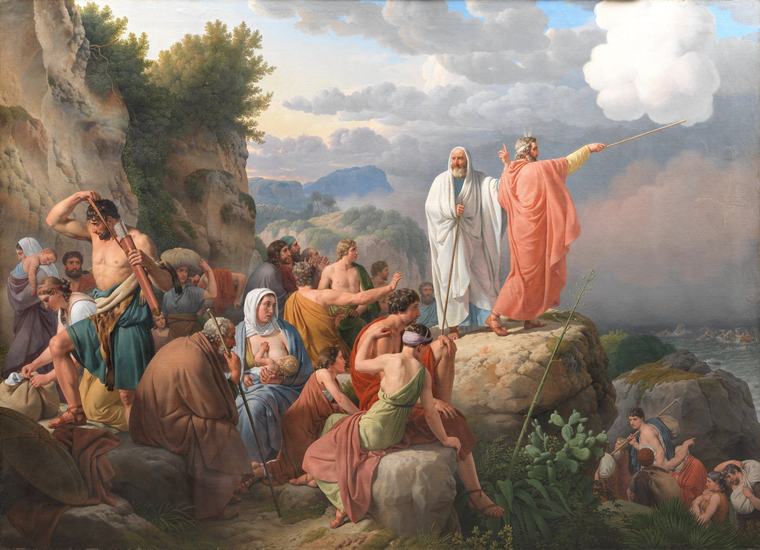
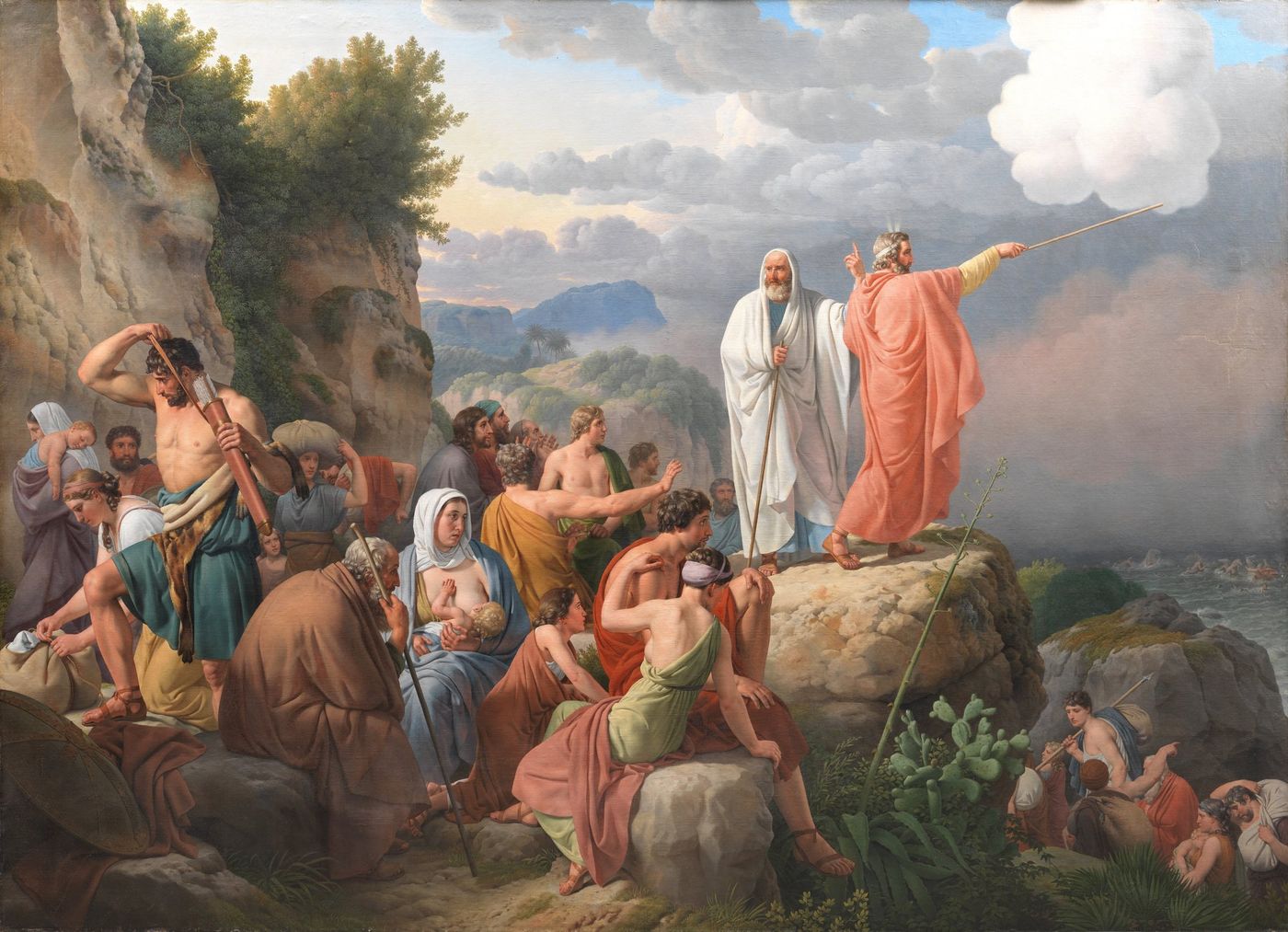
Moses stretches his staff toward the sea while Israelites who have just come through it rest and gather their bundles, and the Egyptian host struggles in the water at far right (Exodus 14), the passage Paul reads as a kind of baptism in 1 Corinthians 10:1-2. Representative image: C.W. Eckersberg's 1815 painting, which shows the moment just after the crossing rather than the crossing itself.
The Red Sea and baptism
MAXIMUM
Exod 14:21-31; Exod 15:1-2→1 Cor 10:1-11; 1 Pet 3:20-21; Rom 6:3-4→Rev 15:2-3
The Israelites cross the sea on dry ground, with the water “a wall” on both sides, and the Egyptians are left dead on the shore. Paul says Israel “were all baptized into Moses in the cloud and in the sea”, and that these things happened to them “by way of example”. I rate it maximum because Paul himself makes the comparison. His point is a warning: all of them were baptized, and most still fell.
My rating: Paul says Israel “were all baptized into Moses in the cloud and in the sea” and calls what happened to them “examples” (1 Cor 10:2, 6, 11). The Greek word is typoi, the root of ‘type’. That is a named comparison. I keep MAXIMUM with a warning: in this passage the word is best read as ‘warning example’, not ‘prediction’.
The arc
The textExod 14:21-22, 30; 13:18 Yahweh drives the sea back with “a strong east wind all night,” and Israel goes through “on the dry ground; and the waters were a wall to them on their right hand and on their left.” Israel “saw the Egyptians dead on the seashore.” The Hebrew name is yam suf, usually taken as ‘sea of reeds’. The Septuagint (the ancient Greek translation of the Hebrew Bible) calls it the Red Sea.
The text1 Cor 10:1-4 Paul says “our fathers were all under the cloud, and all passed through the sea”, and “were all baptized into Moses in the cloud and in the sea”. He uses the word ‘all’ (pantes) five times in verses 1 to 4. They ate the same “spiritual food”, drank from “a spiritual rock that followed them,” and “the rock was Christ.” Exodus 17:6 and Numbers 20:8-11 tell of water from a rock, but neither says it followed them.
The text1 Cor 10:6, 11; Rom 5:14 In verse 6 Paul calls these events typoi, and in verse 11 the SBLGNT has the adverb typikōs, where the Majority Text has typoi again. The WEB renders them “our examples” and “by way of example”. Thayer’s Greek Lexicon files these two verses under ‘a pattern of warning’ and files Romans 5:14 (Adam, “a foreshadowing of him who was to come”) under ‘a type’. So I read Paul’s point here as a warning.
The patternGen 1:9-10; Exod 14:22; Rev 15:2-3 The crossing shares a word with creation. The Hebrew for “dry ground” in Exodus 14:22, yabbashah, is the word for “dry land” in Genesis 1:9-10, where the waters are gathered and dry land appears. It is rare (14 uses by my count), and seven of those are about crossing water. At the end of the Bible, those who overcame the beast are “standing on the sea of glass”, and they “sang the song of Moses, the servant of God, and the song of the Lamb”.
The readingRom 6:3-4; 1 Pet 3:20-21 Christians have long read the sea as baptism: going down into the water as death, coming up as new life (Romans 6:3-4). But Paul’s own words in 1 Corinthians 10 are “baptized into Moses”. Peter ties baptism to the flood in Noah’s day, using the word antitypon (‘counterpart’): “This is a symbol of baptism, which now saves you”. My notes’ table (cloud = the Holy Spirit, Pharaoh’s army = sin) is a reading, and Paul says none of that about the sea.
Key passages
Exod 14:22Type
the waters were a wall to them on their right hand and on their leftWorld English Bible (public domain)
וְהַמַּיִם לָהֶם חֹמָה מִימִינָם וּמִשְּׂמֹאלָםWestminster Leningrad Codex (public domain), as given in the Open Scriptures Hebrew Bible (WLC 4.20); vowel points kept, cantillation marks and meteg omitted
1 Cor 10:2Antitype
and were all baptized into Moses in the cloud and in the seaWorld English Bible (public domain)
τύποςtyposa mark, pattern, example1 Cor 10:6 (typoi)Thayer’s lexicon lists ‘mark of a blow’, ‘image’, ‘pattern’ and ‘example’. The WEB translates it “examples” in 1 Corinthians 10:6.
τυπικῶςtypikōsas examples; in the manner of a type1 Cor 10:11 (SBLGNT)The only place the word occurs in the New Testament (I searched the SBLGNT). The Majority Text reads typoi instead.
יַבָּשָׁהyabbashahdry ground, dry landExod 14:16, 22, 29; Gen 1:9-10The same word for dry ground in the creation account and the crossing. It occurs 14 times in the Hebrew Bible.
חֹמָהchomahwallExod 14:22, 29The water stands as a wall on both sides.
יַם־סוּףyam sufsea of reedsExod 13:18The Brown-Driver-Briggs lexicon takes it as probably ‘sea of rushes or reeds’. The Septuagint renders it erythra thalassa, ‘Red Sea’.
ἀντίτυπονantityponcounterpart; corresponding thing1 Pet 3:21Peter uses it of baptism, set against the flood waters of Noah’s day, not the Red Sea.
Limits
Typos is an ordinary Greek word for a mark, pattern or example. Thayer’s Greek Lexicon files 1 Corinthians 10:6 and 10:11 under ‘a pattern of warning’ and puts Romans 5:14 under ‘a type’, a person or thing foreshadowing a future one. Paul’s aim in chapter 10 is a warning, not a prediction about baptism. In verse 11 the SBLGNT reads typikōs, while the Majority Text reads typoi.
Paul says ‘baptized into Moses’, not that the sea foreshadows Christian baptism. Romans 6:3-4 does not mention the Red Sea, and 1 Peter ties baptism to the flood. The ‘rock that followed them’ is not in Exodus or Numbers, and I could not confirm where Paul got that detail.
Moses lifts the bronze serpent on a pole while Israelites bitten by snakes look up and are saved (Numbers 21:6-9), the scene John 3:14 compares to the lifting up of the Son of Man. Representative image: an engraving made between 1720 and 1728 by Cornelis Huyberts after Gerard Hoet for an Amsterdam picture Bible.
The bronze serpent and the cross
MAXIMUM
Num 21:4-9→John 3:14-15
Israel is bitten by snakes in the wilderness. At God’s word Moses makes a serpent of bronze and sets it on a pole, and anyone bitten who looks at it lives. Later Jesus tells Nicodemus that as Moses lifted up the serpent, the Son of Man must be lifted up, so that whoever believes in him has eternal life. Elsewhere John explains that “lifted up” points to how Jesus would die.
My rating: My notes say: “Jesus himself confirms this typology.” I checked it: in John 3:14 Jesus compares himself to the serpent Moses lifted up, and John 12:33 says what “lifted up” signals, which meets my top test. The deeper layers below, such as the sound play and the “form of the curse,” are my pattern and my reading.
The arc
Bitten, then a sign on a poleNum 21:5-9 The people speak against God and Moses. God sends snakes, many die, and the people say they have sinned. God tells Moses to make a serpent and set it on a pole. Anyone who is bitten and looks at it lives. (The text)
Lifted upJohn 3:14-15; 12:32-33 Jesus says the Son of Man must be lifted up, as Moses lifted up the serpent. Later he says he will draw all people to himself when he is lifted up, and John adds that this signals the kind of death he would die. (The text)
Look and live, believe and liveNum 21:8; John 3:15 In Numbers life comes by looking. In John it comes by believing. Jesus links the lifting. I link the looking and the believing. (The pattern)
The curse and the cureRom 8:3; Gal 3:13 Paul writes that God sent his Son “in the likeness of sinful flesh” and that Christ became a curse for us, since it is written, “Cursed is everyone who hangs on a tree”. Some readers pair these lines with the serpent: the likeness of the thing that kills becomes the means of healing. Paul does not mention the serpent in either place. (The reading)
Later misuse2 Kgs 18:4 Much later the people burned incense to the bronze serpent, and King Hezekiah broke it in pieces. (The text) Saying it was always meant to point to Christ is a Christian reading, not something that verse says. (The reading)
Key passages
Num 21:8Type
It shall happen that everyone who is bitten, when he sees it, shall live.World English Bible (public domain), 2020 stable text, Num 21:8
וְהָיָה֙ כָּל־הַנָּשׁ֔וּךְ וְרָאָ֥ה אֹת֖וֹ וָחָֽיWestminster Leningrad Codex (public domain), text as in the OpenScriptures Hebrew Bible, Num 21:8
Num 21:9Type
Moses made a serpent of bronze, and set it on the pole.World English Bible (public domain), 2020 stable text, Num 21:9
וַיַּ֤עַשׂ מֹשֶׁה֙ נְחַ֣שׁ נְחֹ֔שֶׁת וַיְשִׂמֵ֖הוּ עַל־הַנֵּ֑סWestminster Leningrad Codex (public domain), text as in the OpenScriptures Hebrew Bible, Num 21:9
John 3:14Antitype
As Moses lifted up the serpent in the wilderness, even so must the Son of Man be lifted upWorld English Bible (public domain), 2020 stable text, John 3:14
He also broke in pieces the bronze serpent that Moses had made, because in those days the children of Israel burned incense to itWorld English Bible (public domain), 2020 stable text, 2 Kgs 18:4
וְכִתַּת֩ נְחַ֨שׁ הַנְּחֹ֜שֶׁת אֲשֶׁר־עָשָׂ֣ה מֹשֶׁ֗ה כִּ֣י עַד־הַיָּמִ֤ים הָהֵ֨מָּה֙ הָי֤וּ בְנֵֽי־יִשְׂרָאֵל֙ מְקַטְּרִ֣ים ל֔וֹWestminster Leningrad Codex (public domain), text as in the OpenScriptures Hebrew Bible, 2 Kgs 18:4 (the verse continues with “and he called it Nehushtan”)
Wisdom of Solomon 16:7Support
For he that turned himself toward it was not saved by the thing that he saw, but by thee, that art the Saviour of all.King James Version with Apocrypha (1769 text, public domain), Wisdom 16:7
Words that matter
נְחַשׁ נְחֹשֶׁתnechash nechoshetserpent of bronzeNum 21:9; compare 2 Kgs 18:4 (with the article)Nachash is the ordinary word for serpent, and it is the word for the snake in Gen 3:1 and 3:13 as well as in Numbers 21. Nechoshet means copper or bronze. The two sound alike and Num 21:9 sets them side by side, which is a sound play. Brown-Driver-Briggs gives the bronze word its own entry with no derivation from the serpent word. Strong’s derives it from another copper word (H5154) and only tentatively links that family to the verb ‘to hiss’ or to the color of a hissing serpent’s throat. I do not claim a shared root.
שָׂרָףsaraphburning one; fiery (venomous) serpentNum 21:6, 8; Deut 8:15; Isa 14:29; 30:6The same spelling names the winged seraphim in Isa 6:2. Brown-Driver-Briggs gives the snake and the seraphim separate entries and thinks they are probably related, with the seraphim first imagined with serpent bodies, but it also offers another guess (lightning). I treat the link as an open question. The Septuagint, the ancient Greek translation of the Hebrew Scriptures, renders Num 21:6 as “deadly serpents” (Brenton’s English), not “fiery.”
נֵסnespole, standard, signalNum 21:8-9; Isa 11:10Brown-Driver-Briggs gives “standard, ensign, signal, sign” and lists Num 21:8-9 as a pole holding up the bronze serpent. In Isa 11:10 it is a banner (WEB: “a banner of the peoples”). In Num 21:8-9 the Septuagint has “sign” (sēmeion) and uses the Greek verbs for “put” and “set up,” not for “lift.” Some readers pair the banner of Isa 11:10 with the cross, and that pairing is a reading.
הִבִּיטhibbithe looked at (from nabat, to look)Num 21:9; Zech 12:10 (hibbitu)Numbers uses two verbs for the looking: raah, “see,” in 21:8, and hibbit, “look at,” in 21:9. John 3:15 speaks of believing, not looking, so that step is a pattern. John 19:37 cites a Scripture that says “They will look on him whom they pierced.” That line is Zech 12:10, and the Hebrew of Zech 12:10 uses the same verb as Num 21:9. The link is a pattern, and John’s Greek verb there differs from the Septuagint’s verb in Num 21:9.
ὑψόωhypsoōto lift up; to exaltJohn 3:14 (twice), 8:28, 12:32, 12:34Jesus says it in 3:14, 8:28 and 12:32, and the crowd repeats it in 12:34. John adds the same comment in 12:33 and 18:32: it signals the kind of death Jesus would die. Thayer’s lexicon lists both a literal sense (lift up on high) and a figurative one (exalt). Whether John means both at once is a reading.
נְחֻשְׁתָּןNechushtanNehushtan, the name given to the bronze serpent2 Kgs 18:4In WEB and KJV the one who gives the name is Hezekiah: “he called it Nehushtan.” Strong’s derives it from nechoshet, bronze. Brown-Driver-Briggs reports several proposals, including “bronze-god” and a link to nachash, serpent, and does not settle it.
Limits
Jesus’s comparison is about the lifting and the life it brings. Numbers says Moses set the serpent on a pole, and the Septuagint says on a “sign,” so “lifted up” is Jesus’s own word. The other layers I list, such as the serpent as the form of the curse, are readings: John 3 does not state them, and Paul does not mention the serpent in Romans 8:3 or Galatians 3:13.
A skeptic can say the story needs no Christian meaning. The Wisdom of Solomon, a Jewish book written in Greek around the turn of the era, retells the story and speaks of “a sign of salvation” (16:6), adding that the one who turned to it “was not saved by the thing that he saw, but by thee” (16:7). The Mishnah, a Jewish collection compiled around 200 CE, says in Rosh Hashanah 3:8 that Israel was healed when it looked upward and gave its heart to God. So the story was read as a call to trust God without the cross in view.
The tabernacle in the wilderness seen from above: the tent of meeting at the back of its curtained courtyard, the altar and washing basin before it, and the Israelite camp all around. Representative image: a 1705 etching by the Dutch artist Jan Luyken, made as an illustration for Petrus Cunaeus's La republique des Hebreux, an artist's reconstruction that shows the structure behind John's language of the Word 'tabernacling' among us (John 1:14) and of Jesus's body as the temple (John 2:19-21).
God told Moses to build a sanctuary so that he could dwell among his people. John says the Word became flesh and lived among us, using a verb that means pitched his tent, and he explains Jesus’ saying about destroying and raising the temple as a saying about the temple of his body. Hebrews calls the tabernacle a copy and shadow of heavenly things. Revelation ends with God’s dwelling among people and no temple in the city.
My rating: My notes say “explicit NT identification.” I checked it: John 2:21 says in so many words that Jesus spoke of the temple of his body, and Hebrews 8:5 calls the tabernacle a copy and shadow and uses the word typos for the pattern shown to Moses. The tent link in John 1:14 is a verbal echo. I keep the rating at very strong because the explicit statement in John 2:21 is about the Jerusalem temple, with the tabernacle as the wider frame.
The arc
A dwellingExod 25:8-9; 40:34 God asks for a sanctuary so that he may dwell among the people, built to a pattern. At the end of Exodus, the glory of Yahweh fills the tabernacle. (The text)
Pitched his tentJohn 1:14 John writes that the Word became flesh and lived among us, and that we saw his glory. The Greek verb for “lived” (eskēnōsen) means pitched a tent, or tabernacled. (The text) That this echoes the tabernacle is a pattern. (The pattern)
The temple of his bodyJohn 2:19-22 Jesus says, “Destroy this temple, and in three days I will raise it up.” John says he spoke of the temple of his body, and that the disciples understood after the resurrection. (The text)
Copy and shadow, and the veilHeb 8:5; 10:19-20 Hebrews calls the earthly tabernacle a copy and shadow of heavenly things, and says the way into the holy place is through the veil, that is, his flesh. (The text, in Hebrews’ own words)
No templeRev 21:3, 21:22 God’s dwelling is with people, and he will dwell with them. There is no temple in the city, for the Lord God and the Lamb are its temple. (The text)
Key passages
Exod 25:8Type
Let them make me a sanctuary, that I may dwell among them.World English Bible (public domain), 2020 stable text, Exod 25:8
וְעָ֥שׂוּ לִ֖י מִקְדָּ֑שׁ וְשָׁכַנְתִּ֖י בְּתוֹכָֽםWestminster Leningrad Codex (public domain), text as in the OpenScriptures Hebrew Bible, Exod 25:8
John 1:14Antitype
The Word became flesh and lived among us. We saw his gloryWorld English Bible (public domain), 2020 stable text, John 1:14 (the Greek verb behind “lived” is ἐσκήνωσεν, “tabernacled”)
who serve a copy and shadow of the heavenly things, even as Moses was warned by God when he was about to make the tabernacleWorld English Bible (public domain), 2020 stable text, Heb 8:5
שָׁכַןshakanto dwell, to settleExod 25:8 (“I may dwell”)The noun mishkan, “dwelling” or “tabernacle” (Exod 25:9), comes from the same root. The word “Shekinah” is not in these verses. Exod 40:34 speaks of Yahweh’s glory (kavod) filling the tabernacle, and I use that wording.
σκηνόωskēnoōto pitch a tent, to dwellJohn 1:14 (ἐσκήνωσεν); Rev 21:3 (σκηνώσει)Thayer gives “to fix one’s tabernacle” and “abide (or live) in a tabernacle (or tent).” The same verb opens and closes the story: past tense in John 1:14, future in Rev 21:3. The Septuagint, the ancient Greek translation of the Hebrew Scriptures, does not use it in Exod 25:8, where it says “I will appear among you” (Brenton’s English). It does use a verb of the same family (kataskēnoō) for shakan in Zech 2:10 (2:14 in the Hebrew text).
כָּבוֹדkavodgloryExod 40:34The Septuagint has “the tabernacle was filled with the glory of the Lord” (Brenton’s English) in Exod 40:34, which Brenton prints as 40:31. The Greek is δόξης Κυρίου ἐπλήσθη ἡ σκηνή.
δόξαdoxagloryJohn 1:14John 1:14 has the words “We saw his glory” in the same sentence as the tent verb. The shared idea is glory in the dwelling.
τύποςtypospattern, modelHeb 8:5 (quoting Exod 25:40)Hebrews 8:5 goes on: “See, you shall make everything according to the pattern that was shown to you on the mountain.” Here typos means the model Moses was shown, which Thayer lists as one sense of the word; the sense of a person or thing that prefigures a later one (Rom 5:14) is another. The Septuagint of Exod 25:40 has the same word.
Limits
The tent link in John 1:14 rests on one verb. John does not mention Exodus there, and the Septuagint’s own Exod 25:8 does not use that verb. Zechariah 2:10 (2:14 in the Hebrew text) shows the pairing of shakan with a tent-verb exists, so it is a fair echo, not a quotation.
John 2:21 states plainly that the temple is Jesus’ body, so that link is John’s own. What the saying meant to the first hearers is another matter. The speakers in 2:20 take it as the building, and John says the disciples understood only after the resurrection (2:22). Hebrews 8-10 and Revelation 21 are the New Testament’s own readings of the tabernacle, not independent confirmations.
Dieric Bouts's panel from the Last Supper altarpiece in Leuven (1464-68) shows Melchizedek, priest and king of Salem, bringing bread and wine to Abraham (Genesis 14). It is a representative image: the bread and wine are exactly what this study ties to the priesthood of Christ.
Melchizedek and Christ’s priesthood
MAXIMUM
Gen 14:18-20; Ps 110:4→Heb 5:5-10; Heb 6:20-7:28
Genesis 14 gives Melchizedek three verses: a king of Salem and priest of God Most High who blesses Abraham and receives a tenth. Psalm 110:4 names a priest “forever in the order of Melchizedek.” Hebrews 5 to 7 quotes that verse and applies it to Jesus. I rate it maximum because Hebrews quotes the verse and makes the comparison itself. The bread-and-wine link to the Last Supper is a later reading.
My rating: Hebrews quotes Psalm 110:4 and applies it to Jesus (5:6; 7:17), and says Melchizedek was “made like the Son of God” (7:3). That is a direct quotation and a named comparison. My notes also say Jesus implies it in Mark 12:35-37. That passage quotes Psalm 110:1, not 110:4, so I removed that support.
The arc
The textGen 14:18-20 Melchizedek is “king of Salem”. He “brought out bread and wine” and “was priest of God Most High.” He blesses Abram, and Abram gives him a tenth of all. Salem is an old short name for Jerusalem (compare Psalm 76:2 in English Bibles, where it matches Zion), and Genesis says nothing more about him.
The textPs 110:4; Heb 7:20-21 A psalm says Yahweh “has sworn”: “You are a priest forever in the order of Melchizedek.” The Hebrew phrase al-divrati (‘in the order of’) is rare, and elsewhere the same construction means ‘because of’ (Eccl 3:18; 7:14; 8:2), so its exact sense is uncertain. The Septuagint translates it with the Greek word taxis (‘order’), and Hebrews follows that. Hebrews 7:20-21 stresses the oath: the Levitical priests were “made priests without an oath”, but Jesus became priest “with an oath”.
The textHeb 5:6; 7:1-3, 17 Hebrews quotes Psalm 110:4 in 5:6 and 7:17 and applies it to Jesus. It reads the name Melchizedek as ‘king of righteousness’ and Salem as ‘king of peace’ (7:2). It says he was “without father, without mother, without genealogy” and “made like the Son of God”. The first part is an argument from what Genesis does not say.
The textHeb 7:4-12, 23-25 The argument has three steps. Abraham gave Melchizedek a tenth, so (Hebrews says) Levi, “yet in the body of his father”, gave it too. If the Levitical priesthood had made people perfect, no other priest would be needed (7:11), and “the priesthood being changed” means “a change made also in the law” (7:12). Priests under the law die, but Jesus “lives forever to make intercession” (7:25).
The readingGen 14:18; Heb 7 Hebrews never mentions the bread and wine. Cyprian, a bishop who died in 258, wrote that in Melchizedek ‘we see prefigured the sacrament of the sacrifice of the Lord’ (Letter 63, called Epistle 62 in older English editions). Many Christian writers have linked the bread and wine to the Last Supper since. I hold that as a reading, not as text.
Key passages
Gen 14:18Type
Melchizedek king of Salem brought out bread and wine. He was priest of God Most High.World English Bible (public domain)
וּמַלְכִּי־צֶדֶק מֶלֶךְ שָׁלֵם הוֹצִיא לֶחֶם וָיָיִן וְהוּא כֹהֵן לְאֵל עֶלְיוֹןWestminster Leningrad Codex (public domain), as given in the Open Scriptures Hebrew Bible (WLC 4.20); vowel points kept, cantillation marks and meteg omitted
Ps 110:4Type
Yahweh has sworn, and will not change his mind: “You are a priest forever in the order of Melchizedek.”World English Bible (public domain)
נִשְׁבַּע יְהוָה וְלֹא יִנָּחֵם אַתָּה־כֹהֵן לְעוֹלָם עַל־דִּבְרָתִי מַלְכִּי־צֶדֶקWestminster Leningrad Codex (public domain), as given in the Open Scriptures Hebrew Bible (WLC 4.20); vowel points kept, cantillation marks and meteg omitted
Heb 5:6Antitype
As he says also in another place, “You are a priest forever, after the order of Melchizedek.”World English Bible (public domain)
without father, without mother, without genealogy, having neither beginning of days nor end of life, but made like the Son of GodWorld English Bible (public domain)
מַלְכִּי־צֶדֶקMalki-tsedeq‘my king is righteousness’ or ‘king of righteousness’Gen 14:18; Ps 110:4The Brown-Driver-Briggs lexicon reads the name as ‘my king is Zedek’ (tsedeq means ‘righteousness’). Hebrews 7:2 gives the Greek basileus dikaiosynēs (‘king of righteousness’). Jeremiah 23:6 names a coming king “Yahweh our righteousness”; hearing Melchizedek in that is a reading.
שָׁלֵםShalemSalem; related to shalom, ‘peace’Gen 14:18Hebrews 7:2 gives basileus eirēnēs (‘king of peace’). The Brown-Driver-Briggs lexicon takes Salem as short for Jerusalem. Isaiah 9:6 calls a coming child “Prince of Peace”; that echo is a reading too.
עַל־דִּבְרָתִיal-divrati‘in the order of’ (uncertain)Ps 110:4The Brown-Driver-Briggs lexicon gives ‘cause, reason, manner’ and takes the phrase as ‘after the order, or manner, of’ here, but ‘because of’ in Ecclesiastes 3:18; 7:14; 8:2. The Septuagint reads kata tēn taxin (‘according to the order’).
ἀγενεαλόγητοςagenealogētoswithout genealogyHeb 7:3This is the only place the word occurs in the New Testament (I searched the SBLGNT).
ἀφωμοιωμένοςaphōmoiōmenosmade likeHeb 7:3Also found only here in the New Testament. It says Melchizedek was made to resemble the Son.
ἀπαράβατοςaparabatospermanent; not passing to anotherHeb 7:24Also found only here in the New Testament.
Limits
Genesis gives Melchizedek three verses, so Hebrews builds on what is not said: no parents, no birth, no death. Jewish tradition read that silence differently. Rashi (died 1105) records the midrash (an old rabbinic retelling) that Melchizedek is Shem, the son of Noah, which gives him a family.
Genesis 14 does not say the bread and wine were an offering. Rashi gives two Jewish readings: a meal for men tired from battle, or a hint of the meal offerings and drink offerings that Abraham’s descendants would later bring in Jerusalem. The step to the Last Supper is Christian.
William Holman Hunt's The Scapegoat (1854-55) pictures the goat of the Day of Atonement driven into the wilderness bearing the people's sins (Leviticus 16), set on the Dead Sea shore. It is a 19th-century painting, not an ancient image, and the museum records that Hunt saw the scapegoat as an Old Testament counterpart of Christ.
The Day of Atonement and the cross
MAXIMUM
Lev 16→Heb 9:11-28; Heb 10:1-22; Heb 13:11-12; Rom 3:25
Once a year the high priest entered the inner room of the sanctuary with blood, and a second goat carried the people’s sins into the wilderness (Leviticus 16). Hebrews 9 and 10 compare that day with Christ’s death, in its own words: copy, shadow and once for all. I rate it maximum. The two-goats match and the torn veil are readings, and I mark them that way.
My rating: Hebrews sets the yearly Day of Atonement rite beside Christ’s death point by point: “once in the year” against “once for all,” the blood of goats against “his own blood” (9:7, 12, 25), and it calls the law “a shadow of the good to come” (10:1). That is a named comparison made by the New Testament author.
The arc
The textLev 16:2, 15, 34 Aaron may not come “at just any time” into the Most Holy Place “within the veil”. On the day of atonement he kills the people’s goat and brings the goat’s blood in. The text says he will “sprinkle it on the mercy seat”, and the rite happens “once in the year”.
The textLev 16:21-22 A second goat, left alive, receives the people’s sins when Aaron lays “both his hands on the head of the live goat”. It “shall carry all their iniquities on himself to a solitary land” and is released in the wilderness.
The textHeb 9:7, 12, 25; 13:11-12 Hebrews says the high priest enters “once in the year, not without blood”. Christ, “through his own blood, entered in once for all”. He does not offer himself often, “as the high priest enters into the holy place year by year with blood not his own”. Hebrews 13:11-12 adds that the animals’ bodies “are burned outside of the camp” (Lev 16:27) and that Jesus “suffered outside of the gate.”
The textHeb 8:5; 9:24; 10:1 Hebrews calls the earthly tabernacle “a copy and shadow of the heavenly things” and says the law has “a shadow of the good to come, not the very image of the things”. In 9:24 it uses the Greek word antitypa for the earthly holy places: “representations of the true”. That is the reverse of how ‘antitype’ is used in later Christian writing. In Hebrews the earthly place is the copy and the heavenly one is the real thing.
The readingMatt 27:51; Heb 10:20 Two later links are readings. Matthew 27:51 says “the veil of the temple was torn in two from the top to the bottom”, and Hebrews 10:20 speaks of the way “through the veil, that is to say, his flesh,” but Hebrews never mentions the tearing. The Epistle of Barnabas (usually dated between about AD 70 and 135) reads both goats as pictures of Jesus. No New Testament book uses the Septuagint’s word for the scapegoat (I searched the SBLGNT).
Key passages
Lev 16:34Type
to make atonement for the children of Israel once in the year because of all their sinsWorld English Bible (public domain)
לְכַפֵּר עַל־בְּנֵי יִשְׂרָאֵל מִכָּל־חַטֹּאתָם אַחַת בַּשָּׁנָהWestminster Leningrad Codex (public domain), as given in the Open Scriptures Hebrew Bible (WLC 4.20); vowel points kept, cantillation marks and meteg omitted
Lev 16:22Type
The goat shall carry all their iniquities on himself to a solitary landWorld English Bible (public domain)
וְנָשָׂא הַשָּׂעִיר עָלָיו אֶת־כָּל־עֲוֺנֹתָם אֶל־אֶרֶץ גְּזֵרָהWestminster Leningrad Codex (public domain), as given in the Open Scriptures Hebrew Bible (WLC 4.20); vowel points kept, cantillation marks and meteg omitted
Heb 9:12Antitype
nor yet through the blood of goats and calves, but through his own blood, entered in once for all into the Holy PlaceWorld English Bible (public domain)
כִּפֶּרkipperto make atonement (literally ‘to cover over’)Lev 16:16, 34The Brown-Driver-Briggs lexicon gives ‘cover over, pacify, make propitiation’. The day’s Hebrew name, Yom ha-Kippurim, comes from the same root (Lev 23:27).
כַּפֹּרֶתkapporetmercy seat; the gold lid of the arkLev 16:2, 15The Brown-Driver-Briggs lexicon prefers ‘propitiatory’ to ‘lid’.
ἱλαστήριονhilastērionmercy seat; or atoning sacrificeHeb 9:5; Rom 3:25The Septuagint uses it for kapporet (Exod 25:17; Lev 16:2), and Hebrews 9:5 uses it for the mercy seat. Whether Paul means the same in Romans 3:25 is disputed.
ἀντίτυπαantitypacopies, counterpartsHeb 9:24The only other use in the New Testament is antitypon in 1 Peter 3:21, where baptism is the counterpart of the flood waters (I searched the SBLGNT).
ἐφάπαξephapaxonce for allHeb 9:12Set against the yearly rite of Leviticus 16:34.
σκιάskiashadowHeb 8:5; 10:1Thayer’s lexicon glosses it as a sketch or outline, set against eikōn, the ‘express likeness’ in 10:1.
ὑπόδειγμαhypodeigmacopy, pattern, exampleHeb 8:5; 9:23Paired with ‘shadow’ in 8:5.
Limits
Hebrews calls the earthly sanctuary a copy, a shadow and a pattern. Calling the sanctuary a ‘type’ and the cross its ‘antitype’ is how later Christians use the words, and Hebrews’ own word antitypa for the earthly places points the other way. Romans 3:25 is also disputed: ‘mercy seat’ (as in Heb 9:5) or ‘atoning sacrifice’ (the WEB’s choice, with ‘propitiation’ in a footnote).
The torn veil and the two goats are readings. Matthew says only “the veil of the temple”, and the temple had two curtains; Thayer’s lexicon holds that the New Testament means the inner one. Hebrews never mentions the tearing. The two-goats match is made in the Epistle of Barnabas, which is outside the New Testament.
A 1575 engraving of Aaron in the high priest's vestments: the twelve-stone breastplate, ephod and belt, turban and bell-hung hem described in Exodus 28, with a censer and altar. It is a representative 16th-century picture of the priest this study compares with Christ.
The high priest and Christ
MAXIMUM
Exod 28-29; Lev 4:3; Lev 16; Lev 21:10→Heb 4:14-5:10; Heb 7:26-28; Heb 9:11-14; Heb 10:11-12
Under the law of Moses only the high priest could enter the inner room of the sanctuary, once a year. He wore the names of Israel on his heart and was called “the anointed priest”. Hebrews says Jesus is the high priest who is sinless, does not die, and offered himself once for all. I rate it maximum because Hebrews makes the comparison itself. One Hebrew verb, ‘to bear’, ties the high priest, the scapegoat and the Servant together.
My rating: Hebrews calls Jesus a “high priest” (2:17; 3:1; 4:14) and compares him point by point with the high priest of the law (5:1-4; 7:27; 10:11-12). That is a named comparison. It rests on Hebrews alone: I found no other New Testament book that calls Jesus a high priest. My notes also say Jesus ‘implicitly claims priestly authority throughout John’. I could not support that, so I removed it.
The arc
The textExod 28:29, 33-38; Lev 4:3 Aaron, the first high priest, “shall bear the names of the children of Israel in the breastplate of judgment on his heart”. A gold plate on his forehead reads “HOLY TO YAHWEH”, and a robe hung with bells makes a sound that “shall be heard when he goes in to the holy place before Yahweh, and when he comes out, that he not die”. Leviticus 4:3 calls him “the anointed priest”, in Hebrew mashiach, the word behind ‘Messiah’ and the Greek ‘Christ’.
The textHeb 4:14-15; 5:1-3 Hebrews says every high priest is “taken from among men” and “surrounded with weakness”, so he must offer sacrifices “for the people, as well as for himself.” Jesus is a high priest “who has passed through the heavens,” tempted “in all points” yet “without sin.” The author draws this comparison, not me.
The textHeb 7:23-27; 10:11-12 Priests under the law die and must be replaced (7:23). Jesus “lives forever” and offered himself “once for all” (7:25, 27). Every priest “stands day by day” offering the same sacrifices, but Jesus “sat down on the right hand of God” (10:11-12). Standing and sitting are the author’s own contrast.
The patternExod 28:38; Lev 16:22; Isa 53:12 One Hebrew verb, nasa (‘to lift, carry, bear’), ties three figures together: the high priest “shall bear the iniquity” of the holy things, the goat on the Day of Atonement “shall carry all their iniquities on himself”, and the Servant in Isaiah “bore the sins of many”. First Peter 2:24 says Christ “bore our sins”. The shared verb is in the Hebrew text, but it is a very common verb (654 uses by my count of the Westminster Leningrad Codex), so the link is a pattern, not a proof. Seeing Christ in it is a reading.
Key passages
Exod 28:29Type
Aaron shall bear the names of the children of Israel in the breastplate of judgment on his heartWorld English Bible (public domain)
וְנָשָׂא אַהֲרֹן אֶת־שְׁמוֹת בְּנֵי־יִשְׂרָאֵל בְּחֹשֶׁן הַמִּשְׁפָּט עַל־לִבּוֹWestminster Leningrad Codex (public domain), as given in the Open Scriptures Hebrew Bible (WLC 4.20); vowel points kept, cantillation marks and meteg omitted
Exod 28:38Type
Aaron shall bear the iniquity of the holy thingsWorld English Bible (public domain)
וְנָשָׂא אַהֲרֹן אֶת־עֲוֺן הַקֳּדָשִׁיםWestminster Leningrad Codex (public domain), as given in the Open Scriptures Hebrew Bible (WLC 4.20); vowel points kept, cantillation marks and meteg omitted
Lev 4:3Type
if the anointed priest sinsWorld English Bible (public domain)
אִם הַכֹּהֵן הַמָּשִׁיחַ יֶחֱטָאWestminster Leningrad Codex (public domain), as given in the Open Scriptures Hebrew Bible (WLC 4.20); vowel points kept, cantillation marks and meteg omitted
Heb 4:15Antitype
but one who has been in all points tempted like we are, yet without sinWorld English Bible (public domain)
כֹּהֵן גָּדוֹלkohen gadolhigh priest (literally ‘great priest’)Lev 21:10The Hebrew reads ha-kohen ha-gadol, ‘the priest who is great’.
מָשִׁיחַmashiachanointedLev 4:3Leviticus uses it of the high priest. The same word is the root of ‘Messiah’.
נָשָׂאnasato lift, carry, bearExod 28:29, 38; Lev 16:22; Isa 53:4, 12The one verb behind the ‘bear’ and ‘carry’ of the high priest, the goat and the Servant. It is very common: I counted 654 uses in the Westminster Leningrad Codex.
ἀρχιερεύςarchiereushigh priestHeb 2:17; 3:1; 4:14The title Hebrews gives Jesus.
ἐφάπαξephapaxonce for allHeb 7:27; 9:12; 10:10The word occurs five times in the New Testament, three of them in Hebrews (I counted in the SBLGNT).
ἐκάθισενekathisenhe sat downHeb 10:12Set against “stands” (hestēken) in 10:11. Some readers hear an echo of Jesus’s word from the cross, tetelestai (‘it is finished’, John 19:30); that link is a reading.
Limits
Jesus came from Judah, not Levi, and Hebrews says so: “if he were on earth, he would not be a priest at all” (8:4), and Moses “spoke nothing concerning priesthood” for Judah (7:14). Hebrews answers with Melchizedek, so this study depends on that one.
Only Hebrews calls Jesus a high priest. The Gospels do not, and the letter does not name its author. A reader who does not accept the argument in Hebrews has no second New Testament witness for this link.
Ugolino da Siena painted this Last Supper around 1325: Jesus and his twelve disciples are gathered at a long table laid with round loaves, bowls and cups. It is a representative medieval image for the study of the new covenant at the Last Supper (Luke 22:19-20), not a record of the event itself.
The new covenant and the Last Supper
MAXIMUM
Jer 31:31-34; Exod 24:8→Luke 22:19-20; 1 Cor 11:25; Heb 8:6-13; Heb 10:16-18
Jeremiah 31:31 promises “a new covenant” in which God writes his law on the heart and forgives sin for good. I searched the whole Hebrew text: the words for ‘new covenant’ appear nowhere else. At the Last Supper Jesus calls the cup “the new covenant in my blood”, and Hebrews 8 quotes Jeremiah’s promise in full and applies it to him. I rate it maximum. Whether ‘new’ means ‘replacing’ is where readers split.
My rating: Jesus says “new covenant” over the cup (Luke 22:20; 1 Cor 11:25). The Greek words, kainē diathēkē, are the ones the Septuagint uses for Jeremiah 31:31, whose Hebrew words for ‘new covenant’ appear nowhere else in the Hebrew Bible. Hebrews 8:8-12 then quotes Jeremiah 31:31-34 in full and applies it to Christ’s work (8:6; 9:15). That is a matching phrase plus a direct quotation.
The arc
The textJer 31:31-34 God promises “a new covenant with the house of Israel, and with the house of Judah,” unlike the old one, “which covenant of mine they broke”. The law will be put “in their inward parts” and written “in their heart.” All will know God, and he will “remember their sin no more.” The Hebrew phrase berit chadashah (‘new covenant’) appears only here in the whole Westminster Leningrad Codex (I searched it).
The textLuke 22:20; 1 Cor 11:25 Jesus says, “This cup is the new covenant in my blood, which is poured out for you.” Paul has nearly the same words in 1 Corinthians 11:25. The Greek is kainē diathēkē (‘new covenant’), the same two words the Septuagint (the ancient Greek translation of the Hebrew Bible) uses in Jeremiah, which it numbers 38:31.
The patternMark 14:24; Exod 24:8 In the SBLGNT, Mark has to haima mou tēs diathēkēs (‘my blood of the covenant’). Moses used almost the same words when he sprinkled blood at Sinai: “this is the blood of the covenant” (Exod 24:8). So the cup language echoes the old covenant ceremony as well as Jeremiah. The Majority Text edition adds ‘new’ in Mark 14:24, and the WEB reads “new covenant” there.
The textHeb 8:8-13; 10:16-18 Hebrews quotes Jeremiah 31:31-34 in 8:8-12 and part of it again in 10:16-17. It concludes that “he has made the first obsolete” (8:13). After the promise of forgiveness it adds, “there is no more offering for sin” (10:18).
The patternEzek 36:26-27; 2 Cor 3:3, 6 Ezekiel says something close in other words: “a new heart,” “a new spirit”, and “my Spirit within you”. Paul calls himself a servant of “a new covenant, not of the letter but of the Spirit”, and speaks of letters written “not in tablets of stone, but in tablets that are hearts of flesh.” Linking this to Pentecost is a later reading, so I leave it out.
Key passages
Jer 31:31Type
that I will make a new covenant with the house of Israel, and with the house of JudahWorld English Bible (public domain)
הִנֵּה יָמִים בָּאִים נְאֻם־יְהוָה וְכָרַתִּי אֶת־בֵּית יִשְׂרָאֵל וְאֶת־בֵּית יְהוּדָה בְּרִית חֲדָשָׁהWestminster Leningrad Codex (public domain), as given in the Open Scriptures Hebrew Bible (WLC 4.20); vowel points kept, cantillation marks and meteg omitted
Jer 31:34Type
for I will forgive their iniquity, and I will remember their sin no moreWorld English Bible (public domain)
כִּי אֶסְלַח לַעֲוֺנָם וּלְחַטָּאתָם לֹא אֶזְכָּר־עוֹדWestminster Leningrad Codex (public domain), as given in the Open Scriptures Hebrew Bible (WLC 4.20); vowel points kept, cantillation marks and meteg omitted
Exod 24:8Support
Look, this is the blood of the covenant, which Yahweh has made with you concerning all these words.World English Bible (public domain)
הִנֵּה דַם־הַבְּרִית אֲשֶׁר כָּרַת יְהוָה עִמָּכֶם עַל כָּל־הַדְּבָרִים הָאֵלֶּהWestminster Leningrad Codex (public domain), as given in the Open Scriptures Hebrew Bible (WLC 4.20); vowel points kept, cantillation marks and meteg omitted
Luke 22:20Antitype
This cup is the new covenant in my blood, which is poured out for you.World English Bible (public domain)
בְּרִית חֲדָשָׁהberit chadashahnew covenantJer 31:31Found only here in the whole Hebrew Bible (I searched the Westminster Leningrad Codex).
בְּרִיתberitcovenant; a binding agreementJer 31:31-34; Exod 24:8The Septuagint translates it diathēkē.
διαθήκηdiathēkēcovenant; also ‘will, testament’Luke 22:20; Heb 8-9Hebrews 9:16-17 is often read as using the second sense: “where a last will and testament is, there must of necessity be the death of him who made it.”
πεπαλαίωκενpepalaiōkenhas made old; has made obsoleteHeb 8:13Thayer’s lexicon glosses the verb in Hebrews 8:13 as ‘to declare a thing to be old and so about to be abrogated’.
Limits
Does ‘new’ mean ‘replacing’? Hebrews 8:13 says the first covenant is obsolete. Radak (Rabbi David Kimhi, about 1160 to 1235) reads Jeremiah 31 as the same Torah finally kept, not a new Torah, and Jeremiah 31:35-37 says Israel will not cease to be a nation before God. Jewish interpretation, as in Radak, does not read this passage as pointing to Jesus.
The SBLGNT prints Luke 22:19b-20 in single brackets, which its editors use for doubtful text. Paul has nearly the same cup words in 1 Corinthians 11:25. And John places the Passover meal after Jesus’s arrest (18:28; 19:14), while Luke calls the Last Supper a Passover meal (22:15). I do not settle that difference.
A page from the Silos Apocalypse, a Spanish manuscript dated 1109, illustrates Daniel's vision in Daniel 7: four beasts rising from the sea beneath an enthroned figure in an almond-shaped frame ringed by angels. It is a representative medieval illustration of the Ancient of Days scene (Daniel 7:2-10), made in 1109.
Daniel’s Son of Man and Jesus
MAXIMUM
Dan 7:13-14→Mark 14:61-62; Matt 26:64; Luke 22:69→Rev 1:7
In Daniel 7, “one like a son of man” comes with the clouds to the Ancient of Days and receives an everlasting kingdom. When the high priest asks Jesus if he is the Christ, Jesus answers with Daniel’s words about the Son of Man coming with the clouds. I rate it maximum because the words match closely. Daniel’s own explanation says “the saints of the Most High” receive the kingdom, which is the main objection.
My rating: Jesus answers the high priest with Daniel’s words, “coming with the clouds of the sky” (Mark 14:62; Matthew 26:64 has “coming on the clouds of the sky”). That is a close verbal echo in his own words, as the Gospels report them. One caution: this is a title taken from a vision, not an event repeated, so ‘type’ fits it only loosely.
The arc
The textDan 7:13-14 The vision is in Aramaic (a language closely related to Hebrew, used for parts of Daniel), not Hebrew. It shows “one like a son of man” (kebar enash, which simply means ‘a human being’) who comes “with the clouds of the sky” to the Ancient of Days and is given dominion, glory and a kingdom, “that all the peoples, nations, and languages should serve him”. The Aramaic verb for ‘serve’, pelach, means ‘to pay reverence to, serve a deity’ in the Brown-Driver-Briggs lexicon. Daniel uses it of the true God (3:17; 6:16) and of the king’s gods (3:12, 18).
The textMark 14:61-64 The high priest asks, “Are you the Christ, the Son of the Blessed?” Jesus answers, “I am. You will see the Son of Man sitting at the right hand of Power, and coming with the clouds of the sky.” The high priest tears his clothes and says they have heard “the blasphemy”. Jesus has joined Daniel 7:13 to Psalm 110:1 (“Sit at my right hand”).
The textMatt 26:64; Luke 22:69 The other Gospels word it differently: Matthew has “coming on the clouds of the sky”, and Luke has only “seated at the right hand of the power of God”. In Greek, Mark’s meta tōn nephelōn (‘with the clouds’) matches the Aramaic and the Greek Daniel that Brenton prints, which is the version of Theodotion, a Greek translator of the second century AD. Matthew’s epi tōn nephelōn (‘on the clouds’) matches the Old Greek, the older Greek translation of Daniel 7:13. So the quotation is looser than my notes say.
The patternPs 104:3; Isa 19:1; Ps 68:4 Elsewhere in the Hebrew Bible, riding on clouds is something God does. He “makes the clouds his chariot” (Ps 104:3), “rides on a swift cloud” (Isa 19:1), and is the one “who rides on the clouds” (Ps 68:4). A human-looking figure arriving on the clouds fits a divine role. I call that a pattern, and I give the objection below.
The patternMark 2:10; 8:31; Acts 7:56; Rev 1:7 The phrase “the Son of Man” appears 81 times in the four Gospels in the SBLGNT by my count (Matthew 30, Mark 14, Luke 25, John 12), almost always in Jesus’s own words. The sayings can be sorted into three groups: authority on earth (Mark 2:10), suffering (Mark 8:31) and coming (Mark 14:62). Stephen sees “the Son of Man standing at the right hand of God” (Acts 7:56), standing where Mark has him seated. Revelation 1:7 joins Daniel 7:13 to “those who pierced him”.
Key passages
Dan 7:13Type
behold, there came with the clouds of the sky one like a son of manWorld English Bible (public domain)
וַאֲרוּ עִם־עֲנָנֵי שְׁמַיָּא כְּבַר אֱנָשׁ אָתֵה הֲוָהWestminster Leningrad Codex (public domain), as given in the Open Scriptures Hebrew Bible (WLC 4.20); vowel points kept, cantillation marks and meteg omitted
Dan 7:14Type
that all the peoples, nations, and languages should serve himWorld English Bible (public domain)
וְכֹל עַמְמַיָּא אֻמַיָּא וְלִשָּׁנַיָּא לֵהּ יִפְלְחוּןWestminster Leningrad Codex (public domain), as given in the Open Scriptures Hebrew Bible (WLC 4.20); vowel points kept, cantillation marks and meteg omitted
Dan 7:18Support
But the saints of the Most High will receive the kingdom, and possess the kingdom foreverWorld English Bible (public domain)
וִיקַבְּלוּן מַלְכוּתָא קַדִּישֵׁי עֶלְיוֹנִין וְיַחְסְנוּן מַלְכוּתָא עַד־עָלְמָאWestminster Leningrad Codex (public domain), as given in the Open Scriptures Hebrew Bible (WLC 4.20); vowel points kept, cantillation marks and meteg omitted
Mark 14:62Antitype
I am. You will see the Son of Man sitting at the right hand of Power, and coming with the clouds of the sky.World English Bible (public domain)
כְּבַר אֱנָשׁkebar enashlike a son of man; like a human beingDan 7:13The Brown-Driver-Briggs lexicon glosses bar enash as ‘a son of man, human being’.
עִם־עֲנָנֵי שְׁמַיָּאim ananei shemayyawith the clouds of heavenDan 7:13The Aramaic preposition is ‘im, ‘with’.
פְּלַחpelachto pay reverence to, serve (a deity)Dan 7:14; 3:17; 6:16The Brown-Driver-Briggs lexicon’s gloss. In Daniel 7:27 the same verb is used of ‘all dominions’.
ὁ υἱὸς τοῦ ἀνθρώπουho huios tou anthrōpouthe Son of ManMark 14:62With the article it works as a title. I counted 81 uses with the article in the four Gospels, plus John 5:27, which has no article.
μετὰ τῶν νεφελῶνmeta tōn nephelōnwith the cloudsMark 14:62; Rev 1:7Matthew 26:64 and 24:30 have epi tōn nephelōn, ‘on the clouds’.
ἐγώ εἰμιegō eimiI amMark 14:62It can be a plain ‘yes’ or an echo of the divine name. Matthew and Luke word the answer differently.
Limits
Daniel 7 explains the vision, and says that “the saints of the Most High will receive the kingdom” (7:18) and that the kingdom “will be given to the people of the saints of the Most High” (7:27). A skeptical reader can take the ‘son of man’ as a picture of that holy people. Jesus applies it to himself as a person; that step is his, and I mark it as a reading.
Why the high priest called Jesus’s answer blasphemy is debated, and ‘I am’ in Mark can be a plain ‘yes’. Matthew has “You have said so”, and Luke has “You say it, because I am.” I do not settle that.
Pieter Lastman's 1621 painting shows the great fish releasing Jonah beside a rocky shore. It illustrates the sign of Jonah that Jesus tied to his own burial and rising (Matthew 12:40).
Jonah and the resurrection
MAXIMUM
Jonah 1:17-2:10→Matt 12:38-42; Luke 11:29-32; Matt 16:4→1 Cor 15:3-4
Jonah spends “three days and three nights” in a huge fish and prays from “the belly of Sheol”, the place of the dead. Asked for a sign, Jesus says only “the sign of Jonah the prophet” will be given, and that the Son of Man will be “three days and three nights in the heart of the earth.” I rate it maximum because Jesus makes the comparison. Luke’s version is shorter, and the day count is debated.
My rating: In Matthew 12:39-40 Jesus names “the sign of Jonah the prophet” and compares Jonah “three days and three nights in the belly of the huge fish” with the Son of Man “three days and three nights in the heart of the earth.” That is a named comparison by Jesus himself, as Matthew reports it. Luke’s version leaves out the three days, so the resurrection reading rests on Matthew.
The arc
The textJonah 1:17; 2:2, 6 Yahweh prepares “a huge fish”, and Jonah is in its belly “three days and three nights.” From inside he says he cried “Out of the belly of Sheol” (Sheol is the Hebrew word for the place of the dead) and that “you have brought my life up from the pit”. English Bibles number the fish verse 1:17. The Hebrew text numbers it 2:1.
The textMatt 12:38-40 When scribes and Pharisees ask for a sign, Jesus answers that “no sign will be given to it but the sign of Jonah the prophet”, and explains: “so will the Son of Man be three days and three nights in the heart of the earth.” Matthew’s Greek for ‘in the belly of the huge fish three days and three nights’ is word for word the Septuagint’s Greek for Jonah 2:1: en tē koilia tou kētous treis hēmeras kai treis nyktas. The Septuagint is the ancient Greek translation of the Hebrew Bible.
The textMatt 12:41-42 Jesus adds that the men of Nineveh “repented at the preaching of Jonah; and behold, someone greater than Jonah is here.” The Greek word pleion (‘more, greater’) is neuter, so it reads ‘something greater’. Jesus puts himself above Jonah, and then above Solomon (12:42).
The textLuke 11:29-32; Matt 16:4 Luke has the same demand for a sign but explains it differently: “For even as Jonah became a sign to the Ninevites, so the Son of Man will also be to this generation.” Luke has no fish and no three days. Matthew 16:4 repeats “the sign of the prophet Jonah” with no explanation. So the resurrection reading depends on Matthew 12:40.
The patternMatt 12:40; Esth 4:16; 5:1; 1 Cor 15:4 The day count is debated, and on the usual Friday-to-Sunday timeline Jesus was in the tomb for two nights, not three. The Bible also counts parts of days as days: Esther orders a fast of “three days, night or day” (Esth 4:16) and then appears “on the third day” (5:1). Paul says Christ was raised “on the third day” (1 Cor 15:4). I do not settle the count.
Key passages
Jonah 1:17Type
Yahweh prepared a huge fish to swallow up Jonah, and Jonah was in the belly of the fish three days and three nights.World English Bible (public domain)
וַיְמַן יְהוָה דָּג גָּדוֹל לִבְלֹעַ אֶת־יוֹנָה וַיְהִי יוֹנָה בִּמְעֵי הַדָּג שְׁלֹשָׁה יָמִים וּשְׁלֹשָׁה לֵילוֹתWestminster Leningrad Codex (public domain), as given in the Open Scriptures Hebrew Bible (WLC 4.20); vowel points kept, cantillation marks and meteg omitted; this verse is Jonah 2:1 in the Hebrew numbering
Jonah 2:6Type
yet you have brought my life up from the pit, Yahweh my GodWorld English Bible (public domain)
וַתַּעַל מִשַּׁחַת חַיַּי יְהוָה אֱלֹהָיWestminster Leningrad Codex (public domain), as given in the Open Scriptures Hebrew Bible (WLC 4.20); vowel points kept, cantillation marks and meteg omitted; this verse is Jonah 2:7 in the Hebrew numbering
Matt 12:40Antitype
so will the Son of Man be three days and three nights in the heart of the earth.World English Bible (public domain)
דָּג גָּדוֹלdag gadolgreat fishJonah 1:17 (Hebrew 2:1)The Hebrew says only ‘great fish’. The WEB has “huge fish”.
κῆτοςkētossea monster; huge fishMatt 12:40; Septuagint Jonah 2:1Thayer’s lexicon glosses it ‘sea-monster, whale, huge fish’. The Septuagint has kētei megalō (‘a great sea monster’) for dag gadol.
שְׁאוֹלShe’olSheol, the place of the deadJonah 2:2 (Hebrew 2:3)The Brown-Driver-Briggs lexicon glosses it ‘underworld’ and says its origin is uncertain.
καρδία τῆς γῆςkardia tēs gēsheart of the earthMatt 12:40Matthew does not say what this means. The grave and the depths of Sheol are both possible readings.
σημεῖονsēmeionsignMatt 12:38-39The “sign” Jesus gives is Jonah’s.
πλεῖονpleionmore, greater (neuter)Matt 12:41The neuter form reads ‘something greater’. The WEB has “someone greater”.
Limits
Luke 11:30 gives the sign a different meaning: Jonah “became a sign to the Ninevites,” and the Son of Man will be a sign to this generation. A skeptical reader can say Matthew 12:40 is Matthew’s own explanation, and that without it the sign is Jonah’s call to repent.
Jonah does not die in the story. He is alive in the fish and prays there, and the death language in his prayer (Sheol, the pit) describes a rescue from near death. The match to Jesus’s actual death and rising is Jesus’s interpretation, not part of Jonah’s plot. The three-days-and-nights count also does not fit the usual Friday-to-Sunday timeline word for word.
Christ as the Man of Sorrows, with the crown of thorns, the wounds and the three crosses of Golgotha behind him. This representative image from the Netherlands, painted around 1545 to 1550 by Maarten van Heemskerck's workshop, shows how Isaiah 53:3 (King James Version: “a man of sorrows”) shaped the picture of the trial and death of Jesus.
The Suffering Servant and the trial and death of Jesus
MAXIMUM
Isa 52:13-53:12→Acts 8:32-35; Luke 22:37; Matt 8:17; John 12:38; Rom 10:16; 1 Pet 2:22-25→Rev 5:6
Isaiah 53 describes a servant of Yahweh who is “despised and rejected by men,” “pierced for our transgressions”, silent like a lamb, and who “bore the sins of many”. The New Testament quotes the chapter in at least six places. Jesus quotes verse 12 about himself, and in Acts 8 Philip starts from Isaiah 53 and tells an Ethiopian official about Jesus. I rate it maximum. Who the servant was for the first readers is still debated.
My rating: The New Testament quotes Isaiah 53 in at least six places: Matthew 8:17, Luke 22:37, John 12:38, Acts 8:32-33, Romans 10:16 and 1 Peter 2:22. In Luke 22:37 Jesus quotes verse 12 about himself, and in Acts 8:35 Philip starts from this passage and “preached to him about Jesus.” That is direct quotation and a named identification.
The arc
The textIsa 53:3-7 The servant is “despised and rejected by men”, and “he was pierced for our transgressions. He was crushed for our iniquities.” Like “a lamb that is led to the slaughter”, he “didn’t open his mouth”. The poem keeps switching between ‘he’ and ‘our’: our transgressions, our iniquities, our peace.
The textMatt 8:17; Luke 22:37; John 12:38; Acts 8:32-33; Rom 10:16; 1 Pet 2:22 At least six New Testament passages quote Isaiah 53: Matthew 8:17 (verse 4), Luke 22:37 (verse 12), John 12:38 (verse 1), Acts 8:32-33 (verses 7-8), Romans 10:16 (verse 1) and 1 Peter 2:22 (verse 9). In Luke 22:37 the speaker is Jesus: “this which is written must still be fulfilled in me: ‘He was counted with transgressors.’”
The textActs 8:32-35 An Ethiopian official is reading Isaiah 53:7-8 aloud and asks, “Who is the prophet talking about? About himself, or about someone else?” Philip, “beginning from this Scripture, preached to him about Jesus.” The quotation in Acts follows the Septuagint, the ancient Greek translation, which words these lines a little differently from the Hebrew.
The patternMark 15:5; Matt 27:57; Isa 53:9 Jesus “made no further answer” to Pilate (Mark 15:5), as the servant “didn’t open his mouth.” He was buried by “a rich man from Arimathaea named Joseph” (Matt 27:57), and Isaiah 53:9 has the servant “with a rich man in his death”. These fits are real, but Matthew and Mark do not tie them to Isaiah in those verses.
The readingIsa 53:10-11; 1 Pet 2:24 Isaiah says that when the servant’s soul is made “an offering for sin”, “he will see his offspring” and “will prolong his days”, and in verse 11 “he will see the light”. The Dead Sea Scrolls and the Septuagint have “the light”; the standard Hebrew text does not (the WEB notes this in a footnote). Christians read the whole poem as the servant taking on what ‘we’ deserve, and these lines as life after death. First Peter 2:24 says Jesus “bore our sins in his body on the tree”.
Key passages
Isa 53:7Type
As a lamb that is led to the slaughter, and as a sheep that before its shearers is silentWorld English Bible (public domain)
כַּשֶּׂה לַטֶּבַח יוּבָל וּכְרָחֵל לִפְנֵי גֹזְזֶיהָ נֶאֱלָמָהWestminster Leningrad Codex (public domain), as given in the Open Scriptures Hebrew Bible (WLC 4.20); vowel points kept, cantillation marks and meteg omitted
Isa 53:12Type
because he poured out his soul to death and was counted with the transgressors; yet he bore the sins of manyWorld English Bible (public domain)
תַּחַת אֲשֶׁר הֶעֱרָה לַמָּוֶת נַפְשׁוֹ וְאֶת־פֹּשְׁעִים נִמְנָה וְהוּא חֵטְא־רַבִּים נָשָׂאWestminster Leningrad Codex (public domain), as given in the Open Scriptures Hebrew Bible (WLC 4.20); vowel points kept, cantillation marks and meteg omitted
Luke 22:37Antitype
this which is written must still be fulfilled in me: ‘He was counted with transgressors.’World English Bible (public domain)
עַבְדִּיavdimy servantIsa 52:13; 49:3The Hebrew eved means servant. Isaiah 49:3 calls the servant “Israel”, and 42:1 and 52:13 say “my servant”. Scholars commonly group four passages in Isaiah as ‘Servant Songs’ (42:1-4; 49:1-6; 50:4-9; 52:13 to 53:12).
נָשָׂאnasato lift, carry, bearIsa 53:4, 12The same verb is used of the high priest (Exod 28:38) and the scapegoat (Lev 16:22).
ἀναφέρωanapherōto carry up; to offer up; to bear (sins)Septuagint Isa 53:12; 1 Pet 2:24; Heb 7:27; 9:28The Septuagint of Isaiah 53:12 says the servant ‘bore’ (anēnenke) the sins of many. Peter (1 Pet 2:24) and Hebrews (9:28) use the same verb of Christ, and Hebrews 7:27 uses it of his offering himself. Thayer’s lexicon ties Hebrews 9:28 to Isaiah 53:12.
מְחֹלָלmecholalpierced; woundedIsa 53:5Older English versions read ‘wounded’, the WEB “pierced”. The root can mean to pierce or to wound (Brown-Driver-Briggs).
אָשָׁםashamguilt offeringIsa 53:10The Brown-Driver-Briggs lexicon notes that this word is used of the trespass offering in Leviticus 5.
ἀμνόςamnoslambActs 8:32; John 1:29Acts quotes the Septuagint of Isaiah 53:7. John the Baptist uses the same word of Jesus.
ἄφωνοςaphōnosvoiceless; silentActs 8:32The Septuagint’s word for the silent lamb.
ἀρνίονarnionlamb (a diminutive form)Rev 5:6Revelation’s word for the slain Lamb is arnion, not amnos.
Limits
Who is the servant? Isaiah 49:3 says “You are my servant, Israel”. Rashi (died 1105) reads chapter 53 as the people Israel, and an old Aramaic translation, Targum Jonathan, reads 52:13 as ‘my servant the Messiah’. Acts 8:34 shows the question was already open, so the Christian reading is one of these.
Two links in my notes do not hold. Mark 15:28 (“counted with transgressors”) is missing from the SBLGNT, though the WEB, which follows the Majority Text, includes it. John ties the spear thrust to Zechariah 12:10, and the unbroken bones to Exodus 12:46 or Psalm 34:20, not to Isaiah 53. Isaiah 53 also never mentions crucifixion; the Hebrew verb behind ‘pierced’ can also mean ‘wounded’.
Every research note, every study and the passages they share. Tap a dot to read what it is and everything it connects to. Search for a verse or a word.
Languages
What the Hebrew and the Greek actually say
Five studies of words and word networks, each split into what is established and what is contested. The last two (how the Septuagint translated key words, and the 666 versus 616 variant in Revelation 13:18) show the habit I use on family records: compare the copies and say which witnesses support which reading.
Moses lifts the bronze serpent on a pole while Israelites bitten by snakes look up and are saved (Numbers 21:6-9), the scene John 3:14 compares to the lifting up of the Son of Man. Representative image: an engraving made between 1720 and 1728 by Cornelis Huyberts after Gerard Hoet for an Amsterdam picture Bible.
The nachash word family
The Hebrew word for Eden's serpent, nachash, sounds like a verb for divination and like the word for bronze, nechoshet. Numbers 21:9 puts the serpent word and the bronze word side by side, and that sound match is checkable. Whether the words share one root, or whether nachash means a shining being, is disputed. The standard dictionaries say serpent.
Established
The text: Genesis 3:1 calls the creature הַנָּחָשׁ (hannachash, 'the serpent'). The standard Hebrew lexicon BDB (1906) glosses nachash as 'serpent'. It lists Genesis 3:1 under 'crafty tempter' and the bronze serpent of Numbers 21:9 and 2 Kings 18:4 under 'bronze image'.
The text: A separate verb with the same three consonants (נחש) means 'to practice divination' or 'to observe signs': Genesis 30:27; Genesis 44:5 (Joseph's cup); forbidden in Leviticus 19:26 and Deuteronomy 18:10. A related noun for 'omen' or 'enchantment' is in Numbers 23:23. Strong's lists these as three separate entries (H5175 serpent, H5172 verb, H5173 noun), and BDB also gives the verb its own entry.
The text: The Hebrew word for bronze or copper is נְחֹשֶׁת (nechoshet). Numbers 21:9 reads נְחַשׁ נְחֹשֶׁת (nechash nechoshet), 'a serpent of bronze'. The first word is the form of nachash used before another noun. Both words begin with the consonants נ-ח-ש, and nechoshet adds a final tav, so they sound alike.
The pattern: Readers commonly hear a play on words in nechash nechoshet and in the name Nehushtan (2 Kings 18:4), which sounds like both 'serpent' and 'bronze'. That is a fair literary observation. It does not by itself show that the two words share one root or one meaning.
The text: 2 Kings 18:4 says King Hezekiah broke in pieces the bronze serpent Moses had made, because in those days Israel burned incense to it, and called it Nehushtan (נְחֻשְׁתָּן).
The text: The Hebrew word שָׂרָף (saraph, 'burning') is used seven times in all. It names snakes in Numbers 21:6 (הַנְּחָשִׁים הַשְּׂרָפִים, 'the serpents, the saraphs'), Numbers 21:8 and Deuteronomy 8:15, and a 'flying saraph' in Isaiah 14:29 and 30:6. The plural שְׂרָפִים (seraphim) names the six-winged beings above the throne in Isaiah 6:2 and 6:6. BDB gives two entries: I, a serpent; II, seraphim.
The text: The Septuagint (the Greek translation of the Hebrew Scriptures, begun in the third century BC and traditionally said to have been made at Alexandria) has 'deadly serpents' in Brenton's English (τοὺς ὄφεις τοὺς θανατοῦντας) for the pair in Numbers 21:6, and ὄφιν χαλκοῦν, a serpent of bronze, in 21:9. The Hebrew sound play is gone in Greek. In Isaiah 6:2 the Greek has σεραφίμ, a loan word, so the Greek translators treated the two uses differently. (Brenton's edition, printed pp. 204 and 841.)
The text: Revelation 12:9 and 20:2 call the dragon ὁ ὄφις ὁ ἀρχαῖος (literally 'the ancient serpent'; 'the old serpent' in the WEB) and name him the devil and Satan. In 2 Corinthians 11:3 Paul says the serpent deceived Eve by his craftiness. In 11:14 he says Satan disguises himself as an angel of light. (SBL Greek New Testament.)
The pattern: The idea that Eden's serpent was the devil is older than Revelation. The Wisdom of Solomon, a Jewish book written in Greek and not part of the Hebrew Bible, says in the WEB that death entered the world by the envy of the devil (Wisdom 2:24). It does not mention Eden or the serpent, so it is a nearby idea, not a proof.
The pattern: My notes chain these words into a circuit. The serpent of Genesis 3:1 leads to the bronze serpent of Numbers 21:9, then to John 3:14 and the cross; it also leads to the ancient serpent of Revelation 12:9 and 20:2, who is bound. Three links are in the text: Numbers 21:9 makes the bronze serpent, John 3:14 compares it to the Son of Man, and Revelation 12:9 calls the dragon the ancient serpent. The step from Eden's creature to the wilderness serpents, and any 'shining one' meaning, is a pattern or a reading, not a statement of the text.
Contested
The pattern: Whether the serpent word, the divination verb and the bronze word come from one root. Strong's derives nachash 'serpent' from the verb, which it says meant 'to hiss'. BDB lists the two as separate entries, calls the root an apparent imitation of a hiss, and reports one older view that the verb comes from the serpent noun. It names a difficulty: Aramaic has the verb but not the noun.
The pattern: Whether the bronze word brings 'shining' into the serpent word. BDB lists nechoshet as its own word, with relatives in Phoenician, Syriac, Arabic and Ethiopic, and calls worked bronze 'polished' and 'shining' (1 Kings 7:45; Ezra 8:27). Strong's (1890) guesses that a related copper word comes from the same verb (perhaps in the sense of ringing) or from the red color of a hissing serpent's throat. Neither BDB nor Strong's says that nachash itself means 'shining'.
The reading: Whether Genesis 3:1 should read as a title such as 'the shining one' instead of 'serpent'. Nearly every English version, including the KJV and WEB, says serpent or snake; one modern translation, the ISV, renders the word as a title instead. This is the main claim in arguments from a Christian apologist's published material. It is an interpretive proposal, not the dictionary meaning.
The pattern: Whether the seraphim of Isaiah 6 and the fiery serpents of Numbers 21 are one kind of being. For: it is the same word, Isaiah 14:29 and 30:6 have a 'flying saraph', and BDB calls the Isaiah seraphim 'probably akin' to the serpent word, as beings first pictured with serpents' bodies (it also offers another idea, lightning). Against: BDB still gives two entries, and the Greek translators handled the two uses differently. (Bibliography, not opened: K. R. Joines, 'Winged Serpents in Isaiah's Inaugural Vision', Journal of Biblical Literature 86, 1967.)
The reading: Paul's 'angel of light' (2 Corinthians 11:14) is said of false apostles. He does not say the Eden serpent shone, and he does not link the verse to Genesis 3:1. Using it to show the nachash was a shining being is a reading.
The reading: That Revelation's 'ancient serpent' is Eden's serpent. Revelation does not quote Genesis 3. Christians have read it this way from early on, and Genesis 3 itself never names Satan.
The reading: That Genesis 3:1 means 'the enchanter' because of the divination verb. Genesis 3 never says the serpent practiced divination, and the verb is used of people (Genesis 44:5; Deuteronomy 18:10). A sound link between words does not show what a writer meant.
Terms
נָחָשׁnachashserpent, snakeGen 3:1; Num 21:9; Deut 8:15Strong's H5175. BDB lists 'crafty tempter' (Gen 3:1) and 'bronze image' (Num 21:9; 2 Kgs 18:4) as senses.
נָחַשׁnachash (verb)to practice divination, to observe signsGen 30:27; Gen 44:5; Lev 19:26; Deut 18:10Strong's H5172. Strong's guesses the root meaning is 'to hiss'.
נַחַשׁnachash (noun)omen, enchantmentNum 23:23Strong's H5173. A separate entry from the serpent noun.
נְחֻשְׁתָּןNechushtanthe name given to the bronze serpent2 Kgs 18:4Strong's H5180.
שָׂרָףsaraphburning; a fiery, poisonous serpentNum 21:6, 8; Deut 8:15; Isa 14:29; 30:6Strong's H8314, from the verb 'to burn' (H8313).
שְׂרָפִיםseraphimburning ones; the six-winged beings of Isaiah's visionIsa 6:2, 6BDB lists this as its own entry (II) and calls it 'probably akin' to the serpent word.
ὄφιςophisserpent (Greek)Gen 3:1 and Num 21:9 (Septuagint); John 3:14; Rev 12:9Strong's G3789.
ὁ ὄφις ὁ ἀρχαῖοςho ophis ho archaiosthe ancient (original) serpentRev 12:9; 20:2Strong's G744: original, primeval.
ὄφιν χαλκοῦνophin chalkouna serpent of bronze (Septuagint)Num 21:9 (Septuagint)The Greek has no sound play with the Hebrew nechash nechoshet.
σεραφίμseraphimGreek loan word for the Hebrew seraphimIsa 6:2 (Septuagint)Used in Isaiah 6, not in Numbers 21.
Key passages
Gen 3:1Type
Now the serpent was more subtle than any animal of the field which Yahweh God had made.World English Bible (public domain)
וְהַנָּחָשׁ הָיָה עָרוּם מִכֹּל חַיַּת הַשָּׂדֶה אֲשֶׁר עָשָׂה יְהוָה אֱלֹהִיםWestminster Leningrad Codex (public domain), text via the Open Scriptures Hebrew Bible, WLC 4.20; cantillation accents, paseq and meteg removed, consonants and vowel points unchanged
Num 21:9Type
Moses made a serpent of bronze, and set it on the pole.World English Bible (public domain)
וַיַּעַשׂ מֹשֶׁה נְחַשׁ נְחֹשֶׁת וַיְשִׂמֵהוּ עַל־הַנֵּסWestminster Leningrad Codex (public domain), text via the Open Scriptures Hebrew Bible, WLC 4.20; cantillation accents, paseq and meteg removed, consonants and vowel points unchanged
Num 21:6Support
And the LORD sent fiery serpents among the peopleKing James Version (public domain)
וַיְשַׁלַּח יְהוָה בָּעָם אֵת הַנְּחָשִׁים הַשְּׂרָפִיםWestminster Leningrad Codex (public domain), text via the Open Scriptures Hebrew Bible, WLC 4.20; cantillation accents, paseq and meteg removed, consonants and vowel points unchanged
Num 21:6 (Septuagint)Support
And the Lord sent among the people deadly serpentsBrenton's English translation (public domain)
Καὶ ἀπέστειλε Κύριος εἰς τὸν λαὸν τοὺς ὄφεις τοὺς θανατοῦνταςBrenton, The Septuagint Version of the Old Testament, Greek and English (London: Bagster, 1879 printing), public domain; Greek read from the page images of the Internet Archive scan
Isa 6:2Support
Above him stood the seraphim. Each one had six wings.World English Bible (public domain)
שְׂרָפִים עֹמְדִים מִמַּעַל לוֹ שֵׁשׁ כְּנָפַיִם שֵׁשׁ כְּנָפַיִם לְאֶחָדWestminster Leningrad Codex (public domain), text via the Open Scriptures Hebrew Bible, WLC 4.20; cantillation accents, paseq and meteg removed, consonants and vowel points unchanged
2 Kgs 18:4Support
He also broke in pieces the bronze serpent that Moses had madeWorld English Bible (public domain)
וְכִתַּת נְחַשׁ הַנְּחֹשֶׁת אֲשֶׁר־עָשָׂה מֹשֶׁהWestminster Leningrad Codex (public domain), text via the Open Scriptures Hebrew Bible, WLC 4.20; cantillation accents, paseq and meteg removed, consonants and vowel points unchanged
John 3:14Antitype
As Moses lifted up the serpent in the wilderness, even so must the Son of Man be lifted up,World English Bible (public domain)
The great dragon was thrown down, the old serpent, he who is called the devil and Satan, the deceiver of the whole world.World English Bible (public domain)
A decorated Masorah page from a Hebrew Bible made in Spain in the 14th century (before 1366). A frame of blue, pink and gold surrounds columns of Masorah, the scribes' notes that record how words and spellings occur so the text can be copied exactly. This is a representative Masoretic manuscript, not the Leningrad Codex itself, which is the manuscript behind the Westminster Leningrad Codex text.
Hebrew key terms
These are the Hebrew words the study leans on: tree of life, in the beginning, serpent, bronze, burning ones, cherubim, dwell, work, keep, bread, lamb and mercy seat. Each was checked against the Westminster Leningrad Codex and the standard Strong's numbers. Most are plain dictionary words. A few carry more weight in my notes than the dictionaries give them.
Established
The text: All the Strong's numbers in my notes' table match the lemma tags of the Westminster Leningrad Codex text (H7225, H5175, H5172, H5178, H8314, H3742, H7931, H5647, H8104, H3899, H7716, H3727; 'tree of life' is H6086 plus H2416).
The text: עֵץ הַחַיִּים (etz hachayyim, 'the tree of life') is in Genesis 2:9, 3:22 and 3:24. The Greek ξύλον ζωῆς is in Revelation 2:7, 22:2, 22:14 and 22:19 (SBL Greek New Testament).
The text: BDB lists the phrase עֵץ (ה)חַיִּים, with or without the article, in Genesis 2:9, 3:22 and 3:24 and also in Proverbs 3:18, 11:30, 13:12 and 15:4. In Proverbs the WEB reads 'a tree of life' as a figure for wisdom, the fruit of the righteous, longing fulfilled and a gentle tongue. So the phrase is also an ordinary image in Hebrew proverbs.
The text: Genesis 2:15 puts the man in the garden לְעָבְדָהּ וּלְשָׁמְרָהּ ('to cultivate and keep it' in the WEB), using the verbs עָבַד (avad, 'to work' or 'to serve') and שָׁמַר (shamar, 'to keep' or 'to guard'). Genesis 3:24 says the cherubim were placed לִשְׁמֹר ('to guard' in the WEB) the way to the tree of life, using the same verb שָׁמַר.
The text: The same two verbs, work and keep, are used of the Levites' duties at the tent of meeting in Numbers 3:7-8. In Numbers 8:26 an older Levite may still keep the charge but no longer does the work.
The text: חַיִּים (chayyim) has a plural form, but BDB lists it as a 'plural abstract emphatic' meaning 'life'. Deuteronomy 30:19 uses the same form in 'choose life'. 'Tree of lives' makes more of the plural than the dictionary allows.
The text: שֶׂה (seh) means one animal of the flock, a sheep or a goat. Exodus 12:5 says 'You shall take it from the sheep or from the goats.' 'Lamb' is the usual translation, but the word is not limited to lambs.
The text: Exodus 25:18-22 describes two gold cherubim at the ends of the כַּפֹּרֶת (kapporet), the cover of the ark. In 25:22 God says he will speak with Moses from above it, between the two cherubim.
The text: Exodus 25:8 reads וְשָׁכַנְתִּי בְּתוֹכָם ('that I may dwell among them'). The noun מִשְׁכָּן (mishkan, 'dwelling, tabernacle') comes from the same root (Strong's H4908).
The pattern: עָרוּם (arum, 'crafty', Genesis 3:1) and עֲרוּמִּים (arummim, 'naked', Genesis 2:25) share the root consonants ע-ר-ם, and the two verses sit side by side. Strong's gives them separate numbers (H6175 and H6174) but derives both from one verb (H6191). Many readers hear a play on words.
The text: The verb that places the cherubim in Genesis 3:24 is וַיַּשְׁכֵּן ('he caused to dwell'), from the root shakan (H7931). The WEB renders it 'placed'. The same root gives mishkan, the tabernacle. The shared root is a fact about the words; whether it ties Eden to the tabernacle is a pattern claim.
Contested
The text: How to read Genesis 1:1. The WEB reads 'In the beginning, God created' and takes בְּרֵאשִׁית as a full phrase. Rashi (11th century) argued that the word is in a linked form, so the verse opens a longer sentence that begins at the start of God's creating. John 1:1 echoes the Greek translation's opening words, so it does not depend on settling this.
The reading: Whether the plural חַיִּים ('lives') adds meaning to 'tree of life'. My notes say it may point to inexhaustible life. BDB treats it as the ordinary form of the word for life, so the claim goes beyond the dictionary.
The pattern: Whether the Isaiah seraphim are serpent-like. The dictionary meaning of saraph is 'burning'. BDB's second entry calls them 'probably akin' to the serpent word, but this is debated (see the nachash note).
The pattern: Whether Adam is a priest-like caretaker. The two verbs of Genesis 2:15 are also used of the Levites, and my notes read that as a priestly pattern. No document says so, and the verse itself says only 'to cultivate and keep it' (WEB).
Terms
עֵץ הַחַיִּיםetz hachayyimthe tree of lifeGen 2:9; 3:22, 24; Rev 2:7; 22:2H6086 (tree) + H2416 (life). BDB: chayyim is a 'plural abstract emphatic' meaning 'life'.
בְּרֵאשִׁיתbereshitin the beginningGen 1:1H7225. Rashi read it as 'at the beginning of'.
נָחָשׁnachashserpentGen 3:1; Num 21:9H5175. See the nachash note.
נָחַשׁnachash (verb)to practice divinationGen 30:27; 44:5H5172.
נְחֹשֶׁתnechoshetcopper, bronzeNum 21:9H5178.
שְׂרָפִיםseraphimburning onesIsa 6:2; Num 21:6 (saraph)H8314.
כְּרוּבִיםkeruvimcherubim (plural, so two or more)Gen 3:24; Exod 25:18-22H3742. Strong's: 'of uncertain derivation'.
שָׁכַןshakanto dwell, to resideExod 25:8; 40:35H7931. The noun mishkan, 'dwelling', comes from it (H4908).
עָבַדavadto work, to serve, to tillGen 2:15; Num 3:7-8H5647.
שָׁמַרshamarto keep, to guard, to watchGen 2:15; 3:24; Num 3:7-8H8104.
לֶחֶםlechembread, foodExod 16:4H3899.
שֶׂהsehone animal of the flock, a sheep or a goatExod 12:3-5H7716. Exodus 12:5 allows 'from the sheep or from the goats'.
כַּפֹּרֶתkapporetthe cover or lid of the ark ('mercy seat')Exod 25:17-22H3727, from the verb kaphar (to cover, to atone) per Strong's. 'Mercy seat' is the traditional English rendering.
the tree of life in the middle of the gardenWorld English Bible (public domain)
וְעֵץ הַחַיִּים בְּתוֹךְ הַגָּןWestminster Leningrad Codex (public domain), text via the Open Scriptures Hebrew Bible, WLC 4.20; cantillation accents, paseq and meteg removed, consonants and vowel points unchanged
Gen 2:15Type
Yahweh God took the man, and put him into the garden of Eden to cultivate and keep it.World English Bible (public domain)
וַיִּקַּח יְהוָה אֱלֹהִים אֶת־הָאָדָם וַיַּנִּחֵהוּ בְגַן־עֵדֶן לְעָבְדָהּ וּלְשָׁמְרָהּ׃Westminster Leningrad Codex (public domain), text via the Open Scriptures Hebrew Bible, WLC 4.20; cantillation accents, paseq and meteg removed, consonants and vowel points unchanged
Gen 3:24Type
he placed cherubim at the east of the garden of EdenWorld English Bible (public domain)
וַיַּשְׁכֵּן מִקֶּדֶם לְגַן־עֵדֶן אֶת־הַכְּרֻבִיםWestminster Leningrad Codex (public domain), text via the Open Scriptures Hebrew Bible, WLC 4.20; cantillation accents, paseq and meteg removed, consonants and vowel points unchanged
Exod 25:8Support
Let them make me a sanctuary, that I may dwell among them.World English Bible (public domain)
וְעָשׂוּ לִי מִקְדָּשׁ וְשָׁכַנְתִּי בְּתוֹכָם׃Westminster Leningrad Codex (public domain), text via the Open Scriptures Hebrew Bible, WLC 4.20; cantillation accents, paseq and meteg removed, consonants and vowel points unchanged
Exod 25:22Support
There I will meet with you, and I will tell you from above the mercy seat, from between the two cherubimWorld English Bible (public domain)
וְנוֹעַדְתִּי לְךָ שָׁם וְדִבַּרְתִּי אִתְּךָ מֵעַל הַכַּפֹּרֶת מִבֵּין שְׁנֵי הַכְּרֻבִיםWestminster Leningrad Codex (public domain), text via the Open Scriptures Hebrew Bible, WLC 4.20; cantillation accents, paseq and meteg removed, consonants and vowel points unchanged
A leaf of the Freer Gospels (Codex Washingtonianus), a Greek Gospel book whose original text dates to the fourth or fifth century. This leaf belongs to a replacement section (John 1:1-5:11) added about the seventh century. It is a representative image from the 1912 photographic facsimile, and the page carries John 1:26-36, including 'Behold, the Lamb of God' (John 1:29).
Greek key terms
These are the Greek words the study leans on, such as logos (word), kepouros (gardener), hypsoo (lift up) and typos (type). Each was checked against the SBL Greek New Testament and counted. Some links hold well, like the ancient serpent in Revelation. Others rest on ordinary words, like gynai (woman), where the link comes from the story and not from the word.
Established
The text: John 1:1 opens Ἐν ἀρχῇ ἦν ὁ λόγος ('In the beginning was the Word'). The Greek Old Testament (Brenton's edition) opens Genesis 1:1 with the same first two words, Ἐν ἀρχῇ. Only those two words are identical; the rest of the two verses differs.
The text: κηπουρός (kepouros, 'gardener') occurs once in the New Testament, in John 20:15, where Mary, 'supposing him to be the gardener', speaks to Jesus. A word that occurs once in a body of writing is called a hapax legomenon (Greek for 'said once'). Strong's builds it from κῆπος (garden) and a word for 'warden'.
The text: κῆπος (kepos, 'garden') is in John 18:1, 18:26 and 19:41 (twice), and in Luke 13:19. Only John says there was a garden at the place of the crucifixion. Matthew 27:60, Mark 15:46 and Luke 23:53 mention a tomb cut in rock and no garden.
The text: ὁ ὄφις ὁ ἀρχαῖος (literally 'the ancient serpent'; 'the old serpent' in the WEB) is in Revelation 12:9 and 20:2. Both verses add 'the devil and Satan'.
The text: ὑψόω (hypsoo, 'to lift up, to exalt') is used in John 3:14 (twice), 8:28, 12:32 and 12:34. In 12:33 John adds that Jesus said this 'signifying by what kind of death he should die' (WEB). So John himself ties 'lifted up' to the manner of the death. The verb is also used of exaltation in Acts 2:33 and 5:31.
The text: The Greek of Numbers 21:9 says Moses 'set up' the bronze serpent on a signal (ἔστησεν αὐτὸν ἐπὶ σημείου). It does not say 'lifted up'. The verb ὑψόω appears in the Greek of Isaiah 52:13, which Brenton renders 'and be exalted, and glorified exceedingly' (ὑψωθήσεται, καὶ δοξασθήσεται σφόδρα). So 'lifted up' in John 3:14 is John's wording, not a copy of the Greek of Numbers.
The text: ἀμνός (amnos, 'lamb') is used in John 1:29, John 1:36, Acts 8:32 and 1 Peter 1:19. ἀρνίον (arnion, 'lamb', a diminutive form) occurs 29 times in Revelation. In 28 of them it means Christ; the exception is 13:11, a beast with horns 'like a lamb'. My notes said 28 uses in all; the full count is 29.
The text: σκηνόω (skenoo, 'to live in a tent') is used in John 1:14 ('lived among us', literally 'pitched his tent') and in Revelation 7:15, 12:12, 13:6 and 21:3. σκηνή (skene, 'tent') is the Greek Old Testament's word for the tabernacle (for example Exodus 40:34-35 in Brenton).
The text: ἱλαστήριον (hilasterion) is used in Romans 3:25 and Hebrews 9:5. In Hebrews 9:5 it clearly means the mercy seat above the ark, with the cherubim over it. The Greek Old Testament uses it for the Hebrew kapporet (Exodus 25:17, Brenton: 'a propitiatory, a lid of pure gold').
The text: τύπος (typos) means a mark, impression, pattern or example. It is the 'print of the nails' in John 20:25, the 'pattern' shown to Moses in Hebrews 8:5 and the 'examples' of 1 Corinthians 10:6. In Romans 5:14 Adam is a τύπος of the one to come, which the WEB renders 'foreshadowing' and the KJV 'figure'.
The text: The adverb τυπικῶς ('as types') is in 1 Corinthians 10:11, and ἀντίτυπος (antitypos, 'corresponding to, a copy') is in Hebrews 9:24 and 1 Peter 3:21. These words give typology (the study of types) and antitype their names. Some manuscripts read τύποι instead of τυπικῶς at 10:11.
The text: γύναι (gynai, 'woman', used in addressing a woman) is what Jesus says to his mother (John 2:4; 19:26), to the Samaritan woman (John 4:21) and to Mary Magdalene (John 20:15). The angels use it in 20:13. Jesus also uses it to a Canaanite woman (Matthew 15:28) and to a woman he heals (Luke 13:12).
The text: πνεῦμα ζῳοποιοῦν (pneuma zoopoioun, 'life-giving spirit') is in 1 Corinthians 15:45, where Paul says 'the last Adam' became this. The sentence follows his quotation about the first Adam becoming a living soul (Genesis 2:7).
Contested
The pattern: Whether γύναι links Mary, or Jesus' mother, to Eve. The word is an ordinary polite address (Matthew 15:28; Luke 13:12; John 4:21), so the link is not in the word. It rests on the Eden setting. My notes' list of 'woman' sayings leaves out John 4:21.
The pattern: Whether κηπουρός was chosen to make Jesus the new Adam. The text says only that Mary supposed he was the gardener, which is natural in a garden. The Adam link comes from Genesis 2:15 ('to cultivate and keep it' in the WEB). 1 Corinthians 15:45 is the only verse that calls Christ 'the last Adam'.
The reading: Whether John means both 'physically raised' and 'exalted' in 3:14. John 12:33 supports the first, and Acts 2:33 and 5:31 show the verb meaning exalt. That John plays on both at once is an interpretation of his intent.
The pattern: Whether the 'print of the nails' (τύπον, John 20:25) hints at typology. In that verse τύπος has its ordinary sense of a mark. The shared word is a coincidence of vocabulary, and no source opened for this study says John meant a pun.
The reading: How to translate ἱλαστήριον in Romans 3:25. The KJV itself has 'propitiation' there and 'mercyseat' in Hebrews 9:5 for the same word. Translators and scholars choose differently between mercy seat, propitiation (turning aside wrath) and expiation (removing sin).
Terms
Ἐν ἀρχῇEn archēin the beginningJohn 1:1; Gen 1:1 (Septuagint)Strong's G746 (archē: beginning, rule).
ἱλαστήριονhilastērionmercy seat; a means of propitiationRom 3:25; Heb 9:5; Exod 25:17 (Septuagint)Strong's G2435.
πνεῦμα ζῳοποιοῦνpneuma zōopoiounlife-giving spirit1 Cor 15:45Strong's G4151 and G2227.
τύποςtyposmark, pattern, example, figureJohn 20:25; Rom 5:14; 1 Cor 10:6; Heb 8:5Strong's G5179. The WEB has 'foreshadowing' in Rom 5:14; the KJV has 'figure'.
τυπικῶςtypikōsas types, by way of example1 Cor 10:11Used once in the New Testament. The SBL Greek New Testament reads τυπικῶς συνέβαινεν; the Byzantine text (RP) reads τύποι συνέβαινον, 'happened as types'.
ἀντίτυποςantityposcorresponding to; a copyHeb 9:24; 1 Pet 3:21In Hebrews 9:24 it names the earthly copy, not the fulfillment.
Key passages
John 1:1Support
In the beginning was the Word, and the Word was with God, and the Word was God.World English Bible (public domain)
The great dragon was thrown down, the old serpent, he who is called the devil and Satan, the deceiver of the whole world.World English Bible (public domain)
A leaf of the Washington Manuscript of Deuteronomy and Joshua, a Greek Septuagint codex written in Egypt in the early fifth century. It is a representative image: the plate comes from the 1910 photographic facsimile, not a modern photograph of the original. The page holds Deuteronomy 5:9-16, part of the Ten Commandments, in large Greek capitals.
The Greek Old Testament's word choices
The Septuagint is the Greek translation of the Hebrew Scriptures, begun in the third century BC. My notes' table of its word choices was checked against Brenton's edition. Most entries hold: en arche, xylon zoes, ophis, cheroubim. Two need care: the Hebrew word for dwelling is not always rendered with the tent verb, and Genesis 3:15 says watch, not strike.
Established
The text: Brenton's printed verse numbers in Genesis 3 run one ahead of the usual Bible numbering, because he counts Greek 2:25 as 3:1. His 3:2 is the usual 3:1, his 3:16 is the usual 3:15, and his 3:25 is the usual 3:24. Anyone checking Brenton's text against a modern Bible needs this.
The text: Genesis 1:1 opens Ἐν ἀρχῇ ἐποίησεν ὁ Θεὸς τὸν οὐρανὸν καὶ τὴν γῆν ('In the beginning God made the heaven and the earth'). Genesis 2:9 reads τὸ ξύλον τῆς ζωῆς ('the tree of life') for עֵץ הַחַיִּים.
The text: ξύλον (xylon) is the ordinary Greek word for wood, a log, a club or a tree (Matthew 26:47; Luke 23:31). The New Testament uses it for the cross in Acts 5:30, 10:39 and 13:29, Galatians 3:13 and 1 Peter 2:24, and for the tree of life in Revelation 2:7, 22:2, 22:14 and 22:19.
The text: Galatians 3:13 quotes 'Cursed is everyone who hangs on a tree' (ἐπὶ ξύλου), introduced by 'it is written'. The words come from Deuteronomy 21:23, which the Greek Old Testament words as κεκατηραμένος ὑπὸ Θεοῦ πᾶς κρεμάμενος ἐπὶ ξύλου. Paul words it a little differently. So the quoted source for the tree wording is Deuteronomy, not Genesis 2:9.
The text: Genesis 3:1 renders נָחָשׁ as ὄφις and עָרוּם ('crafty') as φρονιμώτατος ('most prudent'). Genesis 2:25 says the two were γυμνοί ('naked'), so the Hebrew play on 'crafty' and 'naked' does not survive in Greek.
The text: Genesis 2:15 and Genesis 3:24 both use φυλάσσειν ('to guard') for the Hebrew שָׁמַר. The man was put in the garden to work (ἐργάζεσθαι) and guard it, and the cherubim were stationed 'to guard' the way to the tree of life. The same Greek verb appears in both places.
The text: Genesis 2:7 says God ἐνεφύσησεν ('breathed upon') the man's face. The only New Testament use of this verb is John 20:22, where Jesus 'breathed on' the disciples. The same verb is used when Elijah breathes on a dead child (3 Kingdoms 17:21 in Brenton, 1 Kings 17:21 in English Bibles), so it is not exclusive to Genesis.
The text: Genesis 2:8 and 3:24 call Eden a παράδεισος ('paradise'), a loan word of eastern origin per Strong's, not a κῆπος. John 19:41 uses κῆπος for the tomb garden, so the Eden and tomb-garden link does not rest on a shared Greek word.
The text: Genesis 3:24 has χερουβίμ, a spelling of the Hebrew plural. My notes' table gives χερουβίν; Brenton prints χερουβίμ here (Χερουβίν is the form in Hebrews 9:5).
The text: Genesis 3:15 in Brenton reads αὐτός σου τηρήσει κεφαλήν, καὶ σὺ τηρήσεις αὐτοῦ πτέρναν ('he shall watch against thy head, and thou shalt watch against his heel'). τηρέω means to watch, keep or guard. Brenton's footnote says other readings are πλήξει and πλήξεις ('strike').
The text: The Hebrew verb שׁוּף (shuph) is rare: Genesis 3:15 twice, Job 9:17 and Psalm 139:11. BDB glosses it 'bruise' (and notes Aramaic cognates meaning 'rub off' or 'grind') and Strong's 'snap at'. Neither lexicon glosses it 'crush'. The KJV and WEB say 'bruise'.
The text: The Latin Vulgate (as printed at vulgate.org) reads ipsa conteret caput tuum et tu insidiaberis calcaneo eius. The Douay-Rheims English beside it has 'she shall crush thy head, and thou shalt lie in wait for her heel.' The Latin uses two different verbs, and ipsa is feminine. My note gives only conteret.
The text: The Septuagint renders Hebrew shakan in different ways. Exodus 25:8 has ὀφθήσομαι ἐν ὑμῖν ('I will appear among you'), Exodus 40:35 has ἐπεσκίαζεν ('overshadowed'), and Zechariah 2:10 and 8:3 have κατασκηνώσω ('I will dwell', from the tent-verb family). So my notes' table is true for Zechariah, not for the Exodus verses.
The text: Exodus 25:17 renders כַּפֹּרֶת as ἱλαστήριον ἐπίθεμα (Brenton: 'a propitiatory, a lid of pure gold'). Hebrews 9:5 uses ἱλαστήριον for the mercy seat.
The text: Answers to my own research questions. Numbers 21:6 gives 'deadly serpents' (ὄφεις θανατοῦντες) in Brenton's English while Isaiah 6:2 transliterates σεραφίμ. The nachash and nechoshet wordplay in Numbers 21:9 is not kept (ὄφιν χαλκοῦν). My notes also list a question on how Hebrews quotes the Psalms in Greek; that was not checked.
The text: Brenton's introduction says the apostles used the Septuagint 'more often than not' in their citations, and that in 'not a few places they do not follow it'. My notes' line that they 'overwhelmingly' quote it goes beyond that.
Contested
The text: Why Genesis 3:15 says 'watch'. The translators' reason is not known, and the Hebrew verb's meaning is also uncertain. My notes suggest an old Jewish tradition softened the messianic meaning, but no source opened for this study says so. Brenton's footnote lists πλήξει ('he will strike') as another reading, so the Greek tradition is not uniform.
The reading: That the cross is the tree of life because both are called ξύλον. The shared word is real, but ξύλον is the everyday word for wood or tree. The New Testament authors who use it for the cross may be drawing on Deuteronomy 21:23. Whether they or John meant to echo Genesis 2:9 is a reading.
The text: Which Greek text counts as 'the Septuagint'. There is no single fixed text. Brenton's printed text is reported to follow Codex Vaticanus (a fourth-century Greek Bible manuscript), and its footnotes mark readings from the Alexandrian manuscript and the Aldine printed edition, so anyone quoting it should name the edition. Brenton's own footnote on Genesis 3:15 shows variant readings.
Terms
Ἐν ἀρχῇEn archēin the beginningGen 1:1; John 1:1Strong's G746.
ξύλον τῆς ζωῆςxylon tēs zōēsthe tree of lifeGen 2:9; 3:22, 24; Rev 22:2ξύλον is the ordinary word for wood or tree.
παράδεισοςparadeisosparadise, an enclosed parkGen 2:8; 3:24; Luke 23:43; 2 Cor 12:4; Rev 2:7Strong's G3857: 'of Oriental origin'.
ὄφιςophisserpentGen 3:1, 13Used for Hebrew nachash.
φρονιμώτατοςphronimōtatosmost prudent, most craftyGen 3:1Matt 10:16 uses φρόνιμοι ('wise') in 'wise as serpents'.
χερουβίμcheroubimcherubimGen 3:24A spelling of the Hebrew plural. Hebrews 9:5 has Χερουβίν.
φυλάσσεινphylasseinto guardGen 2:15; 3:24Renders Hebrew shamar in both verses.
ἐνεφύσησενenephysēsenhe breathed uponGen 2:7; 3 Kgdms 17:21; John 20:22The only New Testament use of this verb is John 20:22.
τηρέωtēreōto watch, to keep, to guardGen 3:15Brenton's footnote lists πλήξει ('he will strike') as another reading.
ἱλαστήριονhilastērionlid of the ark; place or means of propitiationExod 25:17; Heb 9:5Strong's G2435.
ὀφθήσομαι / ἐπεσκίαζεν / κατασκηνώσωophthēsomai / episkiazen / kataskēnōsōI will appear / it overshadowed / I will dwellExod 25:8; Exod 40:35; Zech 2:10Three ways the Septuagint renders Hebrew shakan.
σεραφίμseraphimseraphim (loan word)Isa 6:2The Septuagint does not use this in Numbers 21.
θανατοῦνταςthanatountasdeath-dealing, deadlyNum 21:6Used with ὄφεις for the 'fiery serpents'.
Key passages
Gen 1:1Type
In the beginning God made the heaven and the earth.Brenton's English translation (public domain)
Ἐν ἀρχῇ ἐποίησεν ὁ Θεὸς τὸν οὐρανὸν καὶ τὴν γῆν.Brenton, The Septuagint Version of the Old Testament, Greek and English (London: Bagster, 1879 printing), public domain; Greek read from the page images of the Internet Archive scan
Gen 2:7Type
and breathed upon his face the breath of lifeBrenton's English translation (public domain)
καὶ ἐνεφύσησεν εἰς τὸ πρόσωπον αὐτοῦ πνοὴν ζωῆςBrenton, The Septuagint Version of the Old Testament, Greek and English (London: Bagster, 1879 printing), public domain; Greek read from the page images of the Internet Archive scan
Gen 2:9Type
and the tree of life in the midst of the gardenBrenton's English translation (public domain)
καὶ τὸ ξύλον τῆς ζωῆς ἐν μέσῳ τοῦ παραδείσουBrenton, The Septuagint Version of the Old Testament, Greek and English (London: Bagster, 1879 printing), public domain; Greek read from the page images of the Internet Archive scan
Gen 3:15Type
he shall watch against thy head, and thou shalt watch against his heelBrenton's English translation (public domain)
αὐτός σου τηρήσει κεφαλήν, καὶ σὺ τηρήσεις αὐτοῦ πτέρνανBrenton, The Septuagint Version of the Old Testament, Greek and English (London: Bagster, 1879 printing), public domain; Greek read from the page images of the Internet Archive scan; printed there as Genesis 3:16
Gen 3:24Type
and stationed the cherubs and the fiery sword that turns about to keep the way of the tree of lifeBrenton's English translation (public domain)
καὶ ἔταξε τὰ χερουβὶμ καὶ τὴν φλογίνην ῥομφαίαν τὴν στρεφομένην, φυλάσσειν τὴν ὁδὸν τοῦ ξύλου τῆς ζωῆςBrenton, The Septuagint Version of the Old Testament, Greek and English (London: Bagster, 1879 printing), public domain; Greek read from the page images of the Internet Archive scan; printed there as Genesis 3:25
Num 21:9Support
And Moses made a serpent of brass, and put it upon a signal-staffBrenton's English translation (public domain)
Καὶ ἐποίησε Μωυσῆς ὄφιν χαλκοῦν, καὶ ἔστησεν αὐτὸν ἐπὶ σημείουBrenton, The Septuagint Version of the Old Testament, Greek and English (London: Bagster, 1879 printing), public domain; Greek read from the page images of the Internet Archive scan
Exod 25:8Support
And thou shalt make me a sanctuary, and I will appear among you.Brenton's English translation (public domain)
Καὶ ποιήσεις μοι ἁγίασμα, καὶ ὀφθήσομαι ἐν ὑμῖν.Brenton, The Septuagint Version of the Old Testament, Greek and English (London: Bagster, 1879 printing), public domain; Greek read from the page images of the Internet Archive scan
Zech 2:10Support
and will dwell in the midst of thee, saith the LordBrenton's English translation (public domain)
καὶ κατασκηνώσω ἐν μέσῳ σου, λέγει ΚύριοςBrenton, The Septuagint Version of the Old Testament, Greek and English (London: Bagster, 1879 printing), public domain; Greek read from the page images of the Internet Archive scan; printed there as Zechariah 2:10
Deut 21:23Support
for every one that is hanged on a tree is cursed of GodBrenton's English translation (public domain)
κεκατηραμένος ὑπὸ Θεοῦ πᾶς κρεμάμενος ἐπὶ ξύλουBrenton, The Septuagint Version of the Old Testament, Greek and English (London: Bagster, 1879 printing), public domain; Greek read from the page images of the Internet Archive scan
John 20:22Antitype
When he had said this, he breathed on them, and said to them,World English Bible (public domain)
A page of Codex Alexandrinus, a Greek Bible written in the 5th century, covering Revelation 13:4 to 14:7. In the right-hand column, just above the chapter 14 marker, the scribe writes the number of the beast out in Greek words, 'six hundred sixty-six', the reading this study sets beside 616. Shown from a 1909 British Museum photographic facsimile.
666 or 616: the number in Revelation 13:18
Revelation 13:18 tells the reader to calculate the number of the beast. Most Greek manuscripts give 666, but a few give 616, including a papyrus from the third or fourth century. The earliest witnesses split, and Irenaeus called 666 correct and 616 a mistake. A well-known explanation is that both numbers spell Nero Caesar in Hebrew letters; it is one proposal, not a settled one.
Established
The text: The SBL Greek New Testament prints ἑξακόσιοι ἑξήκοντα ἕξ ('six hundred sixty-six') at Revelation 13:18 (printed p. 500). Its note there records only that one edition has a different form of the word for 'hundred' and another writes the number in numerals (χξϛ). It does not list 616. Its notes compare four printed editions, not manuscripts, so a missing 616 says nothing about the manuscripts.
The text: Revelation reads 616 in Papyrus 115 (P.Oxy. 4499, Ashmolean Museum, Oxford), where the number is written in numerals as χιϛ, and in Codex Ephraemi Rescriptus (C, fifth century, Paris), where it is written out in words. Its editor dated P115 to the late third or early fourth century, and some catalogs give the third century. A few other witnesses, such as some Latin manuscripts and copies Irenaeus knew, also have 616. P115 is a set of fragments of a codex.
The text: Revelation reads 666 in Papyrus 47 (Chester Beatty III, third century, Dublin), Codex Sinaiticus (fourth century), Codex Alexandrinus (fifth century) and most later manuscripts, with some differences in how the number is written (a 2024 survey lists P47, Sinaiticus, Alexandrinus, P and 046).
The text: So the earliest evidence is split. P47 (third century) reads 666, P115 (third or early fourth century) reads 616, and Sinaiticus (fourth century) reads 666. The claim that 'the two oldest copies read 616' is not supported. The two witnesses for 616 are P115 and C, and C is later than P47 and Sinaiticus.
The text: Irenaeus, bishop of Lyons, writing in the last quarter of the second century, says 666 is found 'in all the most approved and ancient copies' and is confirmed by 'those men who saw John face to face' (Against Heresies 5.30.1, Roberts and Rambaut translation, public domain).
The text: In the same section Irenaeus says some have 'vitiated the middle number', taking off fifty, 'so that instead of six decads they will have it that there is but one'. He says he does not know how it happened and is 'inclined to think' it was the copyists' fault, because the Greek letter for sixty could easily be stretched into iota. He says those who followed it 'in simplicity, and without evil intent' will probably be pardoned.
The text: Irenaeus is harder on those who, 'for the sake of vainglory', build names on the wrong number. He does not say heretics forged copies.
The text: Irenaeus also says 'many names can be found possessing the number' and gives three: Euanthas, Lateinos and Teitan (Against Heresies 5.30.3). He says he will not state the Antichrist's name positively and that it is safer to await the fulfillment of the prophecy. He still calls Lateinos very probable and argues at length for Teitan.
The text: Hebrew and Greek letters also served as numerals, so a word could be added up. This practice is called gematria in Hebrew and isopsephy in Greek.
The text: Sums, computed for this study. נרון קסר (Nerōn Qesar, 'Nero Caesar') is נ 50 + ר 200 + ו 6 + ן 50 = 306, plus ק 100 + ס 60 + ר 200 = 360, total 666. Without the final nun, נרו קסר (the Latin spelling, 'Nero') is 256 + 360 = 616. In Greek numerals χξϛ is 600 + 60 + 6 = 666 and χιϛ is 600 + 10 + 6 = 616. Both gaps are exactly 50.
The pattern: Several nineteenth-century scholars working independently proposed that 666 stands for Nero Caesar in Hebrew letters, and the 616 variant then reads as the Latin spelling. The arithmetic works. Nothing in the text names Nero, so it is an inference.
The text: Other names and words also reach 666. Irenaeus's three, in Greek letters: Εὐάνθας is 5 + 400 + 1 + 50 + 9 + 1 + 200; Λατεῖνος is 30 + 1 + 300 + 5 + 10 + 50 + 70 + 200; Τειτάν is 300 + 5 + 10 + 300 + 1 + 50. Each is 666. The Greek word θηρίον ('beast') written in Hebrew letters (תריון) also adds to 666, and the form θηρίου used in Revelation 13:18 (תריו) is 616.
The text: Ancient Greek and Hebrew had fixed number values for their letters. English spelling has no such standard, so a sum for a modern English name depends on whichever letter code someone picks.
Contested
The text: Which number is original. Some textual critics have argued that 616 may be earlier, and others defend 666, so specialists disagree. The SBL Greek New Testament prints 666; a footnote in one 2024 article says the Editio Critica Maior (the Münster scholarly edition) prefers it too, which I could not check. (Bibliography: D. C. Parker, 'A New Oxyrhynchus Papyrus of Revelation: P115 (P. Oxy. 4499)', New Testament Studies 46, 2000; C. R. Koester, 'The Number of the Beast in Revelation 13 in Light of Papyri, Graffiti, and Inscriptions', Journal of Early Christian History 6:3, 2016.)
The pattern: How 616 arose. Irenaeus suggests a copyist's slip. One modern proposal is that some readers preferred 616 because it was easier to explain; another is that the written form χιϛ looks like the short forms used for 'Christ' and 'Jesus'. Specialists do not agree. (Bibliography for the second proposal: P. J. Williams, 'P115 and the Number of the Beast', Tyndale Bulletin 58, 2007.)
The text: A common retelling says heretics produced the 616 copies. Irenaeus does not say that in 5.30.1. He blames copyists and treats most followers of the wrong number as mistaken but forgivable.
The reading: Whether Nero Caesar is the answer. It is one widely held proposal, not a settled one, and it reads a Greek or Latin name in Hebrew letters inside a Greek book. The usual Hebrew spelling of 'Caesar', קיסר (with a yod), would add 10 and give 676. Defenders cite a scroll from Wadi Murabba'at, dated to Nero's second year, reported to spell the name without the yod (D. R. Hillers, Bulletin of the American Schools of Oriental Research 170, 1963, p. 65; known here secondhand).
The reading: Other proposals for the number include the word 'beast' itself and Greek names such as Irenaeus's three. Some also suggest the Nero code was a veiled way to point to Domitian. Irenaeus says the vision was seen near the end of Domitian's reign (5.30.3), which is after Nero's death.
The reading: What ἀριθμὸς ἀνθρώπου ('a number of a man') means. The KJV and WEB read 'the number of a man'. Older commentators split: Matthew Henry and Matthew Poole read it as a number counted the way people ordinarily count, while Albert Barnes read it as pointing to a particular man or group. My notes take the second view, and both are readings.
Terms
ἀριθμὸς ἀνθρώπουarithmos anthrōpoua number of a man; a human numberRev 13:18Strong's G706 arithmos (a number) and G444 anthrōpos.
ψηφισάτωpsēphisatōlet him calculate (literally, count with pebbles)Rev 13:18Strong's G5585: 'to use pebbles in enumeration'.
ἑξακόσιοι ἑξήκοντα ἕξhexakosioi hexēkonta hexsix hundred sixty-sixRev 13:18 (SBL Greek New Testament)Written as numerals χξϛ in several manuscripts.
χιϛchi-iota-stigma616 in Greek numeralsRev 13:18 (P115)χ 600 + ι 10 + ϛ 6 = 616. The only difference from 666 is ι (10) for ξ (60).
נרון קסרNerōn QesarNero Caesar, Greek form of the name in Hebrew lettersRev 13:18 (proposed solution)306 + 360 = 666.
נרו קסרNerō QesarNero Caesar, Latin form of the name in Hebrew lettersRev 13:18 (proposed solution)256 + 360 = 616.
תריוןθηρίον in Hebrew letters'beast' (Greek θηρίον) written in Hebrew lettersRev 13:18 (proposed solution)400 + 200 + 10 + 6 + 50 = 666; the form θηρίου, תריו, is 616.
Key passages
Rev 13:18Support
for it is the number of a man. His number is six hundred sixty-six.World English Bible (public domain)
Sixteen passages, some read whole and some as selected verses (the passage column says which), with the edition used and its license.
Passage
Language
Why I read it
Genesis 1-3 in Hebrew Genesis 1:1-3; 1:26-27; 2:7-9; 2:15-17; 3:1; 3:6-7; 3:13-15; 3:22-24 (selected verses; 1:26 and 3:7 are shown in part)
Biblical Hebrew
To read the Hebrew behind the Eden story that the thesis says John 20 reverses: the garden, the tree of life, the man's work, the nachash and the cherubim.Edition · License
Westminster Leningrad Codex (WLC), the Hebrew text of the Leningrad Codex (copied in Cairo in AD 1008 or 1009; the oldest complete manuscript of the Hebrew Bible in the Masoretic text). Read in a Digital Bible Society PDF edition (2023). Verses were checked against the Open Scriptures Hebrew Bible text, WLC 4.20.
Public domain (the WLC text). The Open Scriptures lemma and morphology tags used for checking are CC BY 4.0.
Genesis 1-3 in the Septuagint Genesis 1:1-3; 1:26-27; 2:7-9; 2:15; 2:17; 3:1; 3:6-7; 3:13; 3:15; 3:22; 3:24 (selected verses)
Koine Greek (Septuagint)
To see which Greek words the translators chose for the Eden story (ξύλον τῆς ζωῆς, παράδεισος, ὄφις, χερουβίμ), because the New Testament writers' Greek builds on them.Edition · License
Brenton, The Septuagint Version of the Old Testament, Greek and English, with various readings and critical notes (London: Samuel Bagster and Sons, 1879 printing). Read in a 1,156-page Internet Archive scan (digitized in 2011 with funding from Brigham Young University), with the Greek on the left page and Brenton's English on the right. It holds the Old Testament books only, with no Apocrypha.
Public domain: Brenton died in 1862 and this printing is from 1879. Newer critical editions of the Septuagint and the English translation NETS are under copyright and are not used here.
John 1:1-18 and 1:29 in Greek John 1:1-18 and 1:29
Koine Greek
To compare John's opening (the beginning, the Word, light and darkness, the Word who 'pitched his tent', the Lamb of God) with Genesis 1 and Exodus.Edition · License
SBL Greek New Testament (SBLGNT), 2010. Greek words were checked verse by verse against the official SBLGNT text files.
To read the Hebrew of the bronze serpent story, including the nachash nechoshet word play that Jesus' comparison in John 3:14 points back to.Edition · License
Westminster Leningrad Codex (WLC), the Hebrew text of the Leningrad Codex (copied in Cairo in AD 1008 or 1009; the oldest complete manuscript of the Hebrew Bible in the Masoretic text). Read in a Digital Bible Society PDF edition (2023). Verses were checked against the Open Scriptures Hebrew Bible text, WLC 4.20.
Public domain (the WLC text). The Open Scriptures lemma and morphology tags used for checking are CC BY 4.0.
Revelation 12, 20 and 22 in Greek Revelation 12:1-17; 20:1-10; 22:1-5; 22:14; 22:19
Koine Greek
To read the end of the story, where the ancient serpent is bound and the tree of life returns.Edition · License
SBL Greek New Testament (SBLGNT), 2010. Greek words were checked verse by verse against the official SBLGNT text files.
To read the early church's own answer to the question in the WEB, 'Who is the prophet talking about?': Philip tells the Ethiopian that Isaiah 53 is about Jesus.Edition · License
SBL Greek New Testament (SBLGNT), 2010. Greek words were checked verse by verse against the official SBLGNT text files.
Hebrews 7:1-3 and 7:23-28 in Greek Hebrews 7:1-3 and 7:23-28
Koine Greek
To read Hebrews' argument that Christ is a priest 'according to the order of Melchizedek' (WEB, Hebrews 7:17), with a priesthood that does not pass on.Edition · License
SBL Greek New Testament (SBLGNT), 2010. Greek words were checked verse by verse against the official SBLGNT text files.
Each row sets an event beside the later passage it is said to point to. In the last era the order runs the other way: scenes in Revelation close stories that began in Genesis. Tap a row to open its study.
1 Creation and Fall (Gen 1-3)
Creation: God makes the heavens and the earthGen 1:1 → John 1:1A new creation (my reading; the shared opening words are in the Greek Old Testament, not the Hebrew)
Hostility promised between the serpent's offspring and the woman's offspringGen 3:15 → Gal 4:4; Rev 12:1-5The seed of the woman (a contested reading; the verse names no person)
"There will be no curse any more"Rev 22:3 → Gen 3:17-19 (the type this scene closes)Answers the curse on the ground; the link is by idea, not by word (Rev uses katathema, Greek Gen 3:17 uses epikataratos)
An exploratory test, and what it can and cannot show
A separate line of work from the same research folder: do years where several cycle flags line up (calendar, astronomical and market-cycle) contain more major events than other years? It is a statistics exercise, not a scripture claim, and it does not test the John and Genesis thesis. I mark it exploratory. It is here because it shows the habit this page is about: rebuild a number from its raw counts and report what does not hold, the same way I treat dates and totals in family records.
I looked at one idea: do years where several cycle flags line up hold more major world events? Five of the nine flags are calendar or sky cycles; the other four (two market-cycle models, an empire-cycle flag and a Jubilee marker) have year rules that are not in my notes. Of 127 years (1900 to 2026), 32 had three or more flags switched on, and half of those (16 of 32) held a major event from the event list in my notes, against 28% of the other years. The exact test gives p = 0.032 (a gap this large would turn up by chance about 3 times in 100 if the flags had nothing to do with events), but it rises to 0.057 when the two Shemitah flags and the two market flags are each counted once, so I treat it as a weak, exploratory result, not proof of anything.
Share of years that held a major event, from my notes' own tables. A weak, exploratory result: see the caveats below.
The numbers in full
50.0%Convergence years with a major event
33.9%All years with a major event
2.52Odds ratio
0.0318p-value (exact, two-sided)
My notes score the years from 1900 to 2026 on up to nine flags (listed below) and call a year with three or more on a convergence year. They name 32 of them in 127 years, but they print flags only for the 59 years that are either convergence years or event years, so I could not rebuild the other 68 years' scores. Separately, my notes list 43 years that held a major world event (24 rated critical, 19 high). The test sets up a 2-by-2 table (convergence or not, event or not) and asks how often a gap this large would appear if the flags had nothing to do with events; the standard tool is Fisher's exact test, which counts every possible table with the same row and column totals. (My note printed a chi-squared estimate and labeled it Fisher's exact; see the checks for the recomputed figure.)
years 1900 to 2026 (127 years)
convergence rate 50.0% (16 of 32 convergence years held a major event); the other 95 years: 28.4% (27 of 95)
base rate 33.9% (43 of 127 years held a major event)
odds ratio 2.52 (95% interval about 1.1 to 5.7). The odds ratio compares the odds of an event in convergence years (16 with, 16 without) with the odds in the other years (27 with, 68 without); 1.0 would mean no difference. In plain rates: 1.76 times the rate of the other years, 1.48 times the all-years rate.
p value 0.025683 as printed in my note, labeled Fisher's exact
recomputed p value 0.0318 (two-sided Fisher's exact; 0.0232 one-sided). The printed 0.025683 is the uncorrected chi-squared value.
The cycle systems
Shemitah The Shemitah is the seventh, 'sabbatical' year in the Hebrew calendar's seven-year farming cycle (Hebrew years divisible by 7; that is the traditional count in use today, not something an ancient record establishes). My notes list 18, from Hebrew year 5663 (Oct 2, 1902 to Sept 21, 1903) to 5782 (Sept 7, 2021 to Sept 25, 2022). Reading my notes' tables, the flag is on for every calendar year a Shemitah year touches: 36 of 127 years. Hebrew calendar rule. I checked all 18 start (Tishri 1, the Hebrew new year) and end (Elul 29, the last day of the Hebrew year) dates against the second pass’s own Hebrew calendar arithmetic and against hebcal.com's converter (start dates for 13 of the 18, end dates for 12): no disagreement. hebcal.com gives 5782 as Sept 7, 2021 to Sept 25, 2022.
Shemitah-End The same cycle again: the flag is on for the calendar year in which a Shemitah year ends on Elul 29 (18 of 127 years). That year is always also a Shemitah year, so one cycle gives such a year two points. An earlier note listed the start years; my notes later corrected the end-year flag to one year later. Same Hebrew calendar rule. Anchor dates checked on hebcal.com: Elul 29, 5768 = Sept 29, 2008; Elul 29, 5775 = Sept 13, 2015; Elul 29, 5782 = Sept 25, 2022.
Jupiter-Saturn Jupiter and Saturn pass each other (a 'great conjunction') about every 20 years. My notes list nine dates from 1901 to 2040 and, reading my notes' tables, flag the year before, the year of and the year after each one (22 of 127 years). NASA JPL Horizons planet positions, computed in the second-pass check. Eight of the nine dates match; my note's 1981-01-01 should be 1980-12-31 (see checks).
Solar-Eclipse A central total or hybrid solar eclipse somewhere on Earth during the calendar year ('hybrid' means it looks total along part of its path and ring-shaped along another). It is on in 91 of 127 years (72%), and in 28 of the 32 convergence years, so it adds little information on its own. NASA Five Millennium Catalog of Solar Eclipses (eclipse.gsfc.nasa.gov). The flag in my notes' tables matches it in 58 of the 59 years listed; the one miss is 2021 (a total eclipse over Antarctica on Dec 4, 2021). Years whose only total eclipse was a polar, non-central one (1957, 1967) are off in the tables.
Blood-Moon-Tetrad A tetrad is four total lunar eclipses in a row, about six months apart. My notes list 1949-50, 1967-68, 1985-86 and 2014-15 as tetrads on feast days. My notes' tables show the flag on for 1967, 1968, 2014 and 2015; 1949-50 and 1985-86 appear in neither table, so I cannot tell whether it is on there. NASA Five Millennium Catalog of Lunar Eclipses. The dates of all four tetrads match NASA exactly. NASA lists three more tetrads in 1900 to 2030 that my note leaves out (1909-10, 1927-28, 2003-04); they do not fall on the feasts. Hebrew dates were computed in the second-pass check and checked against its own calendar arithmetic.
Jubilee A 50-year marker from 1917 to 1967 (on in only those two years in my notes' tables). In Leviticus 25 the Jubilee is the fiftieth year after seven Sabbath-year cycles. The ancient count lapsed, so the 1917 starting point is a modern choice, not a continuous count. 2017 would be the next 50-year point, but it appears in neither table, so I cannot tell whether it is flagged. Leviticus 25:8-10 (World English Bible); Talmud, Arakhin 32b (Sefaria); the Balfour Declaration letter is dated Nov 2, 1917 (Wikisource text of the letter); the Six-Day War ran June 5 to 10, 1967 (U.S. Office of the Historian).
Market-Short A short market-cycle model that my notes map onto calendar years, said to come from a published book on debt and empire cycles. My note does not give the rule for which years are on. In my notes' tables it is on in 34 of the 59 years listed. Bibliography only: Dalio, R. (2021). Principles for Dealing with the Changing World Order: Why Nations Succeed and Fail. Avid Reader Press / Simon & Schuster. Title, subtitle, publisher and date (Nov 30, 2021) confirmed from a bookseller listing; I could not check my notes' year mapping against the book.
Market-Long A long-cycle model that my notes also tie to that book, mapped onto years in the same unstated way. I could not check that tie. In my notes' tables it is on in 7 years: 1929, 1933, 1944, 1971, 1980, 2008 and 2020. Same bibliography entry. The rule is not stated in my note.
Empire-Terminal A ninth flag that my note uses but never defines; its name suggests the late, 'terminal' stage of an empire cycle. It is on for 2020, 2021, 2022 and 2026, and in the forward table for 2028 and 2029. Not stated in my note, so I do not know where this flag comes from. The note that should explain it is not among the 48 notes this page draws on.
Fisher's exact test on the main table (16 and 16 in the convergence row; 27 and 68 in the other row) The second pass recomputed it twice (an exact calculation written for the purpose, and SciPy) and got p = 0.0318 two-sided, 0.0232 one-sided. My note's printed 0.025683 is the uncorrected chi-squared p-value (it matches to six digits, and my note's method line says 'chi-squared approximation'; with the usual continuity correction it would be 0.0439). The label 'Fisher's exact' is wrong. The conclusion survives: under 0.05, not under 0.01.
Fisher's exact test on the critical-events-only table (10 and 22; 14 and 81) Critical events: 10 of 32 convergence years (31%) against 14 of 95 other years (15%), odds ratio 2.63. My note prints p = 0.039047, again the uncorrected chi-squared value. The exact two-sided p is 0.0647, which is NOT under 0.05 (one-sided 0.0393). So the critical-events result does not hold up on the exact two-sided test, and I do not call it significant.
Rates and odds ratio 43/127 = 33.9%; 16/32 = 50.0%; 27/95 = 28.4%; rate ratio against all years 1.48; odds ratio (16 x 68) / (16 x 27) = 2.52 with a 95% interval of about 1.10 to 5.74. All match my note. The more natural comparison, convergence years against the other years, is 50.0% vs 28.4% = 1.76 times.
Internal consistency of my note's tables The second pass parsed them. 43 event years (24 critical, 19 high); 32 convergence years; 16 convergence years with an event; 10 critical events in convergence years. All agree with the summary table. One error: the 2020 row prints a score of 4 but lists five systems. It changes no count.
Shemitah arithmetic and the anchor dates All 18 listed Hebrew years (5663 to 5782) are divisible by 7. Start (Tishri 1) and end (Elul 29) dates from hebcal.com (start dates for 13 of the years, end dates for 12) and from the second pass’s own Hebrew calendar arithmetic (all 18) agree. Anchors confirmed: Elul 29, 5768 = Sept 29, 2008; 5775 = Sept 13, 2015; 5782 = Sept 25, 2022; Tishri 1, 5782 = Sept 7, 2021. Minor slips: my note's table says 'Sept' for five dates that are really in October (Oct 2, 1902; Oct 3, 1910; Oct 1, 1951; Oct 2, 1959; Oct 4, 1986). The years are right.
The Dow figure for Elul 29, 5768 Confirmed: the Dow closed down 777.68 points (6.98%) on Sept 29, 2008, to 10,365.45, after the House rejected the bailout bill (NPR and MPR News).
What the Shemitah, Jupiter-Saturn and Solar-Eclipse flags are (inferred from the tables) My note does not state its rules, so I tested guesses against all 59 years in its tables. 'Shemitah' = a calendar year a Shemitah year touches, 'Shemitah-End' = the year it ends, 'Jupiter-Saturn' = the year before, of and after a listed conjunction: all three fit every one of the 59 years. 'Solar-Eclipse' = a central total or hybrid eclipse anywhere on Earth: fits 58 of 59. The one miss is 2021 (NASA lists a total eclipse over Antarctica on Dec 4, 2021, and my notes have no flag). It changes no convergence count.
Solar eclipse counts against NASA My note says 89 total solar eclipses from 1900 to 2030. NASA's catalog has 91 totals (88 central plus 3 polar non-central: 1928, 1957, 1967), plus 9 hybrids. I do not repeat my note's 'US-crossing: 8' list or its '7-year gap' between the 2017 and 2024 eclipses: they are 6 years 7 months apart, and the US list is incomplete (for example the total eclipse of May 28, 1900 crossed the southeastern U.S.). None of these figures feeds the test.
Lunar eclipse counts and feast-day claims against NASA and the Hebrew calendar NASA lists 108 total lunar eclipses for 1900 to 2030 (my note says 107). By my Jerusalem-time calculation, 5 fall on 15 Nisan and 3 on 15 Tishri (1950, 1986, 2015); counting the 14th or 15th, 8 for each, which is how my note's 'Passover: 8' and 'Sukkot: 8' can be reproduced. All four tetrads in my note's table match NASA's dates exactly. Only the 1986 pair of the 1985-86 tetrad is on 15 Nisan and 15 Tishri. Of the 12 eclipses in the 1949-50, 1967-68 and 2014-15 tetrads, 6 fall on the 14th of Nisan or Tishri (the day before the feast), 5 on the 15th, and 1 (Apr 2, 1950) on the night of the 16th.
Jupiter-Saturn conjunction dates against NASA JPL Horizons Match: 1901-11-28, 1921-09-10, 1940-08-08, 1941-02-15, 1961-02-19 (00:01 UT, so Feb 18 in U.S. time zones), 2000-05-28, 2020-12-21, 2040-10-31. One miss: my note's 1981-01-01 is really 1980-12-31 at 21:24 UT. The list of 9 omits 3 of the 12 exact conjunctions in the period (Oct 20, 1940; Mar 4 and Jul 24, 1981); 9 is neither the 8 episodes nor the 12 conjunctions. My note's 'Constellation' column holds zodiac signs (the position along the ecliptic, in 30-degree steps), not sky constellations: all nine entries match the signs exactly. By the official constellation boundaries the planets stood in Sagittarius (1901, 1961), Virgo (1921, 1981, 2040), Aries (1940-41, 2000) and Capricornus (2020), not Aquarius for 2020.
Sensitivity of the main result, from my note's own tables Merge the two Shemitah flags and the two market-cycle flags: 25 years, 13 with an event (52%), p = 0.057. Merge only the Shemitah pair: p = 0.021. Merge only the market-cycle pair: p = 0.079. Cutoff of 4 instead of 3: 13 years, 9 with an event (69%), p = 0.010. Cutoff of 5: 4 of 4 years. Dropping the eclipse flag: 15 years, 11 with an event, p = 0.001. The answer shifts with choices the author made, which is why I call it exploratory.
Jubilee background and dates Leviticus 25:8-10 (WEB) makes the fiftieth year the Jubilee. Arakhin 32b says the Jubilee count ended with the exile of Reuben, Gad and half of Manasseh, and that later 'counting' was kept only to keep the Sabbath-year cycle in step. 1917 to 1967 is 50 years. The Balfour Declaration letter is dated Nov 2, 1917; the Six-Day War ran June 5 to 10, 1967 (U.S. Office of the Historian).
The book cited for the market-cycle flags Title, subtitle, imprint and date confirmed from an Apple Books listing: Principles for Dealing with the Changing World Order: Why Nations Succeed and Fail, Avid Reader Press / Simon & Schuster, Nov 30, 2021. I did not check what the book says about the flags.
What I could not verify The year-by-year rules for Market-Short, Market-Long, Empire-Terminal and Jubilee; who chose the 43 event years and when; any of my notes' scores that depend on those flags. The convergence note points to two other notes (one of them on biblical cycles) and to the script that produced its numbers; none of these is among the 48 notes this page draws on. The Hebrew 'divisible by 7' rule is the traditional count in use in Israel today; I did not test it against ancient records.
Honest limits
The list of 'major events' was chosen by hand: 43 of the 127 years (34%) made it on. My notes themselves warn that events may have been picked after the fact to fit the cycles, and they do not record who picked each event or when. When the same person decides which years count as events and which cycles to track, the result can be nudged without meaning to.
This is an exploratory test, not a confirmed finding. It uses nine flags, hand-set year windows, a cutoff of three, and a hand-picked event list, all set by hand in my notes, not fixed in advance. With that many open choices, a p-value near 0.03 is weak evidence. No correction was made for the other cuts that could have been tried.
The flags are not independent. The two Shemitah flags are one cycle counted twice, and the two market-cycle flags share one source. Treating each pair as a single flag leaves 25 convergence years, 13 with an event (52%), and p = 0.057, which is no longer under 0.05. Merging only the Shemitah pair gives p = 0.021; merging only the market-cycle pair gives p = 0.079.
The result moves with arbitrary choices. Using four flags as the cutoff instead of three gives 9 of 13 years with an event (69%, p = 0.010) from my notes' own tables. Dropping the eclipse flag instead gives p of about 0.001 on the same tables. I show these only to illustrate how far one choice can move the answer; picking the best cutoff after looking would be cherry-picking, so I do not treat any of them as the finding.
One flag does most of the filling. A central total or hybrid solar eclipse somewhere on Earth, including over Antarctica, falls in 72% of years, and 28 of the 32 convergence years have it on. The Shemitah flags cover 28% of years and the Jupiter-Saturn window about 17%. Three flags lining up is therefore common: 25% of all years qualify.
Feast-day eclipses are built into the Hebrew calendar. Hebrew months follow the Moon, so every lunar eclipse falls near the middle of a month. By my calculation (Jerusalem time, with the Hebrew day starting at sunset) all 108 total lunar eclipses from 1900 to 2030 fall on the 13th to 16th of a Hebrew month, and roughly three in four (81 to 83, depending on where sunset is placed) fall on the 14th or 15th.
Of those, 16 fall on the 14th or 15th of Nisan (the spring month of Passover) or Tishri (the autumn month of Sukkot, the Feast of Tabernacles), and both feasts begin on the 15th, so some eclipses will land on them by chance. Once the first eclipse of a tetrad lands on a feast, the others are six lunar months apart and tend to follow, so a tetrad is closer to one coincidence than four.
My notes do not give the rules for the market-cycle flags, the Jubilee flag or Empire-Terminal, and the full year-by-year flag table is not in my notes, so I could not recompute the scores themselves. What I could recompute (Shemitah, Shemitah-End, Jupiter-Saturn and the eclipse flag) is consistent with my notes' list: no year outside the list of 32 reaches three flags on those four alone.
My notes list four possible explanations and cannot choose between them: a real signal, selection bias in the events, events that cluster in time, and overfitting (enough cycle systems will overlap by chance). Even a real statistical pattern would not show that the Bible predicts anything. The Shemitah and Jubilee flags are modern overlays on the data, and the Jubilee count lapsed long ago.
The two market-cycle models and the year mapping come from my notes, not from the book as I could verify it, so the book appears here as a bibliography entry only.
The forward test: My notes' own check looks forward: if a major event lands in the 2027 to 2029 window, that adds evidence that was not fitted to the past (the forward table scores 2028 and 2029 at 3 each: 2028 Shemitah, solar eclipse, Empire-Terminal; 2029 Shemitah, Shemitah-End, Empire-Terminal). I confirmed the calendar part: Hebrew year 5789, the next Shemitah, runs Sept 21, 2028 to Sept 9, 2029 (hebcal.com and my own arithmetic). NASA lists a total solar eclipse on July 22, 2028 and no total or hybrid one in 2029; 2027 also has one, on Aug 2. The check only means something if what counts as a 'major event' is written down before 2027 starts, and one window is one try, not a verdict.
For genealogists
Why scripture in the original matters to a genealogist
Old family records are full of religious language, names, calendars and habits of copying. Reading them well takes the same skills this file uses on scripture.
The Bible's own family lists are records: they have forms, copies, errors and purposes, and the same things turn up in church registers and family trees. I worked from Hebrew, Greek and Septuagint editions, lined up the copies, and recomputed their numbers. Each habit below carries over to a family file, and each comes with an example you can check.
The Ezra miniature from the Codex Amiatinus, an early 8th-century Latin Bible, shows the priest and scribe writing beside a cupboard of books. The inscription above says that Ezra, fervent for the Lord, repaired the work after the sacred books were burned in an enemy attack, which is why it fits the study of Ezra restoring the Law.
10 places the skill shows up
The Bible's family lists are records, and they come in formsThe pattern
Genesis 5 and 11 are linear lists, one line from father to son; Genesis 10 is segmented and shows branches. Matthew 1 runs forward from Abraham, and Luke 3 runs back to Adam. Two reference works, from 1903 and 1909, disagree on how much land law needed such lists but agree that priests had to prove descent. A list's purpose tells you what it can prove. Gen 5:1, Gen 5:6, Gen 10:1, Gen 11:10-26, Matt 1:1-2, Luke 3:23-38
Two copies of one list: Ezra 2 and Nehemiah 7The text
Ezra 2 and Nehemiah 7 give nearly the same register of the families who returned from Babylon, and both state a total of 42,360. Matching the 31 family entries (Bethlehem and Netophah counted as one), 16 carry the same number and 15 do not, and Magbish appears only in Ezra. Comparing two copies of one list is the same habit as comparing two records of one family. Ezra 2:1-70, Ezra 2:12, Neh 7:5, Neh 7:17, Neh 7:66
Example: Azgad: Ezra 2:12 gives 1,222 (אֶלֶף מָאתַיִם, "a thousand, two hundred") and Nehemiah 7:17 gives 2,322 (אַלְפַּיִם שְׁלֹשׁ מֵאוֹת, "two thousand, three hundred"). Hebrew writes numbers as words, so both the thousands word and the hundreds word differ.
Ages in Genesis 5 differ by tradition, so a number in a copy may have been changedThe text
Genesis 5 survives in three old traditions: the Masoretic Text (the standard Hebrew), the Septuagint (the early Greek translation) and the Samaritan Pentateuch (the Samaritans' Hebrew text). Their ages at fatherhood differ, and each version adds up on its own. Many of the shifts are exactly 100 years, which looks like a pattern, not a stray slip. Which version is oldest, I don't decide. Gen 5:18, Gen 5:25, Gen 5:28, Gen 7:6
Example: Age at fatherhood in the Masoretic / Septuagint / Samaritan texts: Methuselah 187 / 167 / 67; Lamech 182 / 188 / 53; Jared 162 / 162 / 62. Septuagint copies disagree on Methuselah: Brenton prints 167 and notes that Codex Alexandrinus (an early Greek Bible manuscript) reads 187. On the 167 reading Methuselah dies in year 2,256 from creation and the Flood comes in 2,242, so he outlives it; on 187 the Flood comes in 2,262.
Biblical and saints' names shape given names in church recordsThe pattern
In Spanish-language records, children were often named for the saint of the day they were born or baptized, or for a relative or godparent. A first name of José or María can show a child's sex when the saint name after it could be either. In File 001, Padre Ballí's father is José María, his mother Rosa María, and his grandfather Nicolás. Matt 1:16
Example: Denver Public Library: children born on December 12 may be named Guadalupe, a name for boys and girls, so records write José Guadalupe or María Guadalupe. José and María are Spanish forms of Joseph and Mary, named in Matthew 1:16 (WEB): "Joseph, the husband of Mary".
The words in a church register tell you what it can proveThe text
The Council of Trent (1563) told parish priests to keep a marriage book naming the couple, the witnesses, the day and the place. It also had baptism sponsors' names recorded, since sponsors took on a spiritual tie that affected later marriages. A dispensation (permission to marry despite a bar) can mean the couple were related, but a bishop could also waive the banns, so the entry should say which.
Example: Trent, Session 24 (11 November 1563), Decree on the Reformation of Marriage, chapter 1 (Waterworth translation, 1848): the parish priest keeps a book in which he "shall register the names of the persons married, and of the witnesses, and the day on which, and the place where, the marriage was contracted." Chapter 2 has the priest register the sponsors' names in the baptism book.
Calendars: one day can carry two dates and two yearsThe text
Pope Gregory XIII ordered the Gregorian calendar in 1582, dropping ten days. Spain and other Catholic lands changed in 1582; Britain and its colonies waited until 1752, when eleven days were dropped and the year began on 1 January instead of 25 March. Jewish records use the Hebrew calendar, which counts years differently. A date in an old record needs a conversion before it can be compared.
Example: George Washington's birth is given as 11 February 1731 (Old Style, the Julian calendar). Add 11 days and start the year on 1 January: 22 February 1732. The Hebrew date is 26 Sh'vat 5492 (27 Sh'vat after sunset). The second pass checked it with its own date calculation and with the Hebcal converter.
Family Bibles count as evidence, with limitsThe text
Widows and parents claiming a soldier's pension had to prove the tie. The National Archives says some Navy widows sent family Bible pages as proof, and its pension files hold more than 100 Bibles. An Allen County Public Library guide rates Bible records fair to good, with the publication date as the key. A birth in 1840 written in a Bible printed in 1850 was entered years later.
Example: NARA's description of Navy widows' pension files (veterans who served 1861 to 1910): pages from family Bibles, photographs and letters were occasionally submitted by a widow as proof of marriage or birth.
Matthew 1:17 says the generations come in three sets of fourteen. In the World English Bible, Abraham to David is fourteen names; the next two sets reach fourteen only if David or Jechoniah is counted twice. The list also skips kings: Matthew 1:8 goes from Joram to Uzziah, while 1 Chronicles 3:11-12 puts three between them. A shaped pedigree can be true and still incomplete. Matt 1:8, Matt 1:11, Matt 1:17, 1 Chr 3:11-12, 1 Chr 3:15-16, 2 Kgs 15:1, 2 Chr 26:1
Example: Matthew 1:8 (WEB): "Joram became the father of Uzziah." 1 Chronicles 3:11-12 (WEB): "Joram his son, Ahaziah his son, Joash his son, Amaziah his son, Azariah his son". Azariah is the king also called Uzziah (2 Kings 15:1; 2 Chronicles 26:1). Left out: Ahaziah, Joash and Amaziah.
Names change as texts change language, so variants are expectedThe text
Names shift as a text crosses languages. In Brenton's English Septuagint, Noah is Noe and Methuselah is Mathusala; the King James Version prints Jesus for Joshua in Hebrews 4:8 and Judas for Judah in Matthew 1:2. A person named in two languages will not keep one spelling, and that is expected, not an error. File 001 shows a variant of its own: Padre Ballí signed both Bally and Ballí. Heb 4:8, Acts 7:45, Matt 1:2, Gen 5:21, Gen 5:29, Gen 29:35
Sacred records and living people are handled with careThe text
Canon 535 of the 1983 Code of Canon Law tells each parish to keep baptism, marriage and death registers accurately and preserve them carefully. European privacy law treats religious belief as a special category of data; it does not cover the dead, though member states may add rules. I read church records for what they show about the dead, and I never publish a living person's religion.
Example: Article 9(1) of the GDPR prohibits processing personal data that reveals religious or philosophical beliefs unless an exception applies; Recital 27 says the regulation does not apply to the personal data of deceased persons and lets member states make their own rules.
One worked example: Ezra 2 and Nehemiah 7: how I compare two copies of one list
Line the two copies up
Nehemiah says he found "the book of the genealogy of those who came up at the first" (Neh 7:5) and then gives a list close to Ezra 2. A 1903 reference work calls Ezra 2 "in reality not a genealogy," so I call it a register. Matching the 31 family entries (Bethlehem and Netophah counted as one), 16 carry the same number and 15 differ. Since Nehemiah says he found the list in an older book, I treat the two as related copies, not independent witnesses.
Difference one, a number
Azgad is 1,222 in Ezra 2:12 and 2,322 in Nehemiah 7:17. The Hebrew writes both in words, and the thousands word and the hundreds word both differ. It could be a copyist's slip, a second tally, or a later edit. The text alone does not say which.
Difference two, a name
Jorah in Ezra 2:18 and Hariph in Nehemiah 7:24 both have 112. It may be one family under two names, or a copying variant. Rehum (Ezra 2:2) and Nehum (Nehemiah 7:7) differ by a single Hebrew letter, ר against נ.
Difference three, a missing line
Magbish, 156 people, is in Ezra 2:30 and has no line in Nehemiah 7. Bethlehem and Netophah are two lines in Ezra (123 and 56, which make 179) and one line in Nehemiah (188). A line can be dropped, added or merged, and I record which.
Recompute the total
I added the lines the total should cover: families, priests, Levites, the singers (sons of Asaph), gatekeepers, the 392 servants, and the 652 or 642 who could not show their fathers' houses. The text puts the 7,337 other servants outside the total. The sums are 29,818 in Ezra 2 and 31,089 in Nehemiah 7, while both copies state 42,360 (Ezra 2:64; Nehemiah 7:66). The text does not explain the gap.
Carry the habit to a family file
With two records of one family that disagree on an age, I list each difference, name its type, ask who supplied the information and how close they were to the event, and look for a third record. Both texts also show why proof mattered: priests who could not find their register were "deemed disqualified and removed from the priesthood" (Ezra 2:62; Nehemiah 7:64).
A page from a Conover family Bible record held by the Indiana State Library: an engraved 'Marriage' frame with columns for names, births and deaths, filled in by hand with the 1815 marriage of George Conover and Mary Dubois and their children's dates. The entries run from 1789 to 1887, a representative example of the handwritten family registers genealogists rely on.
Two copies that agree on the total but not on the lines are a warning, not a comfort. I record every difference, say what kind it is, and look for a third witness before I trust a number.
What this file shows about how I work with AI research assistants
Working from original-language texts in standard editionsTextsI work from passages in the Hebrew of the Westminster Leningrad Codex (the standard digital text of the Hebrew Bible), the Greek of the SBL Greek New Testament, and Brenton's Septuagint, and I show the original words beside the English.
Checking a word against lexiconsJohn and GenesisI test a gloss against standard lexicons before I use it, and I flag the ones that fail. The popular meaning "sorrow" for the name Kenan, for example, is not supported: BDB gives the name no meaning, and no lexicon I checked gives "sorrow."
Comparing manuscript traditionsLanguagesI compare how different manuscripts and versions read the same verse as reported in standard editions and published surveys, such as 666 and 616 in Revelation 13:18 or the ages in Genesis 5, and I say which witnesses support which reading and where I am relying on a published list.
Separating text from interpretationHow I testedEach link in the studies is labeled as the text, the pattern or the reading, so a reader can see what a document says and what a tradition adds.
Rating evidence by a stated rule19 typesEach of the 19 type studies carries a rating and a plain-words reason, and the places where a rating could be argued up or down are listed under Limits.
Recomputing a statisticConvergenceIn this file, the second-pass check rebuilt the statistic from its raw counts instead of copying it, and I kept its result. The convergence note printed a chi-squared p-value under the name Fisher's exact. The exact test gives 0.0318 for the main table and 0.0647 for the critical-events table, and the page reports which method produced each number.
Checking an apologist's claimsLimitsWhen a published argument makes a claim about a text, I check it against the text and the lexicons, say what holds and what goes too far, and leave the speaker unnamed.
Correcting my own notesJohn and GenesisWhen an earlier note of mine is wrong, I fix it and say so. My note said John is the only Gospel with two angels at the tomb; Luke 24:4 has two men, and Luke 24:23 calls the scene a vision of angels, so I corrected the claim.
Corrections
Where my own notes were wrong
The second pass (done with AI research assistants, as described under How I tested) checked the quotations, words, counts and dates in my research notes against a source wherever it could; what it could not check is under Limits. It found errors in my own work. The main ones are listed here, with what each became; a few are reported where they occur, such as the mislabeled Fisher's exact test under Convergence and the 'two angels' claim under John and Genesis. Finding your own mistakes is part of the job.
Saint John the Evangelist shown as a late medieval scribe, a quill in one hand and a pen knife in the other, which the Cleveland Museum of Art describes as erasing an error in his text. It is a representative picture of how scribes corrected a copy by scraping away a mistake, made in Germany about 1480.
What changedMy bronze serpent note reads as if Israel gave the idol the name Nehushtan.
The Hebrew verb in 2 Kings 18:4 has no named subject, and the WEB and KJV both read 'he called it Nehushtan', with Hezekiah naming it. This page follows them.
It said: 2 Kings 18:4 — Hezekiah destroys the bronze serpent because Israel had turned it into an idol (called it Nehushtan …)
What changedMy bronze serpent note writes the Hebrew phrase in Numbers 21:9 as 'nachash nechoshet'.
The verse itself has the linked form nechash. Nechoshet (bronze) begins with the same three consonants and adds a final tav.
It said: נְחַשׁ נְחֹשֶׁת (nachash nechoshet) — "serpent of bronze"
What changedMy Genesis Septuagint note says Jewish scholars in Alexandria translated the Septuagint in the 3rd to 2nd century BCE, as settled fact.
Only the Pentateuch is traditionally placed at Alexandria, and later books were translated over later generations. This page says the translation began in the third century BC, traditionally at Alexandria.
It said: as translated by Jewish scholars in Alexandria (~3rd-2nd century BCE)
What changedMy Greek term list glosses arnion as 'little lamb'.
This page says 'lamb (a diminutive form)', because the diminutive force is largely lost in Revelation.
It said: ἀρνίον (arnion), G721, little lamb, Rev 5:6, 12 (28x in Rev)
What changedMy notes call the 'lifted up' verb in John a triple and say Jesus uses it three times.
John has five uses of the verb in four verses, so 'triple' undercounts it.
It said: Jesus uses this verb three times — each referring to the cross:
What changedMy eclipse summary says 8 total lunar eclipses fell on Passover (Nisan 15) and 8 on Sukkot (Tishri 15).
These totals only reproduce if eclipses on the 14th and the 15th are counted together. Strictly on the 15th the counts are 5 for Passover and 3 for Sukkot.
It said: - On Passover (Nisan 15): 8 - On Sukkot (Tishri 15): 8
What changedMy Jupiter-Saturn conjunction table has a column headed 'Constellation'.
The column holds zodiac signs, not sky constellations (all nine signs match, but the constellations differ), so this page does not show them as constellations.
It said: A table column headed 'Constellation'; first row: 1901, 1901-11-28, Capricorn
What changedMy Joseph table says that of the two men crucified with Jesus, one was saved and one was lost, citing Luke 23:39-43.
Luke 23:39-43 does not say either man was lost. The tally of the 31 parallels is 15 plain, 12 softened and 4 dropped.
It said: Crucified between two others; one saved, one lost (Luke 23:39-43)
What changedMy Mark 14 note says Daniel 7:13 in the Septuagint reads 'with the clouds of heaven' (μετὰ τῶν νεφελῶν), word for word.
The Old Greek of Daniel 7:13 reads epi tōn nephelōn, 'upon the clouds' (checked in the electronic Rahlfs text at CCAT, whose license is non-commercial, so its Greek is not reproduced here). The μετὰ τῶν νεφελῶν wording is Theodotion's Greek version, the one Brenton prints. The page now says which is which.
It said: with the clouds of heaven; Dan 7:13 LXX, verbatim
What changedMy suffering servant note cites Mark 15:28 beside Luke 22:37 for 'numbered with transgressors' and says Jesus himself quotes it.
Mark 15:28 is missing from the SBLGNT, the Greek text my notes follow, though the Majority Text and the World English Bible have it. The second limit on this study says two links, not three.
It said: "Numbered with transgressors" (53:12); Jesus himself quotes this; Luke 22:37; Mark 15:28
What changedMy Red Sea note says the crossing deliberately echoes Genesis 1, with a wind over the waters and dry land appearing as at creation.
The Hebrew word for dry land, yabbashah, occurs 14 times in the Hebrew Bible, and seven of those are about crossing water. This page states that count instead of saying the crossing uses creation words.
It said: The Red Sea crossing deliberately echoes Genesis 1:
What I droppedMy Genesis Septuagint note says paradeisos is a Persian loanword meaning 'enclosed royal park'.
I did not check that against a lexicon, so the claim is not used.
It said: a Persian loanword meaning "enclosed royal park."
What I droppedMy Genesis Septuagint note says Brenton's Septuagint is the version the New Testament authors quoted from.
Too broad to verify. A modern printed edition of the Greek translation is not the text the New Testament authors held, so the line is not used.
It said: This is the version the NT authors quoted from.
What I droppedMy Genesis 5 note says some link Kenan to an Arabic word for 'lament', which is how 'sorrow' got attached to the name.
That Arabic link is not in BDB or Strong's and I could not verify it. BDB gives Kenan no meaning and only notes a Sabaean divine name.
It said: Some link it to an Arabic cognate for "lament," which is how "sorrow" sneaks in
What I droppedMy Genesis 5 note credits a named popular Bible teacher and others with popularizing the name-chain reading.
I found no source tracing the reading to a first author, and naming a popularizer adds nothing the page can verify. The page calls it a devotional reading and says I could not trace who first proposed it.
It said: This is a well-known homiletic reading (popularized by …)
What I droppedMy master timeline says a market-cycle author's empire-cycle theory maps 'strikingly' onto the kingdoms in Daniel 2's statue.
I did not check the parallel against any source, so it stays out.
It said: maps strikingly onto the succession of kingdoms in Daniel 2's statue (Babylon → Medo-Persia → Greece → Rome → divided kingdoms …)
What I droppedMy Hebrew term list glosses nachash (H5175) as 'serpent / shining one', and my nachash note says the noun suggests a luminous being.
No dictionary I opened says nachash itself means 'shining'. Strong's tentatively traces a base copper word to the verb 'to hiss' or to the color of a hissing serpent's throat, and BDB lists the copper word separately, but neither gives 'shining one' as a meaning of nachash.
It said: נָחָשׁ; nachash; H5175; serpent / shining one; Gen 3:1-14, Num 21:6-9
What I droppedMy note on an apologist's arguments says real, deliberate anti-Christian edits to the Greek Old Testament exist.
No source I opened shows it, so the page keeps it only as a flagged, unverified accusation.
It said: Real, deliberate anti-Christian edits exist but are the exception,
What I droppedMy eclipse summary lists eight US-crossing total solar eclipses and a '7-year gap' between 2017 and 2024.
The list is incomplete and the gap is really 6 years 7 months. Neither feeds the test, so neither is repeated.
What I droppedMy tree-of-life note renders the Hebrew as 'tree of the lives' and says the plural may suggest inexhaustible life.
I found no source for reading the plural as 'lives'. BDB calls it a plural 'abstract emphatic' noun meaning life, so the 'lives' reading stays out.
It said: (etz ha-chayyim) — "tree of the lives" (note: חַיִּים is plural)
What I droppedMy cherubim note rates the link 'logically airtight within the framework'.
No source I opened supports that rating, so the phrase stays out.
It said: STRONG — logically airtight within the framework
What I droppedMy bronze serpent note says bronze is the 'metal of judgment in typology'.
No source I opened supports it, so it stays out.
It said: Bronze = metal of judgment in typology
What I droppedMy Eve and Mary table says Eve's act brings a curse on all and calls Mary the first witness and evangelist of the resurrection.
No source I opened supports either claim, so both stay out.
It said: First to act in the fall; First witness/evangelist of the resurrection;, Eve's act brings curse on all; Mary's testimony announces blessing for all
What I droppedMy tabernacle note says the 'Shekinah glory' filled the tabernacle in Exodus 40:34.
No source I opened supports it, so it stays out.
It said: Shekinah glory fills the tabernacle (Exo 40:34)
What I droppedMy Passover note pairs eating the lamb with unleavened bread against Jesus' words 'This is my body' in Luke 22:19.
No source I opened supports that pairing, so it stays out.
It said: Eaten with unleavened bread; "This is my body" (Luke 22:19)
What I droppedMy Isaac note says Mount Moriah and Golgotha are the same mountain range, where Solomon built the Temple and Jesus was crucified.
Neither 2 Chronicles 3:1 nor any Gospel says this. Only 'Moriah is the temple mount' is kept, supported by 2 Chronicles 3:1 and Josephus.
It said: the same mountain range where Solomon builds the Temple (2 Chronicles 3:1) and where Jesus is crucified
What I droppedMy Isaac note says Jesus himself confirms the Isaac typology.
No verse supports it. John 3:16 does not mention Isaac. With that support gone, the study’s rating moved from MAXIMUM to VERY STRONG (see the study and Limits).
It said: MAXIMUM — both Jesus and NT authors explicitly confirm this typology
What I droppedMy Melchizedek note cites Mark 12:35-37 as Jesus claiming the priesthood of Psalm 110:4.
Mark 12:35-37 quotes Psalm 110:1, not Psalm 110:4.
It said: Psalm 110:4 prophesies it; Jesus implicitly claims it (Mark 12:35-37)
What I droppedMy Melchizedek note says Genesis 14 is the only place in the Old Testament where a priest-king offers bread and wine, and that king and priest were strictly separated.
Not verified. Genesis 14 does not call the bread and wine an offering, and Psalm 110 itself joins king and priest.
It said: This is the only place in the OT where a priest-king offers bread and wine.
What I droppedMy Melchizedek note uses 'Before Abraham was, I AM' (John 8:58) as a parallel to Melchizedek being greater than Abraham.
John 8:58 is about Jesus and Abraham, not about Melchizedek.
It said: Greater than Abraham: "Before Abraham was, I AM" (John 8:58)
What I droppedMy high priest note says Jesus implicitly claims priestly authority throughout John's Gospel.
No supporting text. Only Hebrews calls Jesus a high priest.
It said: Jesus implicitly claims priestly authority throughout John
What I droppedMy high priest note says Jesus' seamless tunic (John 19:23) echoes the high priest's seamless garment.
Josephus (Antiquities 3.7.4) says the blue robe was woven in one piece, but his description of the linen tunic does not, and John names a tunic, not the robe.
It said: The seamless tunic detail in John 19:23 is a deliberate echo: Jesus dies wearing the garment of the high priest.
What I droppedMy Day of Atonement note says the slain goat pictures propitiation, the scapegoat pictures expiation, and Psalm 103:12 fulfils the scapegoat.
The New Testament assigns neither role to the goats, and the Septuagint's scapegoat word, apopompaios, never appears in it.
It said: Propitiation — satisfies God's justice; Expiation — removes sin from the people
What I droppedMy new covenant note says Hebrews 8:8-12 is the longest Old Testament quotation in the New Testament.
Could not be verified in any source checked.
It said: Hebrews quotes the entire Jeremiah 31:31-34 passage — the longest OT quotation in the NT:
What I droppedMy new covenant note says every Jew at the Last Supper table hears only Jeremiah 31, with no other possible referent.
It is a claim about what listeners thought, and Mark's wording also echoes Exodus 24:8.
It said: When Jesus says "new covenant," every Jew at the table hears Jeremiah 31. There is no other referent.
What I droppedMy new covenant note says Pentecost (Acts 2) was the experiential inauguration of the new covenant.
The texts do not state this reading. The Ezekiel 36 and 2 Corinthians 3 links stay.
It said: This is Pentecost (Acts 2) — the covenant's experiential inauguration.
What I droppedMy Red Sea note says the east wind (ruach qadim) that parted the sea echoes the Spirit of God in Genesis 1:2.
A word-play the text does not make.
It said: east wind / spirit of the east; God's רוּחַ (ruach — wind/spirit) parts the waters, echoing Gen 1:2
What I droppedMy Matthew 12 note says the verbs for 'rise' in Matthew 12:41-42 are deliberate resurrection language, and that Jonah only appeared to come back from death.
Unverified readings, so they were removed.
It said: The two resurrection verbs are deliberate.
What I droppedMy Jonah note sets shachat in Jonah 2:6 ('pit') beside 'corruption' in Psalm 16:10, quoted in Acts 2:27, as the same word.
The derivation of shachat is disputed, so the link could not be confirmed and was removed.
It said: Cf. Psalm 16:10 (quoted by Peter in Acts 2:27), with “corruption” glossed as שָׁחַת / shachat.
What I droppedMy Son of Man note gives three reasons why Jesus chose that title, including that it avoided political misunderstanding.
These are claims about Jesus' motive that no text states.
It said: It is his preferred self-designation — far more common than "Son of God" or "Messiah" on his own lips. Three reasons:
What I droppedMy suffering servant note says Isaiah 53 was written about 700 years before the crucifixion and that the New Testament authors had no doubt it was about Jesus.
The date is debated, and Acts 8:34 shows the question was still open.
It said: Isaiah 53 reads like a eyewitness account of the crucifixion written ~700 years before the event.
What I droppedMy servant note lists Septuagint words for Isaiah 53 as the exact vocabulary the New Testament uses, including Romans 8:3 as an echo of the guilt offering.
Not checked at a source. Only the link for the verb 'bore' (anapherō: Isaiah 53:12 in the Septuagint, 1 Peter 2:24, Hebrews 9:28) checked out and is kept.
It said: The Septuagint translation of Isaiah 53 provides the exact Greek vocabulary the NT authors use:
What I droppedMy 1 Corinthians 10 note says Paul's 'rock that followed them' draws on a rabbinic tradition of a rock that traveled with Israel.
No early source for that tradition was found. The page says only that where Paul got the detail is unconfirmed.
It said: draws on the rabbinic tradition of a rock that traveled
What I droppedMy Joseph table pairs four events with New Testament moments that no text supports: Gentiles, forgotten versus forsaken, prison to glory, and testing the disciples.
The New Testament side has no matching text for any of these four. They are the four dropped in the Joseph study’s count.
It said: Tests his brothers before revealing himself (Gen 42-44); Tests his disciples' faith
What is still open
A file that only lists what supports it is a brochure. These are the open questions.
No commentary or journal article settled any rating. The ratings rest on the primary texts (the Bible passages themselves) and lexicons (dictionaries of the original languages). Some background facts in the studies (dates, lists of manuscript witnesses, a few counts) come from reference works, commentaries and journal articles. Where a study says “widely accepted” (the tree of life) or “less explicitly cited in mainstream scholarship” (the cherubim), it repeats what my own notes say about other scholars. I did not survey those scholars, and the study says so.
The ratings come from my notes, with one change. The second pass found that the binding of Isaac rests on one Greek phrase in Hebrews 11:19 and recommended VERY STRONG instead of MAXIMUM; that is the rating shown. Adam (Paul calls Adam a type in Romans 5:14) and the tabernacle (John 2:21 makes the link itself) could be argued higher. Two MAXIMUM ratings sit uneasily with the rule: the Red Sea rests on Paul’s word typoi, which he uses as a warning example, and Daniel’s Son of Man rests on a close verbal echo, not a quotation. The rule was written for this page to describe the ratings in my notes, and applying it is a judgment.
Quotations are partial. The Hebrew and Greek lines are often only part of a verse. The first nine type studies keep the chant accents (cantillation marks) and the meteg stress mark of the Leningrad Codex; the rest of the Hebrew leaves out cantillation, paseq and meteg. Brenton’s verse numbers differ from the Hebrew and English in places.
Some dates and facts rest on a reference-work summary, not on a society, museum or university source: the dates of the Wisdom of Solomon and the Mishnah, the date range of the Epistle of Barnabas, the manuscript dates, the grouping of the Servant Songs in Isaiah, the spelling of Wadi Murabbaʿat, and the date of the Great Isaiah Scroll. They are the weakest footing on this page.
Not checked: HALOT (the Hebrew and Aramaic Lexicon of the Old Testament) and LSJ (the Liddell-Scott-Jones Greek lexicon, which was offline, so one gloss rests on Strong’s); the Greek apparatus (the variant-reading notes) for Psalm 95:10; two of Justin Martyr’s four examples of alleged Jewish deletions (see the apologist’s arguments below); and any pre-Christian Greek copy of Isaiah 7:14. I also did not open the critical text of Revelation (the Editio Critica Maior, the Münster scholarly edition). The statement that it prefers 666 rests on a footnote in one 2024 article.
I found no source for who first proposed reading the Genesis 5 names as a sentence, so the page makes no claim about where the reading comes from.
The convergence test is exploratory. The year-by-year table and the rules for four of its nine flags (the two market cycles, the Jubilee and the empire cycle) are not among the 48 notes this page draws on, so the scores that depend on them cannot be rebuilt here, and my notes do not record who chose the 43 event years or when.
One apologist's arguments, checked
One note in my research folder collects arguments from a Christian apologist's published material about the Eden serpent and Isaiah 7:14. The serpent arguments use the same Hebrew words as the bronze serpent and nachash studies above, which is why I checked them. I checked each claim against lexicons, the Hebrew and Greek texts, and early Christian writers. The word facts hold up: the Greek Isaiah says 'virgin' and later Greek versions say 'young woman'. The stronger conclusions do not: a shared root for 'serpent', 'divine' and 'bronze' is disputed, and wholesale Jewish deletions are not supported.
The Hebrew words for 'serpent' (nachash), 'to divine' (nachash, the verb) and 'bronze' (nechoshet) share the same three letters, and Numbers 21:9 plays on this: 'a serpent of bronze' (nechash nechoshet).
Confirmed as a sound-alike in the text. The Westminster Leningrad Codex has נְחַשׁ נְחֹשֶׁת at Num 21:9, and BDB gives the three words the meanings my note states (serpent; practice divination or observe signs; copper or bronze). WEB Num 21:9: "Moses made a serpent of bronze, and set it on the pole." BDB lists Num 21:9 and 2 Kings 18:4 as the 'bronze image of serpent'. Whether the author meant a pun is a reading.
confirmed
The divination verb and the serpent noun come from one root, so 'serpent' carries the idea of enchanting.
Contested. BDB says some scholars form the verb 'divine' from the serpent noun and others do not, and names a 'chief difficulty': Aramaic has the verb but not the noun. Strong's goes the other way, listing the serpent noun (H5175) as coming from the verb (H5172, 'to hiss, i.e. whisper a (magic) spell'), while the Ben Yehuda dictionary lists two separate roots (I, divination; II, serpent). I could not open HALOT, so this is not settled.
contested
The word for bronze (nechoshet) comes from the same root as the serpent word, so the serpent is 'the shining one'.
No lexicon I opened says so. Strong's derives nechoshet (H5178) from nechushah (H5154, 'copper'), a different word. BDB treats it as a copper word found in other Semitic languages (Phoenician, Syriac, Arabic, Ethiopic), gives no derivation from the serpent word, and puts the copper words under a separate 'root III'; Ben Yehuda likewise gives copper its own third root. Shared letters alone do not show a shared origin.
not supported
So the serpent in Genesis 3:1 is better read as a 'Shining One' or enchanter than as a snake.
Not a word meaning. BDB files the Genesis 3 uses under serpent 'as crafty tempter'; Gen 3:1 counts it among the animals of the field that Yahweh God made, and 3:14 has it go on its belly and eat dust (WEB). BDB also lists mythic uses of the same word (Job 26:13; Isa 27:1), so it is not only a garden snake, but that is not the same as 'shining'. One modern English translation, the International Standard Version, uses a title meaning 'shining one' in Gen 3:1, and the translation gives no reason there. A being behind the serpent is a theological reading, not something the Hebrew word says.
not supported
In Numbers 21:6 the 'fiery serpents' are seraphim, the same word as the angels of Isaiah 6, so seraphim are serpentine beings.
The word link is real. BDB lists saraph as a fiery, usually venomous serpent (Num 21:6, 21:8; Deut 8:15; Isa 14:29; 30:6) and says the Isaiah 6 seraphim are probably related, as beings first imagined with serpent bodies (or, in another view, as lightning). Two points: the Hebrew order in Num 21:6 is 'the serpents, the fiery ones' (הַנְּחָשִׁים הַשְּׂרָפִים), not 'seraphim nechashim'; and Isaiah 6:2 describes six wings and says nothing about serpents. Related words, disputed picture.
contested
2 Corinthians 11:14 confirms the adversary is 'shining', and so the Eden serpent was.
The words are there: SBLGNT ὁ Σατανᾶς μετασχηματίζεται εἰς ἄγγελον φωτός; WEB: "And no wonder, for even Satan masquerades as an angel of light." But the verse is about false apostles in Corinth. Eleven verses earlier (11:3) Paul mentions the serpent deceiving Eve "in his craftiness" (WEB) with no light language. The verse does not say the Eden serpent shone.
not supported
Ezekiel 28:12-17, the 'covering cherub' in Eden, may describe the same being as the serpent.
The passage is a lament addressed to 'the king of Tyre' (28:12). It says "You were in Eden, the garden of God" (28:13) and "You were the anointed cherub who covers" (28:14, WEB), which is why some readers link it to Genesis 3. Origen (On First Principles 1.5.4, early 3rd century) reads it of a fallen spiritual power, not a man. The text is addressed to a human king, so a reading as poetry about him is also open, and it names a cherub, never the Genesis serpent.
contested
Revelation 12:9 and 20:2 identify the Eden serpent with the devil and Satan.
Confirmed as text. Both verses call the dragon "the old serpent" (ὁ ὄφις ὁ ἀρχαῖος), the devil and Satan. WEB Rev 12:9: "The great dragon was thrown down, the old serpent, he who is called the devil and Satan, the deceiver of the whole world." That this points back to Genesis 3 is the standard reading, but Genesis never names Satan. It links serpent and Satan; it does not show a 'shining' serpent.
confirmed
The Greek Septuagint reads parthenos ('virgin') at Isaiah 7:14.
Confirmed. Brenton's Septuagint (Vaticanus-based) has ἰδοὺ ἡ παρθένος ἐν γαστρὶ λήψεται: "behold, a virgin shall conceive in the womb, and shall bring forth a son". Swete's edition (3rd ed., 1905) prints ἡ παρθένος with no variant; its apparatus records differences only in other words, including the verb (λήμψεται in Vaticanus, ἕξει in Sinaiticus, Alexandrinus and Marchalianus). Matthew 1:23 quotes the verse with ἡ παρθένος and ἕξει (SBLGNT). The Greek manuscripts I could check are from the 4th century CE or later.
confirmed
Counter-claim, not in my note: the Septuagint's parthenos is a later Christian corruption of the Greek.
Not supported. Swete records no variant for parthenos here, and Origen's Hexapla (as printed by Field) already set the Septuagint's parthenos beside the three later versions' 'young woman'. The Prophets are generally dated to the second century BCE; Irenaeus (about 180 CE) says Jews themselves translated the verse into Greek well before Christ, and Justin's Jewish speaker complains that the Scripture does not say 'virgin' (Dialogue 67). Limit: the manuscripts I checked are 4th century CE and later and I found no pre-Christian copy of this verse, so the early date rests on these indirect witnesses.
not supported
Aquila, Symmachus and Theodotion, later Greek versions, render the Hebrew almah as neanis ('young woman').
Confirmed. Field's edition of the Hexapla (1875) gives ἡ νεᾶνις for all three at Isa 7:14. Irenaeus names Theodotion and Aquila as Jewish converts who translated 'young woman'. Eusebius says Origen set Aquila, Symmachus and Theodotion beside the Septuagint in his Hexapla, and that Symmachus was an Ebionite.
confirmed
They chose 'young woman' on purpose, to hide the virgin-birth prophecy.
Motive not shown. Justin and Irenaeus say so, and in 1875 Field called the charge against Aquila at Isaiah 7:14 'not absurd' (non absurda), noting that Aquila used a different word, 'hidden one', for Rebekah at Genesis 24:43. But 'young woman' is what the Hebrew word means (BDB), Aquila was known for word-for-word translation, and Field's overall conclusion on Aquila was that signs of deliberate malice were not certain enough. The Septuagint itself is not consistent: it uses neanis for almah at Exodus 2:8 and parthenos at Genesis 24:43 and Isaiah 7:14.
contested
Almah always means 'virgin', with no exception.
Not supported. BDB defines almah as 'young woman (ripe sexually; maid or newly married)'. It occurs in only seven verses: Gen 24:43; Ex 2:8; Prov 30:19; Isa 7:14; and in the plural Ps 68:25, Song 1:3 and 6:8. In Gen 24:43 it describes Rebekah, whom Gen 24:16 calls a virgin (Hebrew betulah), so context can make it a virgin; the word does not state it. The usual Hebrew word for virgin is betulah, though even that is debated: Joel 1:8 uses it of a woman mourning "the husband of her youth" (WEB), and BDB lists that verse among its 'virgin' uses.
not supported
The Septuagint's use of parthenos is a strong early Jewish reading but does not prove the Hebrew word means 'virgin' (my note's own correction).
Confirmed. In Greek, parthenos could also name a young woman who was no longer a virgin: Brenton's Septuagint calls Dinah 'the damsel' (Greek parthenos) in Gen 34:3, right after Gen 34:2 says Shechem 'humbled her'. So the Greek choice is a witness to how early translators read the verse, not a dictionary result.
confirmed
The Hebrew word in Isaiah 7:14 was already 'almah' before the Christian era (Dead Sea Scrolls).
Confirmed. Transcriptions of the Great Isaiah Scroll (1QIsaa) and a second Qumran copy (cataloged 4Q65) both read ha-almah harah ('the young woman... pregnant'); the verse's first word, hinneh ('behold'), is damaged or corrected in the Great Scroll. The Great Scroll has the spelling waqara where the Masoretic text has waqarat ('she will call'), which looks like 'he will call'. Neither scroll uses betulah. The Great Scroll is dated about 125 BCE (handwriting 150-100 BCE; one radiocarbon range 356-103 BCE). The scrolls show the Hebrew; they do not settle what the word means. Credit: the scroll readings are from the ETCBC Dead Sea Scrolls dataset (transcription by Abegg, Bowley and Cook), CC BY-NC 4.0, so the Hebrew is given here in transliteration.
confirmed
Justin Martyr (Dialogue with Trypho 43, 67, 71, 84) is the source of the charge that Jewish teachers changed the Greek text.
Confirmed as a record of the charge. Chapters 43, 67 and 84 record the dispute over 'virgin' versus 'young woman' (in chapter 43 Justin says 'you and your teachers' read 'young woman' and apply the verse to Hezekiah; in chapter 67 his Jewish speaker says the same). Chapter 71 accuses the teachers of removing many passages from the Seventy's translation; chapters 72 and 73 give examples. That is a second-century accusation, not a manuscript finding.
confirmed
Jewish teachers deliberately removed messianic passages from the Greek Old Testament, wholesale.
Not supported as a general charge. Take Justin's own examples: Jeremiah 11:19 ('wood on his bread') is still in the Hebrew (tree, bread) and in Brenton's Greek ("put wood into his bread"), while 'from the wood' in Psalm 96:10 (Greek Ps 95:10) is in neither the Hebrew nor Brenton's Greek and, per commentaries I read, survives in Old Latin psalters and early Christian quotations, so its origin is unsettled. I did not trace two more examples (a passover saying credited to Esdras; a line about the Lord remembering his dead). Most Greek-Hebrew differences come from a different Hebrew source text: the Greek Jeremiah is roughly one-eighth to one-seventh shorter than the Hebrew, and a Qumran copy (4QJerb) matches the short Greek form in Jeremiah 10.
not supported
Real, deliberate anti-Christian edits exist, but they are the exception (my note's concession).
I could not verify this as a fact. Later Greek versions were revised toward the Hebrew (Aquila, Symmachus and Theodotion are documented in Origen's Hexapla), but I found no document showing an anti-Christian motive. Field (1875) went through the examples blamed on Aquila and found the signs of deliberate malice not certain enough. I treat 'anti-Christian edits' as a second-century accusation, not an established fact, and I do not rely on that sentence unless a source is found.
not supported
Sources
The texts and the credits
The editions I read, their licenses, and the credit lines they require.
Hebrew Old Testament. The Westminster Leningrad Codex, as published by the OpenScriptures project (unicode text).Westminster Leningrad Codex, public domain, via OpenScriptures Hebrew Bible.
Greek Old Testament (Septuagint). Brenton's Septuagint, with its Greek, read in the 1879 Bagster printing (an Internet Archive scan of the Old Testament books). Brenton's verse numbers differ from the Hebrew in places.Brenton, The Septuagint Version of the Old Testament, Greek and English, with various readings and critical notes (London: Samuel Bagster and Sons, 1879 printing), public domain.
English quotations. The World English Bible (WEB), from ebible.org (the 2020 stable text), and the King James Version (KJV) where marked. The WEB's New Testament follows the Byzantine Greek text (the form of the Greek found in most later manuscripts; editions of it are also called the Majority Text), a different manuscript tradition from the SBL edition, so in some verses (for example John 6:58, 1 Cor 5:7, Rev 2:7, Mark 14:24 and Mark 15:28) the English and the SBL Greek differ.World English Bible (public domain; “World English Bible” is a trademark of eBible.org, so every quotation marked WEB is given unaltered, cut only at clause boundaries or marked with an ellipsis) and King James Version (1769 text; public domain in the United States, while in the United Kingdom its printing is subject to the Crown's letters patent).
Lexicons. Lexicons are dictionaries of the original languages. I used Brown-Driver-Briggs (BDB, 1906) for Hebrew words and the Open Scriptures augmented Strong's list (a numbered index of Hebrew and Greek words) for the name chain, checked on Sefaria and Bible Hub. Thayer's Greek Lexicon is the Greek dictionary cited throughout. Glosses in quotation marks are the lexicon's own words.Brown-Driver-Briggs Hebrew and English Lexicon, Strong's and Thayer's lexicons: public domain. The short glosses from the BDB-augmented Strong's list come from the Open Scriptures Hebrew Lexicon, CC BY 4.0 (credit: Open Scriptures Hebrew Bible Project).
Church registers, wills and family Bibles are full of the same kind of material as this file: names that change spelling between copies, dates counted by feast days, and scribes copying scribes. If your family question runs through records like that, I read the original, compare the copies, and tell you what is proved and what is only believed.
How I work on every file
The records that matter read at the source, in the original language or hand
Copies compared, not trusted: every transcription, index and tree checked against the document
Each finding labeled: what the record says, what it suggests, what is only believed
A written report with every source cited and every dead end logged
Open a Case
Every case starts with one question and a short call, and you get the exact scope and price in writing before anything is charged.